|
All The Stars Your Stage, part 2
It was a little under four hundred years ago when Galileo Galilei (1564-1642) improved upon the design of a recently invented military tool, the telescope - and turned it toward the heavens. With the use of this invention he discovered, among other things, mountains and craters on the Moon, and found four of the moons of Jupiter. He observed the phases of Venus, and by studying the movement of sunspots deduced that the Sun rotates . (It was his announcement that there were imperfect spots on what was supposed to be the perfect creation of God that got Galileo into a whole lot of trouble, but that�s the topic for an article in the future.)
Astronomy didn�t begin with Galileo and the invention of the telescope. It began with the first human beings and the naked eye. By the time Galileo looked through his telescope, quite a bit was already known about the movement of the stars in the heavens - if the reasons for that movement were not.
Since I wanted to learn astronomy �from the beginning,� I decided to start the way the ancients had - by using my eyes only. What can one learn about the night sky by simply watching it with the naked eye? Quite a bit.
First, of course, you need to find an isolated spot - away from the light pollution of street lights or other city lights. For your first night, I suggest you do as I did - go out without guide books. Simply watch the stars for a few hours. I knew about the Little Dipper and the Big Dipper (or the Ploughs, as other people call them) and I knew about the three stars that formed Orion's belt. Don't ask me how I knew - osmosis? But I wanted to see if, by myself, over the course of a few hours, I could see moving stars, shooting stars, and the patterns of stars that became constellations. Try it yourself.
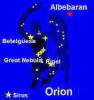
Then make it easy on yourself. The next night you go out, bring a star map from a book or an astronomy magazine (I suggest Stargazing) and use it to help yourself locate the stars.
And what can you deduce from your observations? What did ancient peoples deduce?
From the beginning of time, the Earth was, quite naturally, considered to be the entire universe. All that existed aside from the Earth was the sky - blue by day and lit by the Sun, black at night and illuminated by the Moon and the stars.
Early man thought of the sky as a solid vault enclosing the Earth. When the Earth was believed to be flat (and this was long before Columbus) this vault was a dome that came down to the horizon everywhere at the ends of the Earth. When it was established that the Earth was a sphere (and this was before Columbus, too), the sky became a larger sphere enclosing it - but still a vault - something solid. (Thus the term firmament, from a Hebrew word meaning thin, metallic sheet.)

Buy Now
The Music of the Spheres
Since the sky was solid, metallic or otherwise, it was believed that it turned in one piece. Those who watched the stars from Greece, Babylonia and Egypt noticed that all the stars wheeled in a circle about the North Star. Stars that were close to the North Star made small circles and remained in the sky all night every night. Stars that were further away dipped below the horizon as they circled but emerged again later. They all seemed to move together. They made up patterns (which came to be called constellations - animals, ships, human beings) which remained unchanged from night to night.
Because their movement around the Earth was unchanging, they were referred to as fixed stars - stars fixed to a single sphere which rotated about the Earth.
But what of the Sun and Moon? The Moon is the most conspicuous object in the night sky, and if its movement is watched night after night you can see that it changes position in the sky relative to the stars. The Sun does the same thing, if more slowly. Once the Sun sets, the stars appear, and if you watched the sun set from night to night you would notice that the constellations all shift a little bit westward at each successive sunset.
There are five other objects in the night sky that look like stars, but that shift position among the remaining stars. These five objects were first studied by the Sumerians around 3000 BC, and they seemed so unusual in their freedom of movement that they were given the names of gods. That habit persisted - it was used by the Greeks and then the Romans. The Roman god names are still used today - Mercury, Venus, Mars, Jupiter and Saturn. These five objects, plus the Sun and Moon, were termed the wandering stars, and were called planets, from the Greek word meaning to wander.
These seven planets were always of absorbing interest to mankind, from astrologers (the forerunners of astronomers) to sailors to the average human being. The seven-day week was invented by the Babylonians to memorialize the seven planets. In many European languages, the individual weekdays are named for individual planets. In English there is Sunday, Monday and Saturday. (The other four are named for the Norse gods.) In French, the other four days are mardi (Mercury), mercredi (Mercury), jeudi (Jupiter), and vendredi (Venus).
Since the seven planets wander freely across the sky and therefore cannot be fixed to the solid vault of the sky, the ancient Greeks reasoned that each of these planets must be fixed to a sphere of its own that turned between the sky (the outermost sphere, with the stars affixed to it) and the Earth. Since those inner spheres weren�t visible, they were assumed to be transparent and were called crystalline spheres (crystalline from a Greek word meaning transparent).
The planets did not (and do not) move steadily and regularly, as did the fixed stars. The Moon moves a bit more slowly during one half of its journey through the sky than during the other half, and so does the Sun.
It was seen that the other five planets drifted west to east against the background of the fixed stars. Every once in a while their motion stopped, and for a while they actually drifted backward, east to west, before resuming their western progress. Each of the planets had its own pattern of this direct (west to east) and retrograde (east to west) motion, and each one was also brighter at some times than others. This pattern of the stars was known by at least 150 BC.
How to predict the motion of the stars, and how to explain that direct and retrograde motion? Many Greek astronomers worked out ways of dealing with planetary motion by theorizing that different planets moved on small spheres, the centers of which moved on larger spheres, some of which were slightly off center, and so on.
The system was complicated, and was summarized in a book written about 150 BC by a Greek astronomer, Claudius Ptolemaeus (c. 100-c. 170) better known as Ptolemy. The mathematical structure of the universe, with the Earth at the center and various systems of spheres surrounding it, is called the Ptolemaic universe. It was accepted by most people for 1,700 years.

Buy Now
Bibliography:
Isaac Asimov�s Guide To Earth And Space, Random House, 1991.
Bonus Triskelion Question:
True or false: The Moon is visible only rarely during the day.
|

