| . |
| . |
. |
. |
| THERE MAY BE only two (2) realistic solutions to global warming. I mean substitutes for the problematic large-scale energy sources--coal, oil, and nuclear fission. One possible substitute is nuclear fusion, which doesn�t produce radioactive waste. According to a BBC report of late 2006, French scientists are planning to make renewed effort with nuclear fusion.
The second possible solution, satellite solar power (SSP), has been tirelessly promoted by former NASA scientist, Dr. Peter Glaser. The first, as well as the second, of these potential global warming solutions may involve revival of the idea of space colonization. That's because there are potentially significant deposits of fusionable hydrogen on the lunar surface. An article on the hydrogen deposits was in Newsweek, February 12, 2007, page 38. Space colonization was first proposed by a Russian pioneer at the end of the 19th. century. There has come to be a historical divide between that original idea and NASA's "mission-oriented" approach. Although some U.S. political leaders, such as the senior Bush, have expressed specific interest in "space colonization" in public, that was some time ago. "Space colonization" hasn't been mentioned even once, as far as I know, during the administration of the younger Bush. This may have to do with fears by oil, coal, and nuclear industries--fears of competition Information about Glaser and his ideas may be found on the Internet. In my opinion, it would be useful in 2007 to form a panel of experts to look at various possible modifications and variations of the central SSP idea. Below is some background on how SSP developed. Excerpts are from a letter by David Gaus sent in 2004 to Dr. Glaser. Red in text below indicates editing. |
| . |
| Dear Dr. Glaser,
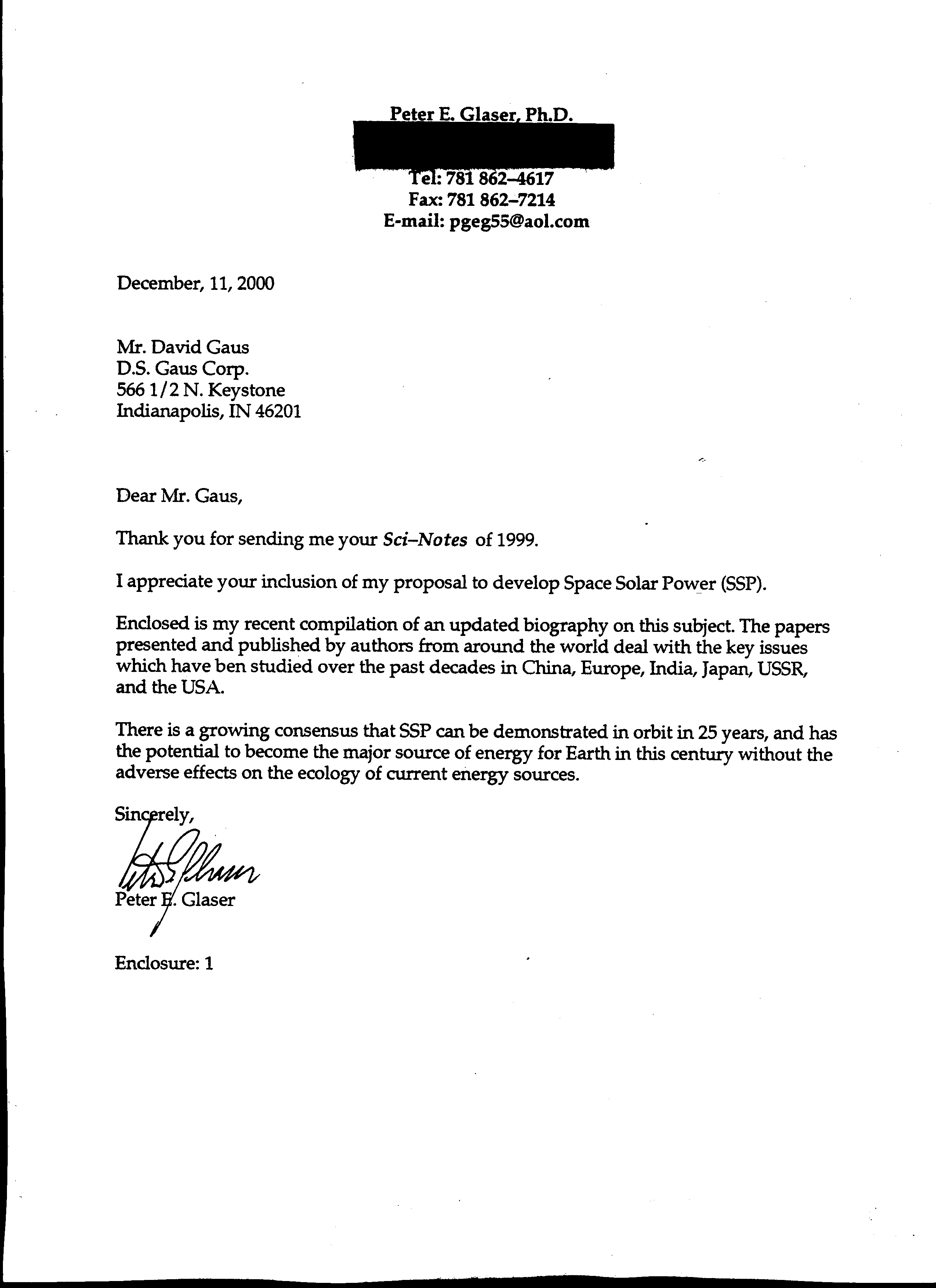
Thank you for your letter of Dec. 11, 2000. I�ve posted that letter here with your home address masked: (click to view) You wrote, �There is a growing consensus that SSP can be demonstrated in orbit in 25 years, and has the potential to become the major source of energy for Earth in this century without the adverse effects on the ecology of current energy sources.� As a self-described �science generalist� or �science journalist,� I�m not an expert on many aspects of SSP (Space Solar Power)�which, for the benefit of others who may read this, envisions beaming pollution-free energy from space to Earth. However the vicissitudes of life have given me some involvement with the subject. So I�ve tried to assess both the scientific and the political issues to the best of my ability. At this point in time, it seems to me that SSP is indeed still a very important idea and that it would be a very good thing if it were to be pushed along a little faster than it is at present. It deserves more attention in the press, including the science press, than it is getting at this time. Although I have limited resources for making others do as I think best, last year I instituted what I called the �Gaus Science Award.� . . . This year I�ve decided to give you the Gaus Science Award. . . . I imagine my humble award as a publicity device. It provides a way of emphasizing my idea of what is scientifically meritorious. Looking around, one sees much that isn�t much good that�s being done in the name of science�so one would like to praise that work that is of better quality. . . . It seems to me that your SSP idea has already proved its worth because of the role that it played in resolving the Cold War. To review events: SSP had been put on a back burner by NASA by the time of the Reagan administration. That was because it had been joined in the �70s to the L5 idea�which was much more of a long-term proposition. In 1984, an episode of the CBS show Simon & Simon featured your idea. That was done without naming you. The L5 encumbrance was not part of that story, which was fortunate. At that time, CBS�with another show, Scarecrow and Mrs. King, was very much a Cold War combatant. And that Simon & Simon episode, which I chanced to play an indirect role in bringing about and which intellectuals might deride as superficial, may have been important in keeping SSP viable in the Cold War. Policy makers, unfortunately, tend to get many of their scientific ideas from the mass media. . . . . . . three years later, in 1987, the Soviets felt compelled to try to match SSP and trumpeted their Energia as the means of accomplishing that purpose. The recent death of President Reagan served as a reminder of that period. Those events of his second administration have yet to be put in proper historical perspective, because SSP was at least as important in resolving the Cold War as was Reagan�s �Star Wars.� Thus, my plan is to . . . try to promote both the past successes and future promise of SSP. The fact that the Soviets were so eager to match your concept shows that they thought there was an important kernel there. That Soviet response is important to my present evaluation of your work. And, in my estimation, our present national security position would benefit from closer relations with the Russians. Your work could provide a basis for closer relations. Russians have been dealing with Islamic jihads, sometimes successfully, since before the discovery of our own New World. Their scientists must often make greater personal sacrifices to achieve their results than Western scientists, but it would be imprudent to distain their cooperation for that reason. Rather, with the end of the Cold War and the start of a new conflict, we should be trying to enhance Russia�s material well-being. As you may know, the catchy name �Energia� survives in a Russian web site: . . . . The launch of their Energia booster came thirty years after the launch of their Sputnik. They seemed to be hoping for a second triumph similar to that of 1957. The fact that they didn�t get that triumph was due to haste of action brought on by Cold War pressures and to inherent Soviet political weaknesses which were becoming apparent at about that time. And both the NASA effort to develop your concept and the later parallel Soviet effort suffered from having too many cooks at work at one time in each of the two competing aerospace �kitchens.� I think there�s an opportunity now to consider various ways in which SSP could be developed. Oil prices are at or near record highs. Demand for oil is also at or near a record. And efforts to regulate carbon emissions have been only partially successful. Such regulation does not appeal to the �inner cowboy� that inhabits every human psyche�but to build and launch a new device is proactive and should be easier to promote. I am hoping that, through my company�s near-term journalistic efforts, we might be able to identify obstacles�whether political, technical, geographic, ecological, or economic�and get a better idea of what might be possible with SSP. I�m also hoping that our actions will be agreeable to you. Some scientists find my habit of mixing science, politics, and current events distasteful. You yourself may not agree with my political ideas. However I think I can point to a good past track record. . . . If you have any further thoughts on the subject, we�d be happy to receive them. My phone is (317) 523-6943. . . . Best Wishes, David Gaus |
| The Simon & Simon episode was titled "The Wrong Stuff." It was first presented in early 1984. The reader may still possibly be able to catch reruns on select rural TV stations in certain English-speaking countries in Africa. I think it may also be purchased on the Internet for home viewing. To see a site with more Simon & Simon information: CLICK |
| Russians remain well aware of the Energia booster as a major accomplishment that still has great potential. To view their Energia website: CLICK |
 |
|
 |
|
|
|