We therefore come back to demographics. There was a big increase in the birth rate in 1946. Many who were born that year were going to want to retire at age 62. The math is easy:
1946
+ 62
2008
So my prediction had been that 2008 would be the beginning of something.
The metaphor I used was a sort of slow-motion "economic tsunami." Year after year, it would roll in, implacably and at an increasing level.
Unless something is done, I said, it might well take the entire American political system�democratic institutions and all--with it out to sea.
While I feel I'm quite quaiified to make a contribution to resolving this problem, I'm only one person. And I have a serious handicap. There are those who like to continue to pretend that there's something terribly wrong with me, in order to help maintain the glorious legend of Alan Greenspan.
Please note that I'm not claiming to be someone who has no faults or doesn't make mistakes. Not at all. In this matter, though, I"m being punished, not for misdeeds, but for doing the right thing.
In early 2007, I made some preliminary efforts to get in touch with Chase Bank, which had merged with JP Morgan. I thought that might be fitting, since Mr. JP Morgan was, in an informal sense, the first head of the federal reserve.
And, although he had his faults, Morgan seems a more admirable historical figure than the more recent Greenspan.
In March 2007 I was therefore in touch with Mr. Tom Kelly, of Chase media relations in Chicago and Mr. John Bradley, who was head of Chase human resources.
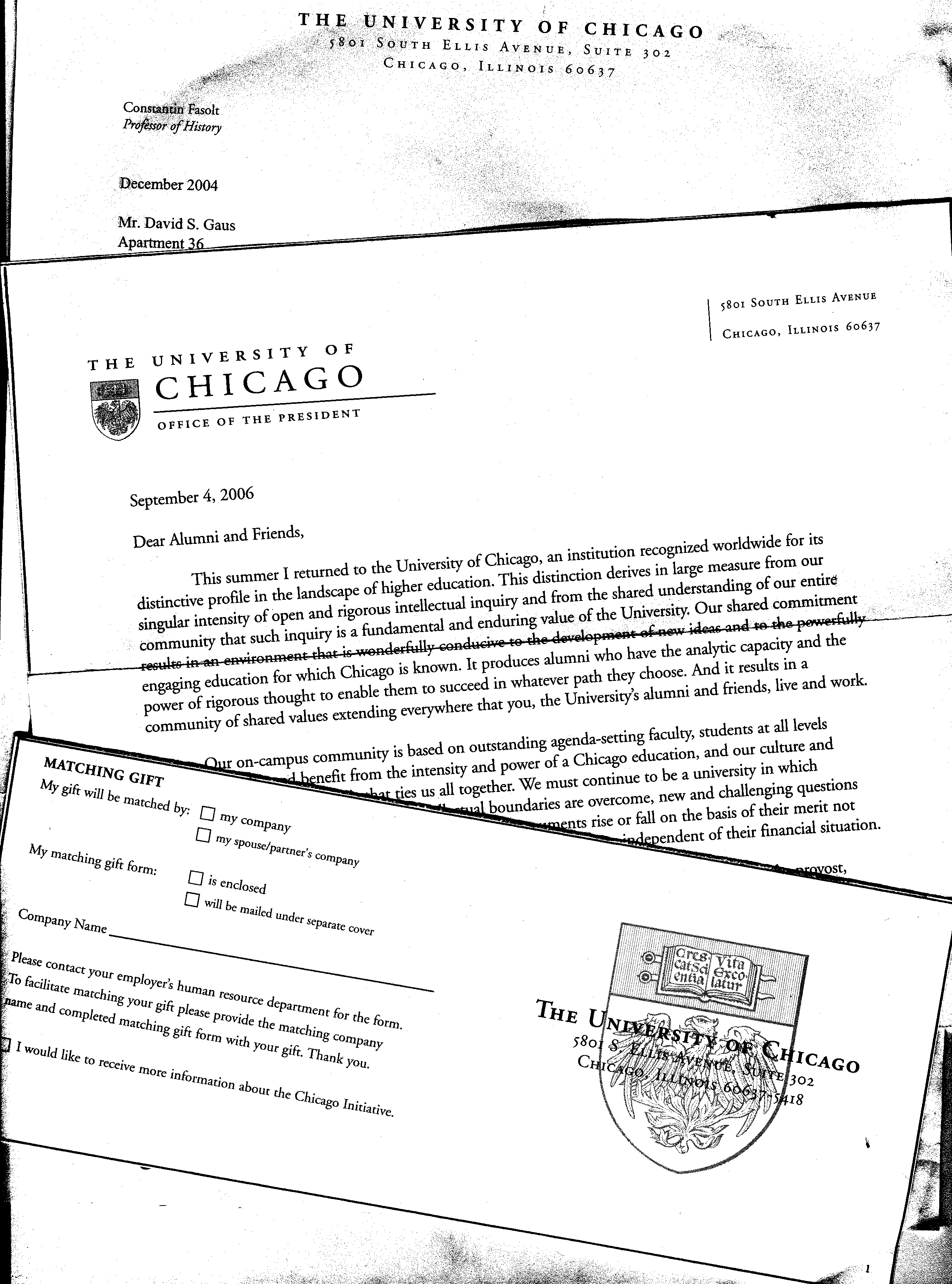
I'd also learned that Mr. Jim Crown was on the board of Chase Bank and also the Chairman of the Board of Trustees of the University of Chicago. I received my undergraduate degree from UChicago. Like the city of Chicago, the administration of UChicago is often venal, cynical, and dishonest. At the start of 2008, pressure from the Greenspan clan had led the university to deny me all alumni privileges. Lest the reader think therefore that I didn't actually graduate from that institution, I've posted scanned documents, including one with my name on it, proving otherwise.
According to classical economic theory, an "Unseen Hand" sometimes intervenes in economic affairs. Such intervention was very evident at the beginning of 2008, with falling stock prices and the beginning of a recession. But my efforts directed toward Chase led me to believe that no one there was really interested in talking about any kind of reform or about using improved methods to evaluate employees. I was told something like this: they wanted to do things their way, and that, after all, Chase was assuming the risk if anything went wrong. That attitude was questionable, however, in view of the large quantitites of public money that were pumped into Chase in late 2008.
Was Alan Greenspan to blame for what had happened? I asked C Hoyt Bleakley of the UChicago Graduate School of Business that question in December 2007. According to Bleakley, Greenspan's "reputation from the '90s was overblown and we're seeing that now."
To his credit, Greenspan came before Congress in late 2008 and took some responsibility for the debacle. Perhaps on the debit side of the ledger, however, was the fact that he used the term economic "tsunami," which he seemed to have gotten from reading earlier versions of this material. (Perhaps I should forgive that slight transgression, since it does indicate that I had at least one reader.)
The "Unseen Hand" is a agent both of commerce and morality. It upsets the schemes and expectations of human beings, brings to light that which was hidden, and forces the economy into new pathways. Thus, in March 2008, for the long-range improvement of the human condition, the stock market was continuing its downward spiral.
In my opinion, Chase and other banks, which had lost vast fortunes, were still resisting reforms at that time. If the Federal Reserve were to keep on bailing out incompetent companies, the result would be higher inflation. Prior to the start of 2008--speaking roughly, as to the timing--the Fed had been able to afford to indulge the clownishness that many business people were exhibiting. After 2008, it became necessary for business people to be, for lack of a better expression, "more businesslike."
And my expectation was that, in 2008 and 2009, enough members of what I was calling America's "Dysfunctional Elite" would be pushed off their perches to allow government and private industry to become more constructive.
(The "dysfuntional elite" would thus be pushed aside by the "Unseen Hand." This could be the basis for a cartoon in an economics magazine.)
But, in that process, enough of truth would emerge so that people, in their collective endeavors, could be working with some semblance of reality. I hope this article will contribute to that. My ideas about how the structure of business can be reformed are in an article which uses the NBA as a basis for the discussion. That may be viewed by clicking at left.
The daunting challenge, ahead is not only baby boomer retirement, but also the provision of a reasonably satisfactory life for those who are younger and whose allegiance and energy will be needed to keep the system working.
While, in March 2008, I did have faith that adequate reforms would eventually occur, the stock market bottom hadn't yet been reached then, and the Unseen Hand was still moving the chess pieces around on the board with great speed and dexterity.
At that point in time, had enough bad news yet emerged for Wall Street to change it's ways, at least somewhat? On my Yahoo site, March 23, 2008, I found an article under the AP heading. The author was Mr. Joe Bel Bruno. Mr. Bruno wrote that many on Wall Street felt that, ". . . the sale of Bear Stearns to JP Morgan & Co. for a stunning $2 per share ultimately won't have that much of an impact . . . ." Wall Street doesn't have a long-term mentality, the article continued to say. What would be a 30-year career in another profession is squeezed into 15 years on Wall St.
If money is going to be a means of social exchange, money has to mean something. So, for example, if someone does a useful analysis of social security demographics, he or she should usually be paid or at least given a little recognition.
To speak more broadly, inflation is a sign that money is losing the meaning it should have.
Some of that lack of meaning comes when people are "given" jobs, in one way or another, rather than having to earn them. One of the things politicians like to do is "give" people jobs, but inflation was on the rise in early 2008, limiting the ability of the government to throw money into the economy.
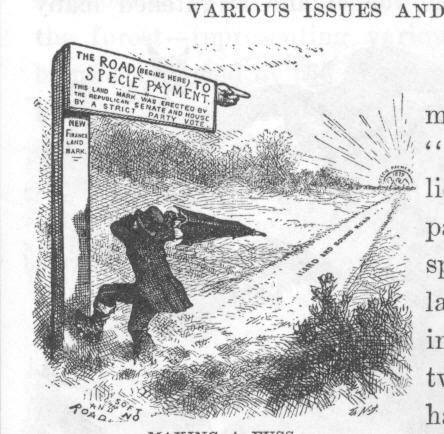
These problems aren't precisely new to American history, although the terms in which they were expressed may have changed somewhat. The cartoon shows how Mr. Thomas Nast depicted a crisis of the late 19th. century--a crisis that involved some of the same issues as today's disruptions.
Start of article
home page
Last modified November 2008
Click for higher magnification