. |
| . |
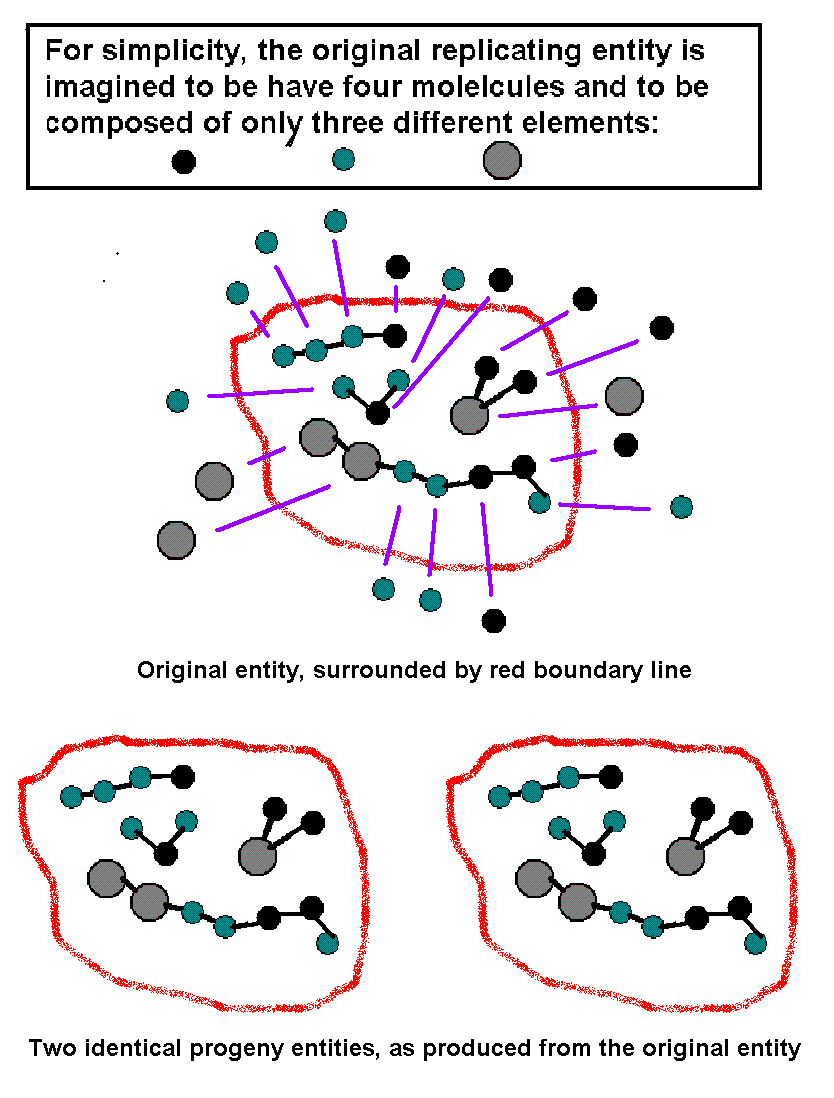 |
| In an enviroment of today, an actual bacterium, before replication, will have many more atoms and molecules, than in my simplified replicating entity. But the principle is the same: in order to make a perfect copy of itself, the bacterium must acquire a duplicate set of all atoms originally contained in that bacterium: each progeny bacterium must contain the same number of hydrogen atoms as in the parent, the same number of nitrogen atoms, etc.
Now, while this idea seems consistent with Western religion, it doesn�t in any way alter or interfere with scientific reasoning about evolution. As an example, I've created a crude mathematical model of how natural selection in a biological system may lead to intake of increased information from the environment. My mathematical model may be viewed by clicking at left. Increased total information leads to evolutionary progress--the production of a more and more faithful image of the Providence that supports life. For a number of reasons the concept of "natural selection" was seen as contrary to religion at the time it was introduced. Darwin saw it that way himself. Today, for those biologists who reject religion, natural selection may be described as a "substitute diety": natural selection decides who shall live and who shall die, and the verdict of natural selection can't be appealed. While natural selection is perhaps an immortal, all the scientists who discuss natural selection so learnedly are themselves mortal and fated to be eventually selected against. For those biologists who don't reject religion, however, natural selection may be seen as an aspect of divine rule. The situation is similar to that in economics where an "Unseen Hand" is sometimes said to operate. That phrase was coined by Adam Smith and the connection of Smith's ideas to religion has often been noted and debated. However Adam Smith certainly didn't feel compelled to become an opponent of religion in the way that Darwin did. A link to two web sites about Adam Smith and religion is a left. Other sites may be found via Google. An important consideration in trying to untangle religion and science by logic is that neither natural selection nor the Unseen Hand are regarded as operating in an afterlife. And religions differ in the emphasis placed on an afterlife. I'd say that religion on a global scale has a certain overall logic to it, even though beliefs differ. For example, Jews may have initially rejected an afterlife as a way of repudiating Eastern ideas about reincarnation. My relative, Karl Friedrich Gauss, believed in an afterlife, even though he didn't believe in a personal God. As the greatest mathemetician of the 19th. century, he didn't live to suffer correction by the greatest mathematician of the 20th, but I imagine he would have had to accept G�del's reasoning. While life may have had relatively simple origins, the model of only four molecules confined to a localized region, as given above, may not be entiely realistic: initial biochemicals may have been few and far between, and spread out in a vast medium or primitive "ocean." The initial Darwinian struggle, a struggle which continues to this day, was between two molecular populations or sets: (1) of innanimate molecules and (2) of biochemical molecules. And the set of biochemcial or biological molecules was distinguished from the set of inanimate molecules in at least two ways. First, the biochemical set exhibited organizational constraint and standardization: that is, the set of biochemical molecules found in the biosphere was much smaller than the set of all the possible molecules that can be made using various chemical elements. Second, any given biochemical molecule was "related" to at least one other biochemcial molecule. Molecule A might have been an enzyme that employed Molecule B as a substrate, for example. Thus, the various biochemical molecules were linked and comprised what can best be described as a "biochemical language." The two populations--of inanimate and of biological molecules--may have initally existed side-by-side difused in a large medium. Viruses served the purpose of scattering biologically active molecules so that those molecules weren't confined to regions in which the substrate for the biologically active molecules had been exhausted. The challenge for a virus, then as now, was to scatter from an area that had been depleted, but not to scatter as far as to enter an area that was entirely barren. This picture of early life is consistent with the fact that there is today a biochemical language that exhibits organizational constraint. The biochemical language has standardization, or a greater simplicity than what nature would otherwise allow in terms of all the possible atomic combinations or permutations. The "biochemical dictionary" or "biochemical language" is discussed more elsewhere on this site. The set of biological molecules may have been partioned into cells only after viruses had become active in the biosphere. That would explain the very intimate and complex interactions that occur today between viruses and the cells they infect. If that view is correct then each and every individual cell of today is ultimately descended from the enitre original set of primiitive biological molecules, absent the viruses. The enitre set of primiitive biological molecules is also the origin of the female sex, while primitive viruses are the origin of the male sex. Let me now change the subject somewhat. While I don�t personally believe that everything in the Bible is literally true, I'd certainly say that Old Testament writers developed an understanding or interpretation of God that was much better than anything else in the ancient world. Although they were forbidden to construct a statue or other physical image of God, they did construct an "image in words" that�s stood the test of time. �Be fruitful and multiply,� for example, are words that almost everyone remembers. And scientists, being those highly intelligent fuzzy critters that they are, don't wish to consider things that are meaningless. See, for example, Dr. Ann Roman's comments, as quoted earlier. Let�s consider a radical notion. Can we say that in biology all meaning is tied up with reproduction? Consider a bacterium. A bacterium is a hub of activity. In some ways it�s like a busy train station or Starbucks shop. There's a lot of traffic, in and out, and in various directions. Atoms and molecules go in and out. Transposons move from place to place on the DNA. And viruses may go in and out, too, assuming they�re the kind of viruses that don�t cause the bacterium to burst open and die. But the bacterial DNA contains �information.� Is that information actually valid or is it mere unreliable �informatics� or similar to spam e-mail or some other form of junk information? There�s a way to tell. If the bacterium is able to reproduce, then the information is confirmed as indeed being valid. That�s perhaps a statement that Darwin would have agreed with: "the capacity to reproduce validates the fitness of the biological entity and the utility or meaningful quality of the information in its DNA." And, as for human beings, is the meaning in their lives also tied up--perhaps in more complex ways--with reproduction? Does sexual activity, which isn�t intended for reproduction, make one�s life more meaningful? Or is one being wafted, like a scrap of paper, by perverse sociological breezes? Is one a puppet being manipulated by various people who have sex-related merchandise to unload at market? I won�t try to develop that more fully here. But in the America of early 2008, it seemed to me that "lack of meaning" could have been considered a valid sociological issue. Inflation was on the rise, for example, and money meant less. Many products, such as bottled water and Viagra, seemed meaningless to begin with. Grades given out by educational institutions were, needlessly, somewhat meaningless. (See "the curve" in the subject index of Screen B of the gaus homepage.) We were fighting a war. Was that war still a "meaningful" effort? In my opinion there was also a lack of intellectual progress. Few contemporary �thinkers� seemed to have much that was new to say to the public. The defects of American culture have usually, in the past, been balanced by the sense of a general forward momentum. But were we moving forward in 2008 or backward? How was one to tell? I'm not a philosopher and am not prepared to write a long essay on the "meaning of meaning." However, one may suspect that most people didn�t really want their entire lives to be meaningless. So some may want to spend a little time reflecting on the tantalizing enigma of reproduction as the possible touchstone of all biological truth. l�ve already mentioned how lucky we are in the US to be free of tyranny. Perhaps the reader will indulge a little more of my nationalistic boasting. While in other parts of the world, the wretched populace may be misled by state-run media, we�re fortunate in the US to be misled much more efficiently, and with less bureaucratic waste, by the for-profit popular media. Now, many influential news sources are owned by companies that are also in the entertainment business. Therefore the line between news, on the one hand, and fantasy or a staged presentation, on the other, isn�t always clear. And while fantasy may sometimes provide needed escape, at other times one may need to escape from fantasy itself. Continue |
|
However the original entity did itself have to meet certain requirements for replication to have occurred. What might be called an �image� of the environment, an accurate image, must have existed in the original entity before it replicated. Also, the fact of replication was what verified the accuracy of that image in the original entity.
How can this be stated in religious terms? One might want to say that the fact that the original entity had replicated showed that it was �at one with the universe.� One would then have computability with Eastern religion of our science speculation about the origin of life. However Kurt G�del, who may have been the greatest mathematician of the twentieth century, thought that he�d proved the existence of a �logical God.� This is closely associated with G�del�s most famous mathematical proof. By a �logical God,� G�del didn�t mean that the universe was being run by a computer, a clockwork, or other mechanical or electronic device. He meant a higher logical entity or higher truth, external to or prior to the universe--and certainly predating human knowledge of mathematics. This higher entity, he found, is in control of all that happens. That, more or less, is the Western definition of God. I respect mathematics and so I respect G�del�s proof. And the implications of his proof need to be considered by serious scientists. I say that because scientists can be a bit pretentious at times. And to present oneself as inherently more intelligent than all fundamentalist preachers isn�t necessarily an adequate demonstration of seriousness in a scientist. G�del's Proof was published in 1935, if I remember correctly. Academic scientists outside of the math field haven't, by and large, dealt with the scientific implications of that proof, and thus seem behind the times. I should balance that by saying that many fundamentalists are in extreme denial about the extent of evidence for evolution. But as a scientist considering this hypothetical first replicating entity, I reject the idea that it�s able to replicate because it�s �at one with the universe.� Instead, I repeat that it�s able to replicate because it constitutes an accurate "image" of the enabling material circumstances in its environment. Furthermore, I'd call those circumstances �Providential.� That puts me in accord both with Western religion and G�del�s proof. Indeed, it seems that God didn�t just create man in His image, but that the entire evolutionary process works to create an image of Providence. And, as G�del showed, that Providence isn�t just clockwork or molecules colliding like billiard balls. Mechanistic or random processes may indeed play a role. but beyond such processes, there's a higher logic and a higher truth. In the upper section of the following illustration, the first replicating entity is shown before making its historic "Big Move." (The "Big Move" is, of course, to be regarded as comparable to the "Big Bang" of astronomy.) Outside the red boundary, are atoms floating in the surrounding medium. The red boundary doesn't indicate a cell wall or membrane, but is simply the boundary of the set of molecules that is to replicate. For simplicity, I�m assuming or pretending that the first replicating entity could have only 17 atoms and 4 molecules. And in my simplified model, there are only 3 chemical elements involved. Black lines indicate molecular bonds while violet partial lines show that each atom within the original entity has a corresponing atom of the same element in the surrounding medium. That's an arithmetical requirement if replication is indded to take place. A nuclear reaction isn't imagined as being part of the process, so atoms are neither created nor destroyed. |
| The writer's opinion of "informatics" may be viewed by clicking "informatics" on the subject index of Screen B of his web site: gaus site |