| . |
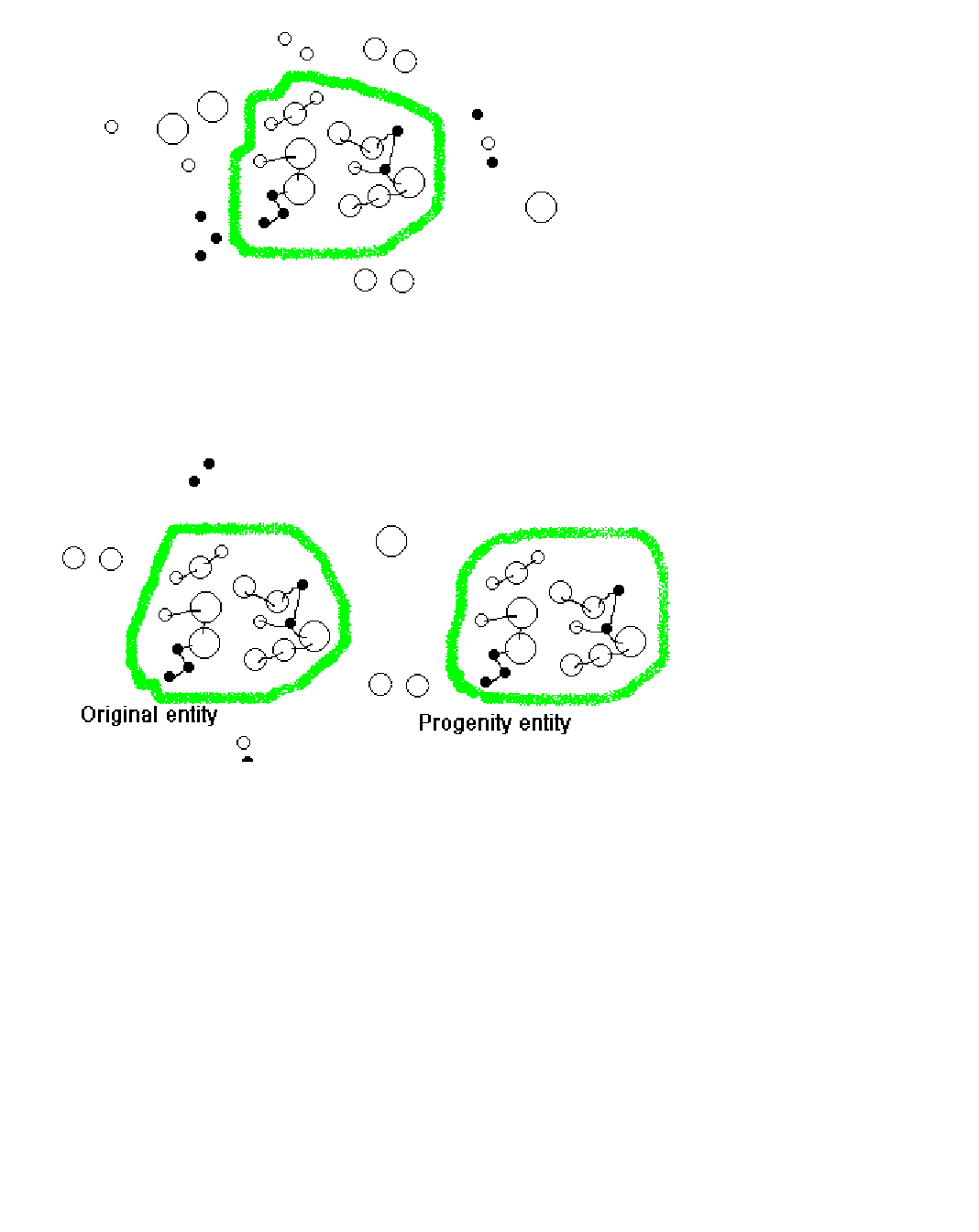 |
| The bottom part of the illustration shows the situation after replication has occurred. Atoms in the environment have all been incorporated into the first progeny entity.
In today�s world, an actual bacterium, before replication, will have many more atoms and molecules, than in my simplified replicating entity. But the principal is the same: in order to make a perfect copy of itself, the bacterium must acquire a duplicate set of all atoms originally contained in that bacterium: the progeny bacterium must contain the same number of hydrogen atoms as in the parent, the same number of nitrogen atoms, etc. Evolutionary progress is the production of a more and more faithful image of the Providence that supports life. While this idea seems consistent with Western religion, it doesn�t in any way alter or interfere with scientific reasoning about evolution. While I don�t personally believe that everything in the Bible is literally true, I would say that the Old Testament writers developed an understanding or interpretation of God that was much better than anything else in the ancient world. Although they were forbidden to construct a statue or other physical image of God, they did construct an image in words that�s stood the test of time. �Be fruitful and multiply,� is a phrase that almost everyone remembers. Let�s consider a radical notion. Can we say that in biology all meaning is tied up with reproduction? Consider a bacterium. A bacterium is a hub of activity. In some ways it�s like a busy train station. Atoms and molecules go in and out. And viruses may go in and out, to, assuming they�re the kind of viruses that don�t cause the bacterium to burst open. Transposons move from place to place on the DNA That DNA contains �information.� Is that information actually valid or is it mere unreliable �informatics?� There�s a way to tell. If the bacterium is able to reproduce, then the information is confirmed as indeed being valid. That�s perhaps a statement that Darwin would have agreed with. The capacity to reproduce validates the fitness of the biological entity and the utility of the >information� in its DNA. And, as for human beings, is the meaning of their lives also tied up--perhaps in more complex ways--with reproduction? Does sexual activity, which isn�t intended for reproduction, make one�s life more meaningful? Or is one being wafted, like a scrap of paper, by perverse sociological breezes? I won�t try to develop that subject more fully here. But in the America of early 2008, it seemed to me that a lot of what was going on was indeed �meaningless.� Inflation was on the rise, for example, and money meant less. Many products, like bottled water and Viagra, seemed meaningless to begin with. There was a lack of intellectual progress. Few contemporary �thinkers� seemed to have much that was new to say to the public. The defects of American culture have usually, in the past, been balanced by the sense of a general forward momentum. Were we moving forward in 2008 or backward? One may suspect that most people didn�t really want their lives to be meaningless. So they might want to spend a little time reflecting on the tantalizing enigma of reproduction--at least in this earthly realm--as being the touchstone of all biological truth. l�ve already mentioned how lucky we are in the US to be free of tyranny. Perhaps the reader will indulge a little more of my nationalistic boasting. While in other parts of the world, the wretched populace may be misled by state-run media, we�re fortunate in the US to be misled much more efficiently, and with less bureaucratic waste, by the for-profit popular media. And many influential news sources are owned by companies that are also in the entertainment business. Therefore, the line between news, on the one hand, and fantasy or a staged presentation, on the other, isn�t always clear. And while fantasy may sometimes provide needed escape, at other times one may need to escape from fantasy itself. Continue |
|
However the original entity did itself have to meet certain requirements for replication to have occurred. What might be called an �image� of the environment, an accurate image, must have existed in the original entity before it replicated. Also, the fact of replication was what verified the accuracy of that image in the original entity.
How can this be stated in religious terms? One might want to say that the fact that the original entity had replicated showed that it was �at one with the universe.� One would then have computability with Eastern religion of our science speculation about the origin of life. However Kurt G�del, who may have been the greatest mathematician of the twentieth century, thought that he�d proved the existence of a �logical God.� This is closely associated with G�del�s most famous mathematical proof. By a �logical God,� G�del didn�t mean that the universe was being run by a computer, a clockwork, or other mechanical or electronic device. He meant a sentient, logical being, external to or prior to the universe and in control of all that happens. That, more or less, is the Western definition of God. I respect mathematics and so I respect G�del�s proof. And the implications of his proof need to be accepted by serious scientists. To present oneself as inherently more intelligent than all fundamentalist preachers isn�t necessarily an adequate demonstration of seriousness in a scientist. I should balance that by saying that many fundamentalists are in extreme denial about the massive evidence for evolution. But as a scientist considering this hypothetical first replicating entity, I reject the idea that it�s able to replicate because it�s �at one with the universe.� Rather, I should repeat that it�s able to replicate because it constitutes an accurate image of the enabling material circumstances in its environment. Furthermore, I would call those circumstances �providential,� in accordance with Western religion and G�del�s proof. Indeed, it seems that God didn�t just create man in His image, but that the entire evolutionary process works to create an image of Providence. And, as G�del showed, that Providence isn�t just clockwork or molecules colliding like billiard balls, Although mechanistic or random processes may indeed play a role, beyond them there's a higher logic. The illustration shows the first replicating entity at the top before making its historic "big move." Outside the green boundary atoms float in the surrounding medium. For simplicity, I�m assuming or pretending that the first replicating entity could have only 17 atoms and 3 molecules. But each atom in the original entity has a corresponding atom of the same element in the medium. |