| Could human males and chimpanzee males have evolved from a common ancestor in lines of descent in which females played no role whatsoever? |
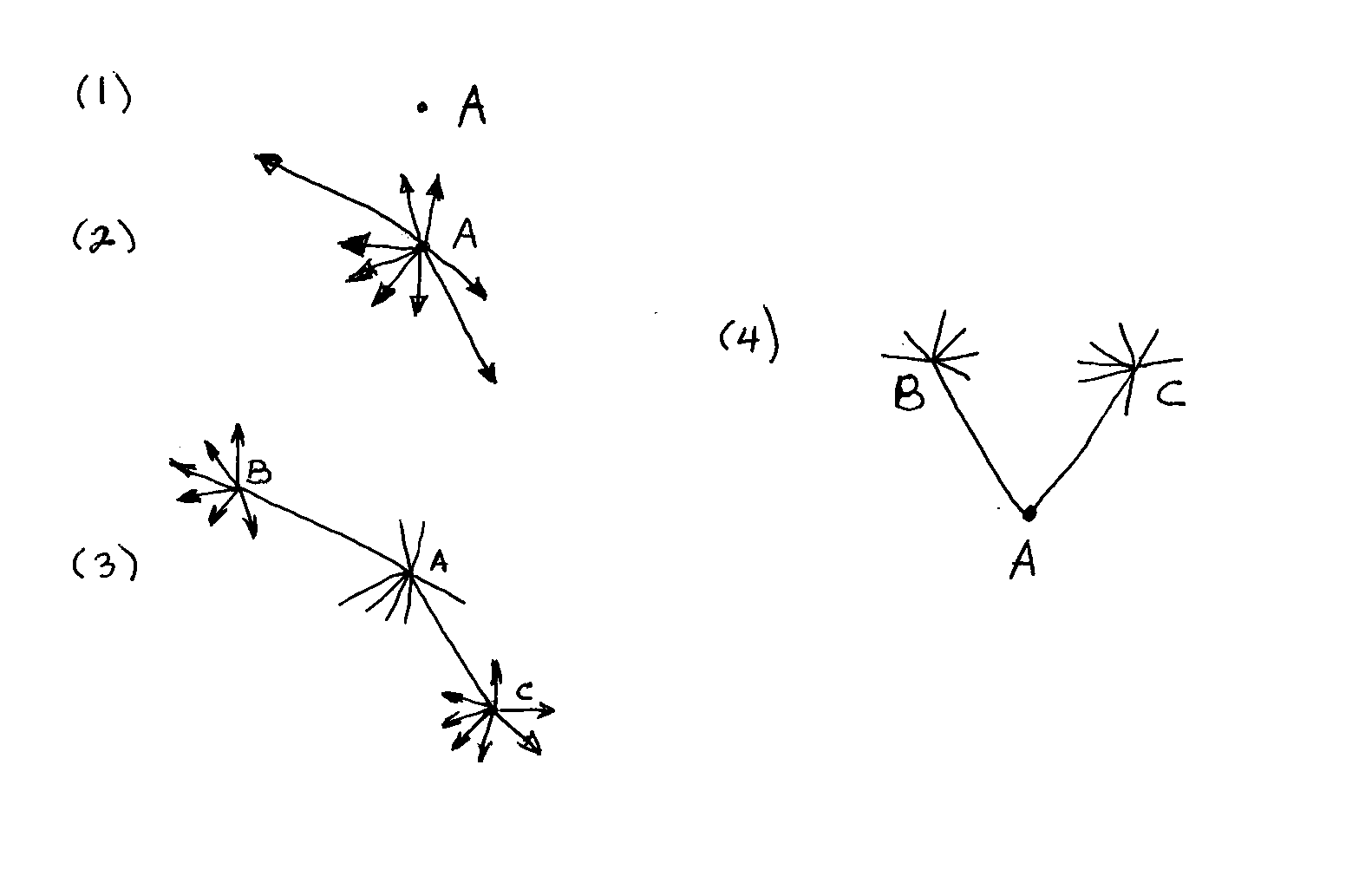 |
| So one shouldn�t think of a virus as evolving as an independent entity. And the idea of a viral "evolutionary tree," which we will meet with in the section after the next one, may be subjected to criticism, perhaps somewhat as follows: When a bacterium bursts, releasing a large number of viruses, the abstract mathematical configuration that might be thought of is a number of straight lines emerging from a point. The center point represents the bacterium, now deceased. At the end of each radiating line, one may imagine that there is a point representing a virus. The reader who hasn't agreed that all viruses are male may now have a bit of a problem. Since viruses don't generally interbreed with each other, one could say that each of the viruses that has emerged represents a brave effort to start a new viral species. If that is to be accepted as the truth, the task of classifying viruses will not be getting any easier. But let's see what sort of an evolutionary tree we can construct. (1 ) In my sketch at left, I start with an infected bacterium, A. (2) Viruses are released from bacterium A, as indicated by radiating lines. The two longer lines in (2) are to give me enough room to continue the process. The longer lines represent viruses that will be able to reproduce. They will do that by infecting the bacteria B and C. (3) This is shown with viral lines now radiating from B and C. (4) Now we can bend lines and eliminate the first generation of non-reproducing viruses to make a sort of a tree. (I have special permission for that from my ancestor, Karl Gauss.) It should be noted that at every crook in the tree there's what I refer to as a "female moiety." That will be true no matter how long one may continue with the tree. But the idea that each virus is its very own species isn't quite as threating to viral classification efforts now. That's because all viruses generated by bacteria B and C have the ghost of bacterium A as their common "maternal" ancestor. That is, they have something in common which could be the basis of putting them in the same group. [ 7 ] War, Sex & Peace This is from a German perspective. Germany has been a multiple source: the English language is of Germanic origin, along with many other aspects of life in both Europe and twenty-first century America. For example the idea of semi-independent states existing within the framework of a larger nation came to the US from Germany. The American Electoral College is based on a German electoral college that chose the Holy Roman Emperor. And although that emperor, who was Catholic, was key in defending the Catholic Church, Germany was also the birthplace of Protestantism. The first comic book was produced in Germany. Albert Einstein was as much German as he was Jewish. We�ve already noted the �gen� in �genetics� and �genesis� as being an Indo-European root. It denotes �origin.� The �ger� in �German� seems to be a variation of that same root--although I wasn't quite able to satisfy myself on that point with the American Heritage Dictionary and its table of Indo-European roots. But the name �Germany� goes back to early Roman times and today still denotes roughly the same geographic area as it did then. There�s something about Germany�s position in Europe that�s made it serve for many centuries as a focal point for major changes in the world, changes both good and bad. Perhaps it�s the moderately northern location. Not as socially volatile as warmer places further south, Germany usually changed more slowly and retained change or remembered tradition longer. And, as a focal point, Germany also tended to condense things: what would be said with many words and gestures in Italy would be said more economically in Germany. Other, though less populous, nations were even farther north in Europe. And, among them, Sweden also had a broad impact on European history. But our subject for the moment is Germany. CONTINUE |
| The reader may click here --to view the above artistic masterpiece at a higher magnification |