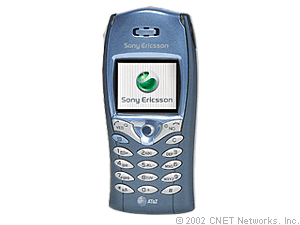
The Sony Ericsson T68i. The ultra-compact, colour, cell phone wonder. The tiny 2.9-ounce T68i bears a strong resemblance to the popular Nokia 8200-series phones--until you get a glimpse of the bright, easy-to-view, five-line, 256-color screen. The Sony Ericsson, like the Nokia, has tiny keys that may bother those with bigger fingers, but the T68i has something the Nokia doesn't: a very useful joystick-like navigational button. However, it's a bit sensitive, so keep it away from other objects in your pockets.The phone is light blue and silver , and the earpiece looks slightly different. Otherwise, the cosmetics are identical. Those not familiar with Sony Ericsson's menu system face a bit of a learning curve. Also, fans of flip phones may not like the way the phone hits your face, with the microphone a bit far from your mouth. However, the T68i retains one great design element found on previous Ericsson models: a button on the top left that, when pressed, accesses the precise amount of remaining standby and talk time.
Along with Bluetooth and infrared, you can also add screensavers, backgrounds, 100x80-resolution GIFs, and as many ring tones (30 are already onboard) as the phone's 1MB of storage can handle. Download Ericsson's free ExtndConnect software and the T68i can synchronize with your Microsoft Outlook calendar info and up to 500 contacts via infrared or Bluetooth. If your computer doesn't have wireless connectivity, you can purchase an optional serial cable. A Bluetooth wireless headset is also available.If you get the CommuniCam MCA-20 digital camera accessory, which clips on to the bottom of the phone, you can take and wirelessly e-mail low-resolution digital images to friends or partners. You can also mix portraits with contacts in your phone book by programming the person's face to appear on your screen when he or she calls you. We tested the digital camera and found it easy to use and to set up, but like most others, don't expect high-quality images. Since the T68i works on GPRS and all flavors of GSM networks, it's considered a world phone. It also supports SMS and EMS (enhanced messaging service), as well as MMS. Included with the phone are icons, and rudimentary graphics that can be sent to other EMS-enabled phones. Also impressing was the T68i's voice-recognition features, which allow you to dial contacts by saying the person's name as well as answer your phone and navigate menus using voice commands.
With allcolor-screen phones, the main concern is battery life. The T68i doesn't suffer in this department, but to conserve power, you'll want to keep the phone in sleep mode whenever you're not using it. And to preserve even more juice, you can set the screen to a black-and-white display.
We managed to squeeze out 5.5 hours of talk time and almost 6 days of standby time. While Sony Ericsson's claims are higher (13 hours of talk time and 12 days standby), the real-world battery-life numbers are impressive, especially when you consider the color screen. Even better, the phone comes with a compact charger. The T68i's call quality was very good in our tests using Cingular service. Callers said they had no problem hearing us and vice versa. We were also able to connect the T68i to a Bluetooth-equipped Pocket PC and surf the Internet wirelessly at speeds of around 30Kbps via a GPRS network. We were able to use Sony Ericsson's latest Bluetooth headset (model HBH-20) with the phone and could make calls fine. However, note that we were unable to connect to a first-generation Bluetooth headset. Overall -- my favourite phone of the 5. 4.5 gears our of 5! |