Gonzalo A. de la Vega
Electronics Engineer
Home |
Electronics |
Linux
|
Software |
Links |
Fixing a Palm Tungsten's battery
This is just a description of what
the autor did. Don't try to reproduce this if you don't know what
you are doing and are not willing to take the risk to brake things. The
author takes no responsibility for any damage resulting from
reproducing this experience. Improperrly charging a Lithium based
battery may
result in fire. You do this at your own risk.
I recommend you have a look at Battery
University to have a good idea about Li batteries.When I "bought" my first Palm, Tungsten T, bluetooth enabled (see the linux part), I did so by exchanging some of my about to expire American Airlines miles, and found a quiet cheap one in Amazon.com. It arrived home , I charged it 3 hours, only to find out that it didn't charge at all. The battery was "bad". Actually, based on some knowledge about batteries and some info form Li+ charging ICs, I found out the battery was charged bellow 40%, and wouldn't charge with the integrated charger.
After fighting PalmOne's support service (IT SUCKS by the way), for a week only to know that they would not cover the warranty because I paied it to cheap! I decided to fix the thing my self. Two hours later it was working great. Here is how.
What happened was that the device was probably stored for a long time, and the battery charged droped too low. When that happens, the usually in battery chargers can not charge it. I'm not sure why, but I guess these small chargers can't deliver enough current, to widthstand the short circuit the battery represents when completely depleted.
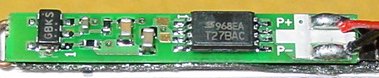
In battery charger
The thing is that I needed to charge the battery somehow, over 40% (~2.7V) of total charge, that is called "conditioning" or "preconditioning" a Li+ cell. So I did this.
Let's get to it
First of all took the device apart following this intructions.Note that the battery leads (red and black), are actually the charging circuit leads, so you won't be able to measure voltage with the battery depleted, and it is not possible to condition the cell because the charger is still on the way. I Took out the battery and took it apart. That means removing the sticker that seals it. The circuitry cover will come out easilly. The sticker has enough glue to stick it again, but if you want to do this repair, you may want to have some tape at hand.
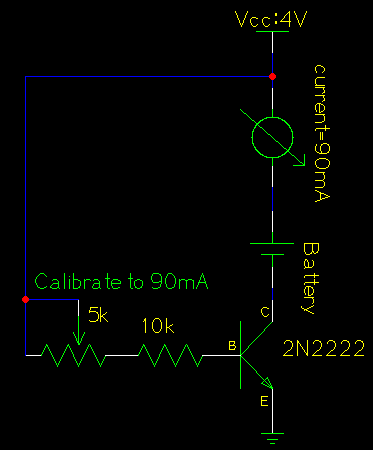 Once I could see the
actual battery leads
(metal strips soildered into
the board), I was able to charge the battery. But that has to be done
with limited current (90mA), and a voltage source of about 4V
(less that 4.2V). To make a constant current source I used a 2N2222
transistor a resistor and potentiometer, to calibrate the current (the
2N2222 current gain is suposed to be ~200, but the one I used was ~280).
Once I could see the
actual battery leads
(metal strips soildered into
the board), I was able to charge the battery. But that has to be done
with limited current (90mA), and a voltage source of about 4V
(less that 4.2V). To make a constant current source I used a 2N2222
transistor a resistor and potentiometer, to calibrate the current (the
2N2222 current gain is suposed to be ~200, but the one I used was ~280).The total base resistence should be:
Rt=hfe*4V/90mA=280*4V/90mA=12.9kOhm
So a 10k resistor with 5k pot was fine.
To calibrate the current source the battery was replaced by a cable. With a power source connected (3.5V or maybe 4.5V or 5V with a series diode), and a multimeter as a current meter, I calibrated the current to 90mA with the potentiometer.
Then it was time to plug the battery, with two cables (red and black, for standard positive an negative), twisted arround the battery leads (metal strips) like in the picture. Note the polarity, I haven't tried, but I understand, Li ion batteries break inmediately with polarity inversion.
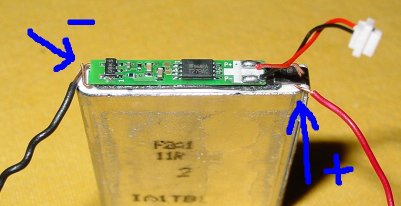
I charged for about 1 minute, and quikly pluged into the Palm, and putted it to charge, without reassembling it, as I was meassuring the batt voltage, and it rapidly climbed when charging, but decreased when unpluged, about 0.5V/min. If it dropped below 2.7V, the charger would not start, so I pluged into the Palm and took no risk to have to take it apart again. Consider that this home made charger is not very "battery aware", so I didn't risk to stress the battery to much.
Now it works great. I charge it less than an hour every two days, and never dropped below half charge (lot of Bluetooth, and still lasts). By the way, as the battery was discharged when stored, it didn't wear out, so it is probably in better condition that if it had charged at once.
To know more about Li ion batteries you can check Battery University
To know about battery charging I just read the National's LM3621 datasheet.