HISTORY
For the early history of the region now known as Pakistan, see Indus Valley
Civilization; India: History.
The British ruled the Indian subcontinent for nearly 200 years-from 1756 to
1947. After a revolt between 1857 and 1859, the British initiated political
reforms, allowing the formation of political parties. The Indian National
Congress, representing the overwhelming majority of Hindus, was created in 1885.
The Muslim League was formed in 1906 to represent the Muslim minority. When the
British introduced constitutional reforms in 1909, the Muslims demanded and
acquired separate electoral rolls. This guaranteed Muslims representation in the
provincial as well as the national legislatures until independence was granted
in 1947.
By 1940, however, the Muslim League had resolved to seek the partitioning of the
subcontinent and the creation of a separate Muslim state-Pakistan. During
preindependence talks in 1946, therefore, the British government found that the
stand of the Muslim League on separation and that of the Congress on the
territorial unity of India were irreconcilable. The British then decided on
partition and on August 14, 1947, transferred power to Pakistan. India gained
its independence the next day. Pakistan came into existence in two parts: West
Pakistan, coextensive with the country's present boundaries, and East Pakistan,
now known as Bangladesh. The two were separated by 1,600 km (1,000 mi) of Indian
territory.
Problems of Partition
The division of the subcontinent caused tremendous dislocation of
populations. Some 3.5 million Hindus and Sikhs moved from Pakistan into India,
and about 5 million Muslims migrated from India to Pakistan. The demographic
shift caused an initial bitterness between the two countries that was further
intensified by each country's accession of a portion of the princely states.
Nearly all of these 562 widely scattered polities joined either India or
Pakistan; the princes of Hyderâbâd, Jûnâgadh, and Kashmîr, however, chose
not to join either country.
On August 14-15, 1947, these three states had become technically independent,
but when the Muslim ruler of Jûnâgadh, with its predominantly Hindu
population, joined Pakistan a month later, India annexed his territory. Hyderâbâd's
Muslim prince, ruling over a mostly Hindu population, tried to postpone any
decision indefinitely, but in September 1948 that issue was also settled by
Indian arms. The Hindu ruler of Kashmîr, whose subjects were 85 percent Muslim,
decided to join India. Pakistan, however, questioned his right to do so, and a
war broke out between India and Pakistan. Although the United Nations (UN)
subsequently resolved that a plebiscite be held under UN auspices to determine
the future of Kashmîr, India continued to occupy about two-thirds of the state
and refused to hold a plebiscite. Pakistan administered the northwestern portion
as Azad (Free) Kashmîr and the Northern Areas. This deadlock, which still
persists, has intensified suspicion and antagonism between the two countries.
Prerepublican Era
The first government of Pakistan was headed by Prime Minister Liaquat
Ali Khan, with Muhammad Ali Jinnah as governor-general, and it chose Karâchi
as its capital. From 1947 to 1951 the country functioned under chaotic
conditions. The government endeavored to create a new national capital, organize
the bureaucracy and the armed forces, resettle refugees, and contend with
provincial politicians who often defied its authority. Failing to offer any
program of economic and social reform, however, it did not gain popular support.
In foreign policy, Liaquat established friendly relations with the United States
when he visited President Harry S. Truman in 1950, but he overlooked the
geographical closeness of the Union of Soviet Socialist Republics (USSR) to
Pakistan and the implications of that fact for the future security of the
country. The visit to the United States injected bitterness into
Soviet-Pakistani relations because Liaquat had previously accepted an invitation
from Moscow that never materialized in a visit. The United States gave no
substantial aid to Pakistan until three years later.
After Liaquat was assassinated in 1951, Khwaja Nazimuddin, an East Pakistani who
had been governor-general since Jinnah's death in 1948, became prime minister.
Unable to prevent the erosion of the Muslim League's popularity in East
Pakistan, however, he was forced to yield to another East Pakistani, Muhammad
Ali Bogra, in 1953. When the Muslim League was nevertheless routed in East
Pakistani elections in 1954, the governor-general dissolved the constituent
assembly as no longer representative. The new assembly that met in 1955 was not
dominated by the Muslim League. Muhammad Ali Bogra was then replaced by Chaudhri
Mohammad Ali, a West Pakistani. At the same time, General Iskander Mirza became
governor-general.
The new constituent assembly enacted a bill, which became effective in October
1955, integrating the four West Pakistani provinces into one political and
administrative unit. The assembly also produced a new constitution, which was
adopted on March 2, 1956. It declared Pakistan an Islamic republic. Mirza was
elected provisional president.
Recent Developments
A civil servant, Ghulam Ishaq Khan, was appointed president,
and Benazir Bhutto became prime minister after her PPP won the general elections
in November 1988. She was the first woman to head a modern Islamic state. In
August 1990 President Ishaq Khan dismissed her government, charging misconduct,
and declared a state of emergency. Bhutto and the PPP lost the October elections
after she was arrested for corruption and abuse of power. The new prime
minister, Nawaz Sharif, head of the Islamic Democratic Alliance, introduced a
program of privatizing state enterprises and encouraging foreign investment. He
also promised to bring the country back to Islamic law and to ease continuing
tensions with India over Kashmîr. The charges against Bhutto were resolved, and
she returned to lead the opposition.
In April 1993 Ishaq Khan once again used his presidential power, this time to
dismiss Sharif and to dissolve parliament. However, Sharif appealed to the
Supreme Court of Pakistan, and in May the court stated that Khan's actions were
unconstitutional, and the court reinstated Sharif as prime minister. Sharif and
Khan subsequently became embroiled in a power struggle that paralyzed the
Pakistani government. In an agreement designed to end the stalemate, Sharif and
Khan resigned together in July 1993, and elections were held in October of that
year. Bhutto's PPP won a plurality in the parliamentary elections, and Bhutto
was again named prime minister.
During the early and mid-1990s, relations between India and Pakistan became more
tense. Diplomatic talks between the two countries broke down in January 1994
over the disputed Jammu and Kashmîr territory. In February Bhutto organized a
nationwide strike to show support for the militant Muslim rebels in Indian Kashmîr
involved in sporadic fighting against the Indian army. She also announced that
Pakistan would continue with its nuclear weapons development program, raising
concerns that a nuclear arms race could start between Pakistan and India, which
has had nuclear weapons since the 1970s. In January 1996, despite some
controversy, the United States lifted economic and some military sanctions
imposed against Pakistan since 1990. The sanctions, imposed to protest
Pakistan's nuclear weapons program, were lifted to allow U.S. companies to
fulfill contracts with Pakistan and to help foster diplomatic relations between
the two countries. Pakistan was beset by domestic unrest beginning in the
mid-1990s. Violence between rival political, religious, and ethnic groups
erupted frequently within Sind Province, particularly in Karâchi.
In 1996 Bhutto's government was dismissed by President Farooq Leghari amid
allegations of corruption. New elections in February 1997 brought Nawaz Sharif
back to power in a clear victory for the Pakistan Muslim League. One of Sharif's
first actions as prime minister was to lead the National Assembly in passing a
constitutional amendment stripping the president of the authority to dismiss
parliament. The action triggered a power struggle between Sharif, Leghari, and
Supreme Court Chief Justice Sajjad Ali Shah. When the military threw its support
behind Sharif, Leghari resigned and Shah was removed. Sharif's nominee, Rafiq
Tarar, was then elected president.
In early 1997 Sharif resumed talks with India over the Kashmîr region; however,
negotiations quickly broke down when armed hostilities erupted again. Tensions
escalated further in 1998, when India conducted several nuclear tests. Pakistan
responded with its own tests, detonating nuclear weapons for the first time in
its history. The Pakistani government then declared a state of emergency,
invoking constitutional provisions that operate when Pakistan's security comes
under "threat of external aggression." Many foreign countries,
including the United States, imposed economic sanctions against both India and
Pakistan for exploding nuclear devices.
In the months following the explosions, the leaders of Pakistan and India placed
a moratorium on further nuclear testing, and the United States initiated
negotiations between the two countries aimed at reducing tensions and
circumventing an arms race in the region. Some economic sanctions were lifted in
late 1998 when both countries tentatively agreed to sign the international
Comprehensive Test Ban Treaty (which bans most types of nuclear weapons testing)
by September 1999. As a result of the ongoing negotiations, in early 1999 the
prime ministers of India and Pakistan signed the Lahore Declaration, which
articulated a commitment to work toward improved relations. However, in April
fears of an arms race revived when both countries tested medium-range missiles
capable of carrying nuclear warheads.
Meanwhile, in October 1998 the lower house of parliament passed an amendment to
Pakistan's constitution that would require the government to enforce Islamic
religious observances and place Sharia (Islamic law) above the constitution;
however, the amendment did not have sufficient support in the upper house to
become law. In late 1998 increasing violence in Sind province led Sharif to
dismiss the provincial government and impose federal rule. In April 1999 the
high court in Lahore found former prime minister Benazir Bhutto guilty of taking
payments from a Swiss company in exchange for a contract.
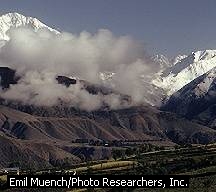
The Hindu Kush mountain system in central Asia extends for 800 km (500 mi)
in parts of Afghanistan, Pakistan, and Tajikistan. With about two dozen peaks
surpassing 7000 m (23,000 ft), the range reaches its highest point in Pakistan's
highlands, where the peak known as Tirich Mîr rises 7690 m (25,230 ft) above
sea level.
 a great place for tourists; the
ranges of korakoram.
a great place for tourists; the
ranges of korakoram.