
Versailles and Asia - Cause and Effect Analysis
By Greg McCulley
Drafted 11 September 1999
����������� The conclusion of World War I and the Versailles Conference that followed was an instance in history that changed the world. �For some nationalist movements in Asia, the results of the conference were bitterly disappointing, but these movements were largely already in class at the time of the conference.� The results of Versailles served as an accelerator to these movements, but it did not start these movements.� This paper will look at what some Asian nationalists were hoping would happen as a result of the conference, and the how the actual results influenced these movements.
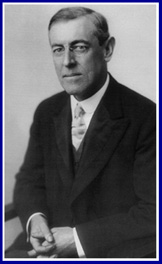
����������� American President Woodrow Wilson had an optimistic vision for the world after World War I.� In his 14 Points, he advocated an agenda that, on the surface, would liberate the oppressed people of the world.� He became an inspiration to these nations, and an icon of hope for the already emerging nationalization of several Asian nations.
����������� Japan got some of the things she wanted out of the conference.� For example, Japan acquired German holdings in Micronesia and China.� But, one thing she wanted that was not granted was an acceptance by the signatories to the treaty the concept of racial equality. �Perhaps this was an attempt to gain diplomatic bargaining chips, but whatever the motive, it legitimized, at least to the Japanese, future diplomatic actions taken against the west.
����������� Vietnam's Ho Chi Minh represented another nation's lack of satisfaction with western dreams for Asia.� Perhaps one of the more debated "what ifs" among historians is the question, what if Ho Chi Minh had been heard by the international community in France in 1919?� Ho was a dishwasher at the time, so it is certainly no surprise that his audience with American President Woodrow Wilson was not given, nor was his petition for an independent Vietnam read or endorsed. He did, however, gain some international attention in the Communist world.� Ho was a believer in self-determination for the people of Vietnam.� He went to America, England, and later France because he felt that "to catch a tiger, you go to the door to its lair."� Paris was the door to the lair of the tiger that occupied Vietnam: imperial France.� He went to France to further a cause that was already alive and well in Asia, and the words of men like President Wilson, ironically, often were the inspiration for these movements to continue.�
In Wilson's 14 Points was an agenda to spread the right of self-determination of all nations and a call for the end of colonialism.� To Ho and other Asian nationalists, this was music to their ears.� Ho looked up to Wilson, but, when Wilson and the west did not support him, he turned to the Communists for support.� Ho helped form the French Communist Party, and in 1923, he moved to the Soviet Union. He studied Lenin for the things Vietnam needed that Versailles would not provide.� For other Asian independence movements, such as Indonesia and China, Communism provided an alternative to Wilson and the west.� ��Organization of these movements was often in exile, as was the case with Ho Chi Mihn's group of radicals that trained in China in the 1920's and 1930's (Borthwick, 193).
����������� As France colonized Vietnam, the Dutch did Indonesia.� The Dutch were ruthless taskmasters to the Indonesians, but because of the number of islands that made up the country was so many, there was seldom any organized resistance.� The Dutch used the island domain to harvest coffee, sugar, tea, and nutmeg.� This went on until a young revolutionary, Sukarno, led a grass roots movement toward independence from the Dutch.� Sukarno was not communist, nor was he a capitalist.� He was pro-Indonesia, and his speeches inspired the people to revolt.� Many early revolutions were put down quickly.� The Dutch often ruled by turning the many clans against one another to maintain order.� But, eventually, Sukarno gained a great amount of popularity, becoming a national icon and popular celebrity at the same time.� As a result, the Dutch exiled him in 1933.
����������� In Sukarno's absence, the people looked to the emerging Japanese empire to the north.� The Indonesians had a myth that spoke of a unifying, liberating force of yellow skinned warriors that would come from the north.� Many saw this to be the Japanese, who proclaimed a benevolent, liberational motive for Asians.� Soon, the Japanese made it down to Indonesia, and when they did so, they simply replaced the Dutch. Indonesia was declared free by the Japanese and also a declared a member of the Greater Asian Coprosperity Sphere.� However, it became obvious that the Japanese were no better than the Dutch, and simply used the resources of Indonesia (including the people as manpower) to fuel the Japanese war machine.� Sukarno returned from exile and was placed in a position to be a Japanese puppet, but he still worked toward freedom for his country.� He maneuvered to have Indonesians trained as soldiers to aid in Japanese defense of the islands, and this worked to his advantage in that he gained the possession of a trained army.� After the war, Sukarno eventually gained independence for Indonesia. The biggest impetus for this entire struggle was to gain freedom from the Dutch and then the Japanese.�
����������� The many nationalist movements in Asia were not started by the disappointments of the Versailles Conference, they were exacerbated by it.� In Vietnam, the movement was already alive, and this was what moved Ho Chi Mihn to travel to Paris and other western cities.� In Japan, leaders were disappointed that racial equality clauses were not included in the treaty, and Indonesia was momentarily caught up in the Japanese cry of an Asian Empire under Japanese rule.� Chine, since Sun Yat-Sen's (check spelling) movement was started before the Versailles Conference.�� The seeds of self-determination were already planted in these emerging states.� The conference did not start plant these seeds, but it did provide the fertilizer to foster the growth of nationalism.

Those who forget history are doomed to miss out on the benefits that come from learning about what happens when you touch a hot stove.
-wgm