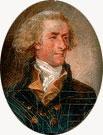
Thomas Jefferson
"The spirit of resistance to government is so valuable on certain occassions that I wish it to be always kept alive."
In Jefferson's 1st innaugural address (1801) he declared, "If there be any among us who would wish to dissolve this Union, or to change its republican form, let them stand undisturbed as monuments of the safety with which error of opinion may be tolerated where reason is left free to combat it." Jefferson was defending the right of free speech and of secession.
----------------------------------------------------------------------------------------------------------
Thomas Jefferson, a true Southern gentleman, was America's third president (March 4, 1801-March 3, 1809). He was born April 4, 1743 in Albemarle County, Virginia.
In the thick of partisan politics in 1800, Jefferson wrote in a private letter, "I have sworn upon the altar of God eternal hostility against every form of tyranny over the mind of man."
This powerful advocate of liberty inherited from his father, a planter and surveyor, some 5,000 acres of land, and from his mother, a Randolph, high school standing. He studied at William and Mary, then read law. In 1772 he married Martha Wayles Skelton, a widow, and took her to live in his partly constructed mountaintop home, Monticello.
Jefferson was eloquent as a correspondent, but he was no public speaker. He therefore contributed his pen rather than his voice to the patriot cause, and at the age of 33 drafted the Declaration of Independence. He later wrote a bill establishing religious freedom, adopted in 1786.
Jefferson succeeded Benjamin Franklin as minister to France, and two separate parties, the Federalists and the Democratic-Republicans, began to form. He eventually assumed leadership of the Republican Party, who sympathized with the revolutionary cause of France. Attacking Federalist policies, he opposed a strong central government and championed the rights of states.
After assuming the presidency, the crisis in France had passed. He slashed Army and Navy expenditures, cut the budget, eliminated the tax on whiskey and reduced the national debt by a third. Further, although the Constitution made no provision for the acquisiton of new land, Jefferson suppressed the qualms over constitutionality when he had the opportunity to acquire the Louisianna Territory from Napoleon in 1803.
Following his second term, Jefferson retired to Monticello to ponder such projects as his grand designs for the University of Virginia. A French nobleman observed that he had placed his house and his mind "on an elevated situation, from which he might contemplate the universe."
He died July 4, 1826 at his Monticello home.
In accordance with Title 17, U. S. Code, any copyrighted work in the message is distributed under fair use without profit, to those having expressed a prior interest in receiving the included information for non-profit research and educational purposes only. http://www.law.cornell.edu/uscode17/1o7.shtml