Rule Of Seven
Even as early as the times of the seven tribes, the predecessors of the Amethyst
Kindred had a reverence for the sacred number of Daioth: 7 (see beliefs).
Thus their important structures had floor plans with a heptagon (seven sided)
shape, such as the tribal chief's dwelling, town markets, the Assembly of
Sages and later on, the castle keeps. The more common dwelling places did not
usually stick to this rule, and by the 2nd Age, all housing plots for the public
inside major citadels and cities took on a more square shape to tessellate better.
At first, these heptagonal structures were little more than tepees, with seven
large wooden beams meeting in the middle and supported by a central beam. This
technique for shelters was quickly succeeded with tents, with seven posts surrounding
a central post, all keeping the material up. These tents were still used by the
Amethyst Kindred through most of their exile, and travelling armies as late as
the 3rd Age used similar dwellings for shelter in the evenings.
When castle building grew in importance, there were many main structures that
used a heptagonal structure: The keep, the assembly of sages, the market, the
multipurpose stage, the warrior-recruitment quarters; even the schools of wisdom
had a room or two with this design. The knowledge required for building such complex
structures has been quite intense, and many foreign architects marvel at these
unique buildings.
In order to create these structures accurately, Amethyst Kindred Architects use
a device with seven long straight sticks bound together at the top with string
and spread out with a seven-sided stone. The different positioning of the stone
(whether up or down) determined how large the heptagon would be. The later invention
of the screw enabled the stone to move up or down, making size adjustments to
the heptagon quite simple.
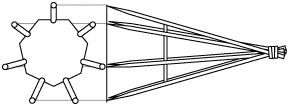
The device used to help draw heptogons
The Central Pillar
The important aspect about a room with an odd number of corners is that if a person
was placed in each corner facing the centre, a central post would not prevent
any two people from seeing each other. This is because on the opposite side of
the corner, there is an edge. In rooms with an even numbers of corners, there
is always corners opposite each other, thus anything in the middle of the room
would block one person's view of another. This aspect has been not only
part of the architecture, but also it has been referred to as strength and stability
in many proverbs (see beliefs).
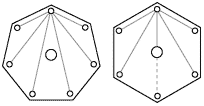
An odd number of corners enables people to see each other
As knowledge in architecture grew, the central pillar was replaced by seven posts that project from the seven pillars towards the central and topmost point of the building. When this was a new discovery, it became fashionable to leave the middle of the room void of objects. This changed, however: after a time most of these buildings still placed an object of some sort in the centre of the room, like a statue or a large table, for example.
