 | |
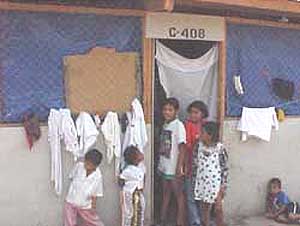
"We'll never go back to our old neighbourhood. They say it's dangerous to live there now," says Marilia, 13, who now lives with her mother and three brothers in cubicle C-408 in the shelter Trebol in Tegucigalpa, Honduras.
|
|
HOMELESS VICTIMS OF HURRICANE MITCH CELEBRATE RED CROSS DAY - HONDURAS
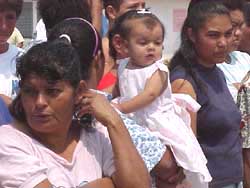 | |
The vast majority of those left vulnerable after Mitch and thus the majority of the inhabitants in the shelters are single mothers with their children.
|
|
 | |
Moises Starkman, the Honduran Minister of International Co-operation and Honduran Red Cross president Dona Meneca de Menc�a visited Trebol to take part in the celebrations. Marco Onorato, Head of the Federation Delegation and Nancy Beaudouin, Team leader for the American Red Cross listen to the Minister's speech.
|
|
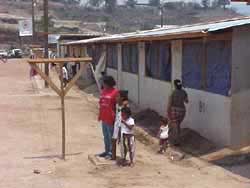 | |
The shelters are basic but they are only a temporary solution for the people made homeless by Hurricane Mitch.
|
|
10 May 1999
�
Six months ago Marilia Palma, 13, lived on the outskirts of Tegucigalpa, Honduras, with her mother and three brothers. They didn't have much, but they had a house. Now, Marilia lives with her family in cubicle C-408, in a shelter called Trebol. At least she survived last October, when the torrential rains accompanying Hurricane Mitch scoured the country for eight terrifying days. Some of her friends weren't that lucky. Quietly, Marilia remembers the fate of two of her schoolmates; lying dead amongst the mud, the rubble and the chaos.
Last Saturday, bad memories were put aside, as for the whole day, laughter, music and singing could be heard from the three shelters in Tegucigalpa; Trebol, Molina One and Molina Two, where some 5,500 people live. It was International Red Cross and Crescent day. Time to celebrate.
Run and administered by the Honduran Red Cross (HRC) with the support of the International Federation of the Red Cross and Red Crescent Societies and the Spanish Red Cross, the shelters are very basic, each family occupies a cubicle of 3x4 meters for up to 8-10 family members. There is really no space to spare. Each shelter is, however, a small village in itself with access to kitchens, bathrooms and washing facilities, schools and kindergartens and medical care. For many the situation is at least some improvement from the overcrowded schools, soccer fields and communal centres that were their homes after Mitch. The shelters are a temporary solution, until the Honduran government purchases land where permanent housing will be constructed.
On Saturday the shelters were a hub of activity. The youngest inhabitants competed in all types of sports, watched puppet shows and sang together. As a special tribute to the Red Cross movement, the children also showed off their paintings and drawings, featuring the Red Cross. Moises Starkman, the Honduran Minister of International Co-operation and HRC president Dona Meneca de Menc�a visited the Trebol shelter on Saturday to take part in the celebrations commemorating the Red Cross day. They were joined by representatives from the International Federation and the five National Red Cross Societies currently working in Honduras.
The vast majority of those left vulnerable after Mitch and thus the majority of the inhabitants in the shelters are single mothers with their children. Marilia's family is no exception. Her mother struggles along with four young children, selling tacos and quesadillas at the city market. The family could only rescue one cupboard and one bed, before they watched their house swept away. "It seemed like the rain would never stop. In the end it was like a river running down the hill, pushing the earth onward and engulfing all the houses," said Marilia. "We can never go back there. They say it's dangerous now, because the same thing could happen again".
Indeed, Tegucigalpa is not built to withstand such forces of nature. The city spreads out on hills, along deep running river valleys. When such torrential rain occurs, both those living on the riverbanks and those on the steep hill slopes, are in danger. Meteorologists agree that the upcoming hurricane season will be even worse than last year's. The Honduran Red Cross is worried about the situation, not least about the three shelters, with their temporary drainage systems, which most agrees will be hard pressed to withstand prolonged rains.
As far as Marilia is concerned, she likes her new home. Trebol is full of children and she has made a new best friend, Maria de Jesus Vasquez Martinez, also 13 years old. Together they have modest dreams about the future. Maria wants to get a degree in the University and Marilia would like to become a secretary. Looking at their eager and earnest, smiling faces, few would doubt that the new millennium is theirs.
|
|
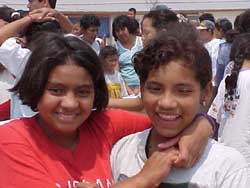 | |
Best friends, Maria (left) and Marilia (right), 13, live in Trebol. Maria hopes to study in the University and Marilia wants to become a secretary.
|
|
|
How you can help


