 | |
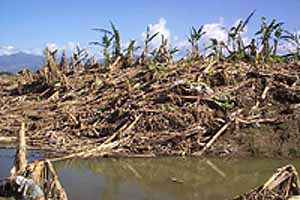
All that remains of the banana plantation just outside the village of Guanacaste, Aguan valley.
|
|
AS FAR AS THE EYE CAN SEE - HONDURAS
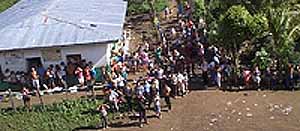 | |
People in isolated communities like this are dependent on the Canadian military for survival -- at least until the roads are passable and other aid can get through.
|
|
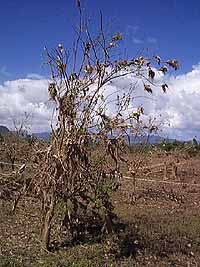 | |
A browned and withered orange tree -- emblematic of the crop damage in the once lush and productive Aguan valley.
|
|
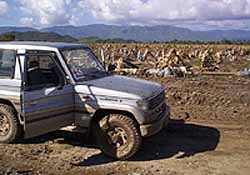 | |
All around the Federation vehicle are stunted banana trees in a sea of mud and silt. The land will have to be replanted from scratch if it is to bear fruit. Most Hondurans believe it will be 2000 before they export bananas again, meaning huge financial loss for the country.
|
|
04 December 1998
�
When Mitch flooding hit the Honduran capital, Tegucigalpa, people living down by the river who saw the torrent coming could at least scramble up the banks to safety. But down on the floor of the Aguan valley -- amidst the banana plantations and orange groves of Colon province -- there was no such escape. The mountains rise very high on either side; the waters descended with terrible force.
"When I came down here after the flooding I saw people swimming in a line to try to reach any high point," a plantation worker, made unemployed by the devastation, said as he took a break from pushing his bicycle through ankle-deep mud. "I guess people who couldn't swim just drowned. I myself lost my mother."
All around is a scene of utter devastation. As far as the eye can see the stumps of banana trees poke through the mud layer. On the few hillocks that exist, tree carcasses are piled one on top of another like mere splinters. The dirt roads through the area blend in with the surrounding quagmire.
In La Ceiba on the north coast, in the neighbouring province of Atlantida, the local Red Cross was at least able to carry out a partial evacuation of the city. Indeed this is the branch's proudest boast. "We had the experience of Hurricane Fifi in 1974 to draw on," says Rosario Arias, vice-president of the Atlantida branch. "The preparedness arrangements in La Ceiba give the responsibility for deciding on and organizing an evacuation to us," she explains. "We got 10,000 people out before Mitch struck, and that's why only nine people lost their lives in La Ceiba."
Now the Honduran Red Cross there has more than 50 volunteers -- young people and women auxiliaries -- helping out, while in the Aguan valley the joint HRC-Spanish Red Cross relief operation extends to the village of Tocoa, where there's an aid depot, about half way up the valley on the southern side. But the logistical problems in this region are immense and really beyond the means of an NGO to address fully.
A special 180-strong Canadian military unit has been running a helicopter-borne relief operation in the Aguan valley almost since Mitch first hit. Their headquarters are in La Ceiba and there's a forward base at the village of Sonaguera just on the edge of the valley. On the large-scale chart in their operations room, about half the length of the Aguan valley is shaded in as being "completely swept away," as they put it, or still under water. A cluster of red dots for settlements within their zone are numbered with a one, two or three. "The 'ones' are the priority," says a Canadian officer. "The only ways in and out are helicopter or wade." He's speaking exactly a month after Mitch.
Each red number one represents somewhere between 1000 and 2000 people. It's not entirely clear what will happen to these people if the roads aren't fixed before the task force leaves -- probably by Christmas. The Canadians are hoping they'll be replaced by qualified NGOs.
"What people here need more than anything else is construction materials to help them rebuild their homes and their lives," says Rosario Arias. "It's not enough just to hand out food indefinitely." The Aguan valley highlights the other huge need in evidence across Honduras now: to repair the transport system -- and to do so quickly enough so that people in such isolated rural communities do not go hungry or die needlessly of treatable disease.
How you can help


