 |
 |
| Alex Camarillo's Soccer Page |
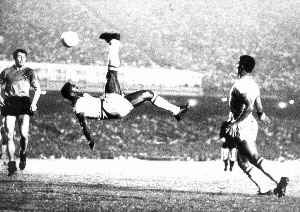 |
| Pele's bycicle kick |
| My Favorite Links: |
| My Info: |
| Alex Camarillo |
| Name: |
| Email: |
 |
|
|
History of SoccerFootball is called Soccer in the United States but the correct term for the game is football. Football originally started in ancient China where it was called Tsu Chu. The game was played by people in the military where it was a part of their training. Around the same time in Japan they played a similar game called Kemari. Some texts refer to games played between teams from China and Japan. The word ?Soccer? comes from an abbreviation of the word association (assoc.). Association stood for association rules or the rules of the Football Association (F.A.). Football is the world?s most popular sport with approximately 1.3 billion people enjoying it worldwide. England has been called ?the birthplace of modern football? however some people believe it was brought by the Romans who had their own version called Harpastum. During the Middle Ages they played a game called Mob Football. Mob Football had unlimited people per team so it was usually played with whole towns competing, there were almost no rules and carrying was allowed just like in rugby. To score you either had to get it through a gate or in between some buildings. Whoever scored first won and intense rivalries were started. It is believed the word derby comes from one of such game played in a town in England called Derbyshire. In Scotland they had an identical game called Gaelic football so both countries developed at roughly the same time. However because of the violence the kings of England and Scotland tried to ban football but never fully did. Around 1850 several schools started to play each other. The only bad thing was that each school had its own rules. In 1848 many schools adopted the Cambridge rules (see appendix 1-A). In 1857 Sheffield the first football club created its own rules (see appendix 1-B). The rules would change two more times before 1864 (see appendix 1-C). Surprisingly it would be quite a while before the number of players on the field was set at eleven. Also there weren?t any substitutions allowed. In 1863 the Football Association (F.A.) was formed. They made a newer set of rules (see appendix 1-D) which stayed in use for many years. One of the new rules was that no player could carry the ball (in their hands). This rule upset the rugby players so much that they split off forming the rugby union in 1871. The twelve founding football clubs were Accrington, Aston Villa, Blackburn Rovers, Bolton Wanderers, Burnley, Derby County, Everton, Notts County, Preston North End, Stoke, West Bromwich Albion and Wolverhampton Wanderers. All but one of these twelve teams is still around Accrington has gone bankrupt. Around this time period football spread around the world thanks to the British and new Football Associations sprouted up everywhere. In 1871 one of the organizers came up with the idea to start the F.A. cup or a championship of the English teams. In 1895 the original F.A. Cup was stolen from a shop window and they had to make an n exact replica (they are on the third Cup now). Originally players were not paid to play however in 1885 the F.A. legalized professionalism which allowed players to get paid. This caused another major split, with people who believed in playing the ?gentlemen?s? sport and those who were professionals. The legalization of professionalism caused a major change not only in who played but also a major change of strategy for al English teams. As many players came over from Scotland they brought their different strategies with them. Up till then the Scottish game had been all about passing (kicking the ball to teammates) while the English game being descendant from Mob Football with large groups of people had been mostly about dribbling. When these elements came together they made a very good combination and led to the strength of the English teams from then on. The original salary of a football player was around �8. Now players get paid up to $30,000,000. One problem with having hundreds of countries playing is that you need one to control all of them and so the Fẻdẻration Internationale de Football Association (FIFA). FIFA was created on May 21, 1904 in Paris; it was created by representatives from France, Belgium, Denmark, Netherlands, Spain, Sweden and Switzerland. Their job is to organize international games also called internationals for short. They also organize the World Cup. The World Cup is an elimination tournament where each team plays three other teams in their group, the top two teams from each group go on to play the winners from the other groups in a single elimination format. When there are four teams left they play each other, the losers play each other for third and fourth place and the winners play for the championship. There are literally hundreds of countries that participate in the World Cup. Every four years the World Cup is played except during World War Two when almost all the football leagues stopped playing. The first World Cup was held in Montevideo Uruguay in 1930 and was won by Uruguay (see appendix 2). They also control the rules and in 1938 changed them to what they are now. One of the major rule changes set by FIFA was the size of the ball in the game. England wasn?t one of the original FIFA board members and they still had their own separate internationals, but eventually decided to join only if they could have a majority on the board because of the fact they invented modern football. As a result they can overwhelmingly vote to change the rules. Pele is widely regarded as being the best football player to ever live. Pele?s real name is Edson Arantes do Nascimento. Pele?s father was a football player and when Pele was seven he started training to become a professional football player. At age fifteen he tried out for the team in S�o Paulo but was rejected, but he also tried out for Santos (another club) who finally accepted him. At age seventeen he played for Brazil in the World Cup and scored four goals! He played for Santos for eighteen years before retiring. At age thirty-four he returned to play in the United States for the New York Cosmos in the NASL (North American Soccer League). He is also known as the inventor of the ?Bicycle Kick?(see picture) the bicycle kick is where you jump in the air do a half flip and kick the ball. Bibliography 1. www.fifa.com 2. www.innots.co.uk/soccer/histrule.htm 3. www.msu.edu/user/fultond/soccer/history.htm 4. The international Book of Soccer 5. The Soccer Book 6. Kyle Rote, Jr.?s Complete Book of Soccer Appendix 1 A. Cambridge Rules 1848 1. This Club shall be called the University Foot Ball Club. 2. At the commencement of play, the ball shall be kicked off from the middle of the ground; after every goal there shall be a kick-off in the same way or manner. 3. After a goal, the losing side shall kick off; the sides changing goals unless a previous arrangement be made to the contrary. 4. The ball is out when it has passed the line of the flag-post on either side of the ground, in which case it shall be thrown in straight. 5. The ball is "behind" when it has passed the goal on either side of it. 6. When the ball is behind, it shall be brought forward at the place where it left the ground not more than ten paces, and kicked off. 7.� Goal is when the ball is kicked through the flag-posts and under the string. 8. When a player catches the ball directly from the foot, he may kick it as he can without running with it. In no other case may the ball be touched with the hands, except to stop it. 9. If the ball has passed a player and has come from the direction of his own goal, he may not touch it till the other side have kicked it, unless there are more than three of the other side before him. No player is allowed to loiter between the ball and the adversaries' goal. 10. In no case is holding a player, pushing with the hands or tripping up allowed. Any player may prevent another from getting to the ball by any means consistent with this rule. 11. Every match shall be decided by a majority of goals. B. Sheffield 1857 1. The kick from the middle must be a place kick. 2. Kick Out must not be more than 25 yards out of goal. 3. Fair Catch is a catch from any player provided the ball has not touched the ground or has not been thrown from touch and is entitled to a free-kick. 4. Charging is fair in case of a place kick (with the exception of a kick off as soon as a player offers to kick) but he may always draw back unless he has actually touched the ball with his foot. 5. Pushing with the hands is allowed but no hacking or tripping up is fair under any circumstances whatever. 6. No player may be held or pulled over. 7. It is not lawful to take the ball off the ground (except in touch) for any purpose whatever. 8. The ball may be pushed or hit with the hand, but holding the ball except in the case of a free kick is altogether disallowed. 9. A goal must be kicked but not from touch nor by a free kick from a catch. 10. A ball in touch is dead, consequently the side that touches it down must bring it to the edge of the touch and throw it straight out from touch. 11. Each player must provide himself with a red and dark blue flannel cap, one colour to be worn by each side. C. Uppingham School 1862 1. A goal is scored whenever the ball is forced through the goal and under the bar, except it be thrown by the hand. 2. Hands may he used only to stop a ball and place it on round before the feet. 3� Kicks must be aimed only at the ball. 4�� A player may not kick the ball whilst in the air. 5� No tripping up or heel kicking allowed. 6. Whenever a ball is kicked beyond the side flags, it must be returned by the player who kicked it, from the spot it passed the flag-line in a straight line towards the middle of the ground. 7� When a ball is kicked behind the line of goal, it shall be kicked off from that line by one of the side whose goal it is. 8. No player may stand within six places of the kicker when he is kicking off. 9� A player is out of play immediately he is in front of the ball and must return behind the ball as soon as possible. If the ball is kicked by his own side past a player, he may not touch it, or advance, until one of the other side has first kicked it, or one of his own side, having followed it up, has been able, when in front of him, to kick it. 10. No charging is allowed When a player is out of play - i.e. immediately the ball is behind him. D. The Football Association, 1863 1. The maximum length of the ground shall be 200 yards, the maximum breadth shall be 100 yards, the length and breadth shall be marked off with flags; and the goal shall be defined by two upright posts, eight yards apart, without any tape or bar across them. 2. A toss for goals shall take place, and the game shall be commenced by a place kick from the centre of the ground by the side losing the toss for goals; the other side shall not approach within 10 yards of the ball until it is kicked off. 3.� After a goal is won, the losing side shall be entitled to kick off, and the two sides shall change goals after each goal is won. 4. A goal shall be won when the ball passes between the goal-posts or over the space between the goal-posts (at whatever height), not being thrown, knocked on, or carried. 5.� When the ball is in touch, the first player who touches it shall throw it from the point on the boundary line where it left the ground in a direction at right angles with the boundary line, and the ball shall not be in play until it has touched the ground. 6. When a player has kicked the ball, any one of the same side who is nearer to the opponent's goal line is out of play and may not touch the ball himself, nor in any way whatever prevent any other player from doing so, until he is in play; but no player is out of play when the ball is kicked off from behind the goal line. 7.� In case the ball goes behind the goal line, if a player on the side to whom the goal belongs first touches the ball, one of his side shall he entitled to a free kick from the goal line at the point opposite the place where the ball shall be touched. If a player of the opposite side first touches the ball, one of his side shall be entitled to a free kick at the goal only from a point 15 yards outside the goal line, opposite the place where the ball is touched, the opposing side standing within their goal line until he has had his kick. 8. If a player makes a fair catch, he shall be entitled to a free kick, providing he claims it by making a mark with his heel at once; and in order to take such a kick he may go back as far as he pleases, and no player on the opposite side shall advance beyond his mark until he has kicked. 9� No player shall run with the ball. 10. Neither tripping nor hacking shall be allowed, and no player shall use his hands to hold or push his adversary. 11. A player shall not be allowed to throw the ball or pass it to another with his hands. 12. No player shall be allowed to take the ball from the ground with his hands under any pretext whatever while it is in play. 13. No player shall be allowed to wear projecting nails, iron plates, or gutta percha on the soles or heels of his boots. Appendix 2 World Cup Winners 2002- Brazil (Runner-up:Germany) 1998 - France (Runner-up: Brazil) 1994 - Brazil (Runner-up: Italy) 1990 - Germany (Runner-up: Argentina) 1986 - Argentina (Runner-up: West Germany) 1982 - Italy (Runner-up: West Germany) 1978 - Argentina (Runner-up: Holland) 1974 - Germany (Runner-up: Holland) 1970 - Brazil (Runner-up: Italy) 1966 - England (Runner-up: West Germany) 1962 - Brazil (Runner-up: Czechoslovakia) 1958 - Brazil (Runner-up: Sweden) 1954 - Germany (Runner-up: Hungary) 1950 - Uruguay (Runner-up: Brazil) 1938 - Italy (Runner-up: Hungary) 1934 - Italy (Runner-up: Czechoslovakia) 1930 - Uruguay (Runner-up: Argentina) Timeline Soccer Milestones 1855 Sheffield Club formed. Members play among themselves and against other local men?s organizations. 1862 Notts County formed. England?s oldest professional club. Early matches are played on local cricket grounds. 1863 The Football Association is formed. 1867 Queen?s Park formed, Scotland?s oldest club 1871 F.A. Cup introduced by the Football Association. 1872 First official International game, Scotland v. England 1873 Scottish F.A. formed 1874 Shinguards (to protect the legs) said to have been introduced, by adapting the pads used by cricketers. 1875 Crossbar introduced to replace the tape across the goal 1876 Welsh F.A. formed 1878 Commonly reported date for first use of referee?s whistle. However, the game was controlled by two umpires 1880 Irish FA founded 1882 Two handed throw-in introduced The International Board was instituted to maintain the laws of the game 1883 F..A. Cup won by a Northern team for the first time (Blackburn Olympic) 1885 Professionalism legalized. Arbroath beat Bon Accord 36-0 in a Scottish Cup tie, which remains the largest score in a British game 1888 Football League founded, after an initiative by William McGregor of Aston Villa. 12 clubs participated. 1889 Preston North End win the first League Championship and the F.A. Cup, to ?do the double? 1891 Scottish League formed. Mr. Brodie of Liverpool introduces the goal net (and patents the design) The penalty kick is included in the laws 1892 The Football League is extended to two divisions by taking clubs from the Football Alliance. 1893 The FA Amateur Cup starts. 1895 The F.A. Cup is stolen from a shop window and never recovered. An exact replica is made. 1901 Players are subject to a maximum wage. 1902 Crowd disaster at Ibrox Park, Glasgow 1904 FIFA founded 1905 First �1000 transfer; Alf Common to Middlesbrough 1907 Players? Union re-introduced 1908 First Charity Shield match Transfer fee maximum set at �350 in January but withdrawn in April 1909 Scottish Cup not awarded after a riot at the Final 1914 King George V becomes the first reigning monarch to attend the FA Cup Final 1921 A yellow shirt introduced for goalkeepers in International matches 1922 Maximum wage in England rises to �8 during the season, �6 in summer. 1923 First Wembley F.A. Cup Final. Not an ?all-ticket? game, some 200,000 people fight their way into the ground. 1924 Newcastle United incur a record fine of �750 by the Football League after playing weakened teams. The Football League rules that the visiting team must were shirts of a different colour. 1925 New off-side law introduced. Only two men needed between an attacker and the goal, not three. 1926 Huddersfield Town are Football League Champions for the third successive year 1927 A Welsh club, Cardiff City, with the English F.A. Cup 1928 The four British nations resign from UEFA The first �10,000 transfer 1930 Uruguay win the first World Cup 1931 Goalkeepers allowed to take four steps when holding the ball, not two. 1933 The Scotland v. England games sets a new world attendance record 1935 Arsenal equal Huddersfield?s record of three successive League championships 1936 Joe Payne of Luton scores ten goals in a League game against Bristol Rovers, which Luton win 12-0 1937 Scotland v. England sets a another record attendance; 149,547 at Hampden Park 1938 Major re-write of the laws of the game 1939 Extensions to Wembley Stadium allow the first 100,000 crowd at an English Cup Final (actually 99,370 attend) Numbering of player?s shirts introduced for Football League games. The Football League is cancelled after the second week because of the outbreak of World War Two. Watering of pitches is allowed in England, except for November to February 1945 The F.A. Cup returns after the War. The League has to wait another year. 1946 Games can be played to a finish because of the problem of arranging replays. Players maximum wage rises to �12 during the season, �10 at other times. |
 |
|
 |

|