| BACK |
Sound system "Atmosphere" for Belvédère
Background information:
Belvédère was built to recreate in a small scale the feeling and moods of an alpine train station - it should give any spectator an audio-visual experience while observing the coming and going of the trains in the station.
Specification:
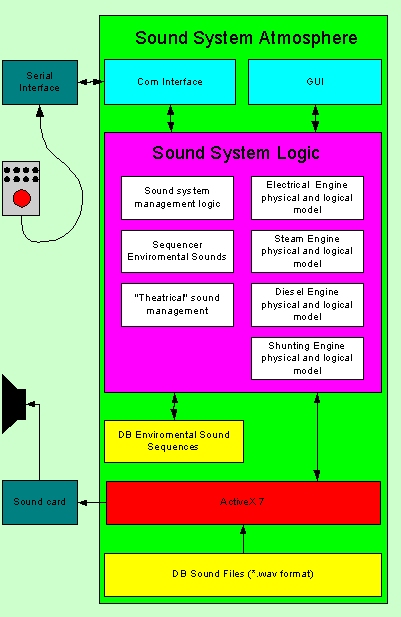
The sound system is programmed in Visual Basic VB6 and runs on a PC Notebook. It uses the DirectX7 technology to process the various sound files and play the sounds. At the moment it is a prototype system customised for Belvédère.
The system is connected to the walk-around throttle. The train sounds are synchronised to the speed of the train.
Technology:
System architecture:
Control panel:
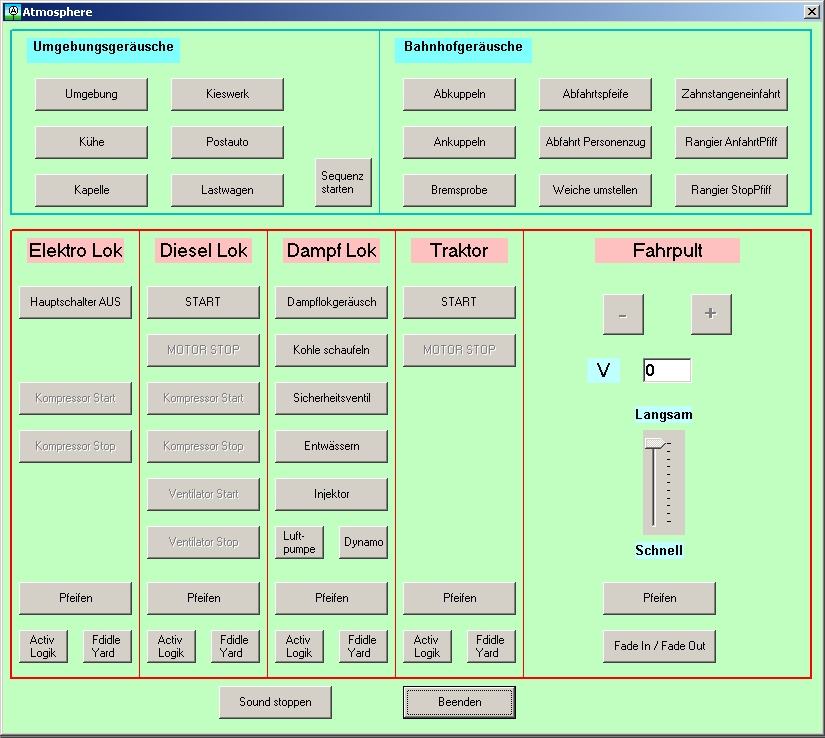
The control panel is used to control the sound system for special effects but also to program the sequencies of the enviromental sounds.
Sounds:
Three categories of sounds are played: background noises, engine sounds and specific railway sounds emerging from the operations.
The background noises include noises like the continuous "atmospherical" cow bell sounds being one of the typical sounds during the alpine summer. On every hour, the faint sounds of a distant church bell emerges from below the valley. Then there is some road traffic from the railway crossing, occasional far thunder growelling in the evening, and many more.
The sounds emerging from the trains are specific for the engine used: diesel engine, electrical engine, steam engine. The physical model manages the individual sounds: so the air system has to be pressurized when coupling has taken place and so the air compressor has to be started. When the steam engine is driving off, the blow downs are open and will be closed as soon as the cylinders are warm: again a specific sound adding some atmosphere to the layout.
Additionally I included some specific railway noises supporting the various train related activities taking place on this shunting style layout: uncoupling the trains, throwing the points, shunting the engines (whistle signals!), performing the break tests after the run-around of the engine, etc.
| BACK |