"There can be no doubt in ones mind that someone or something is playing games with evolution and nature at the Trifuga Site we uncovered a mass-burial, but upon closer examination we found that what lay below the surface was barely human, barely any species we could think of. Something horrible has occured, these mutations we have found are horriflying and alarming in the wake of their discovery... I can but hope what we have found will allow better preparation...now only if half the workers hadn't come down with this strange chemotropic illness.." - Circe Garner
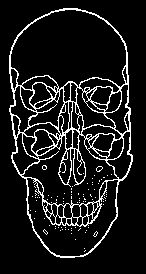
The image to the left is a examiner's redition of a skull found at the Trifuga site, it's one of many and all of them are adult skulls, Apparentl;y the large majority of these creatures died of a blow to the skull area, but what is disturbing is the double-cranium. No other creature int he work has been known to have such a strange thing.  In the Permafrost further north another  team uncovered a fully intact specimen. It seems as if these creatures are largely human-based, but sport a larget body  bulkier muscles composed of ultra-dense black colored muscle, their blood resembles that of the insects, something termed by naturalists as 'hemolymph' apparently these creatures have a inflexible neck region, are constantly shedding teeth, and mya be artifical in creation due to their lack of the obvious scars of natural birth. Below you will find a rough estimate of what a living version of this creature might look like.

Height about 8 or 9 feet
Weight easily 500lbs or more
Width  4 feet at the shoulders.

Description
The 'conservator' as it has been called is beleived to be a slow moving bulky semi-sentient possessing and average sense of smell and possibly a weaker sense of hearing, but, and excellent vison range, possibly spanning into several spectrums. It is estimated that these creatures bear a shuffling gait due to their largely inflexible joints in the legs however this has never been verified. It is know they are tough and thickly muscled with a type of muscle  we have termed "muscle cord"  for the tenacy of the muscle to from in strands cylindrical in shape, that are cgroups in larger bundles, making an oddly scalloped look to a given area, like the bicept for example. We do know these creatures wore clothing, and there were distinct male and female differences, however theior habits are unknown as is their diet, from the mutiple rows of irregurlar thin teeth we can imagine they grind whatever it is they eat to a purree and then swallow it, the location of jaw muscles supports this guess. However it's beleived that perhaps these creatures have exceedingly high metabolism and like sharks must contantly eat to support the said metabolism.
While we do not beleive the conservator is capable of running thick bands of muscle in the legs suggest it can jump great distances and  possibly has a high capacity to climb. It is recommended that no persons should engage in close combat with these creatures as they are exceedingly strong especially in the extremities.
The conservator's skull note the double septum , it is beleived neither nose funtions, assuming that the upper one has openigns at all.
Hosted by www.Geocities.ws

1