SNACK FOODS FROM FRUITS AND VEGETABLES
SNACKS FROM SQUASH
Eating between meals is a common habit among us.
Squash is a good snack rich in Vitamin A and contains calcium, phosphorus and iron. This becomes attractive snacks for the young when served in different ways.
SQUASH CUCHINTA
Procedure:
D. SQUASH MACAROONS
Materials:
1/2 cup butter
4 eggs
1/3 cup white sugar
1/2 pack dessicated coconut
2 tsp. vanilla
3/4 cup grated squash
Procedure:
E. KALCOSUMAN (Squash Suman)
Materials:
1/2 cup malagkit rice Procedure:
KALABASA PAN DE SAL
Materials:
12% flour from squash
88% ordinary flour, yeast, salt (pinch),
oil and sugar as in ordinary bread
Procedure:
SQUASH CORN CHIPS
Materials:
Squash, Corn flour, Oil, Sugar or Salt, Flavoring
Procedure:
NUTRITIOUS CRUNCHIES
Growing children are naturally restless and move a lot because they are full of energy. The parts of their body are developing, they need more energy giving foods to meet their needs for development and to replace the energy they spend. Supplementing corn with munggo gives much of the energy they need. This is enriched with Vitamins A and B.
Materials:
5 1/4 cups corn flour (800 gms)
1 3/4 cups munggo flour (200 gms.)
5 cups water (about 900ml. or less than 1 liter)
2 cups cooking oil and
IRON-ENRICHED CRUNCHIES
In order to meet the iron need of growing children, pregnant women, and nursing mothers, this "nutri-crunch" is enriched with blood of animals (chicken, hog or cow).
Materials:
800 gms. rice flour
150 gms. skimmed milk
50 gms. powdered animal blood
20 gms. sugar
15 gms. salt
60 gms. barbecure flavor
700 ml. water and cooking oil
Procedure:
To prepare powdered blood: RICE BRAN IN PLACE OF FLOUR
DOST researchers have tried mixing rice bran with flour instead of using flour alone for bread and snacks, in efforts to increase the vitamin intake of children.
Procedure: CASSAVA FLOUR
There are two ways of making cassava flour:
CASSAVA CHIPPY
Materials:
1 kilo cassavaProcedure:
CASSAVA SHRIMP STICK
Materials:
1/2 cup all purpose flour
1/2 cup grated cassava
2 tbsp. sugar
1 tsp. baking powder
1/4 tsp. salt
5 tsp. powdered dried shrimp
2 tsp. oil
1 pinch sodium bicarbonate
2 cups water
Procedure:
If necessary, add more flour to facilitate dough flattening.
Procedure:
CASSAVA COCONUT COOKIES
Materials:
2 1/2 cups wheat flourIn a study conducted at UP Los Baños, it was seen that pan de sal made from powdered camote, soybean and sorghum is more palatable, cheaper and more healthful than pan de sal made from flour alone.
Two proportions were tried:
10% soybean
80% all-purpose flour
This contains 12.25 gms. protein with 600 cal./100 gms.
10% soybean flour
80% all-purpose flour
This contains 14.26 gms. protein with 57.04 cal./100 gms.
To make powdered camote, see procedure for cassava powder.
Source: Farming Today, Feb. 1981
HOW TO PREPARE TAMALESMaterials:
For 6-8 pieces tamales
3 1/2 cups powdered rice
3 tbsps. Atsuete seeds
6 cups coconut milk
12 pcs. banana leaves or aluminum foil, 10" x 12"
1 cup brown sugar, salt, pepper for flavoring
2 pcs. children breast, boiled and cut into 1/2" pieces
1 cup ground roasted peanuts
2 cups boiled peanuts
1/2 kilo pork loin, cut into 1/2" pieces
2 boiled eggs, sliced
1/2 kilo cooked, shelled shrimps
1/2 kilo cooked ham, cut into 1/2" pieces
Procedure:
stand for 1/2 hour; strain and set aside the juice.
Source: Natural History, July 1, 1990
HOW TO COOK SIOPAO
To make the dough:
Materials:
4 1/2 cups flour 3 tbsp. oil
1 1/4 cups warm water 1 tbsp. baking powder
3/4 cup sugar 2 tsp. yeast
1/4 tsp. salt
Utensils:
Mixing bowl
Wide board for making dough
Square pieces of paper for each siopao
Procedure:
1. Dissolve the yeast and sugar in the warm water; set aside for 10-15
minutes.
3. Add the dissolved yeast and half of the flour. Mix well.
Apply oil also on the top of the dough.
Put the ball on the square sheet of paper to keep it from sticking to the bottom of the pan.
Filling:
MONGO KROPECK
To provide increased nutrients in the snacks of children, the addition of
mongo flour has been tried and found acceptable.
Materials:
5 cups rice flour
2 1/2 cups mungo flour
2 cups oil or lard
1 1/2 tbsp. flavoring (cheese or barbecue)
2/3 cup water
Procedure:
SOYBEAN KROPECK
Procedure: (The procedure is similar to other kinds of kropeck)
1. Add rice powder, water and salt to the sapal of the milk from soybean.
TAHO FROM SOYBEAN
Materials:
3 cups mature and newly harvested soybeans
2 bars white gulaman
3 cups brown sugar
strainer (muslin or nylon cloth)
Procedure:
1. Soak soybeans overnight in water 3 times its volume.
while grinding.
3. Dissolve 2 bars gulaman in boiling water (7 cups).
4. Pour the ground soybean in boiling gulaman for 7 minutes or until the odor
grains is removed.
5. Set aside until it coagulates.
6. Serve with syrup.
Syrup is prepared as follows:
3 cups sugar is dissolved in 3 cups water. The sugar may be
caramelized to improve color and flavor.
Source: The Philippine Recommends for Soybean, PCARRD 1991
TAHO FROM COCONUT MILK
Instead of soybeans, coconut milk may be used with gulaman in making taho.
Procedure:
To make syrup:
Dissolve 2 cups brown sugar in one cup water. Heat until thick.
Source: ITDI, DOST
SOYBEAN MILK
Materials:
1 cup soybeans
3 cups water for cooking
Procedure:
SOYBEAN COFFEE
Soybean "coffee" is a recommended substitute for real coffee for consumers with heart ailments.
Procedure:
CHEESE FROM POWDERED MILK AND COCONUT MILK
(Contains 12% - 14% protein)
Materials:
1 2/3 cups skim milk powder
6 1/2 cups water
1 1/2 cups coconut milk (first and second extraction)
4 tbsp. salt
1 1/3 tsp. coagulant (DTRI-IFS-6 milk coagulant)
This can be made by soaking in hot water a piece of the cow's abomasum
(available at slaughterhouses) or crude rennet extract -- 20 cc. in 1 tbsp. vinegar.
Utensils:
Casserole or container (with 2-liter capacity), thermometer, stirrer, dipper, knife, perforated tray, muslin cloth, banana leaves or cut-wrap paper.
Procedure:
dissolved.
Source: Greenfields, October 1983, v.13
SWEETS AND PRESERVED FRUITS AND VEGETABLES
MANGO JAM/CANDY
In preparing mango jam, don't use metal utensils like knife, casserole or other similar metal containers of the jam produced.
Procedure:
For Candy: Add more sugar (1 1/2-2 cups for every 2 cups mango) and stir until thick. Cool.
Form into desired size and shape, then roll on confectioner's sugar. Wrap in cellophane.
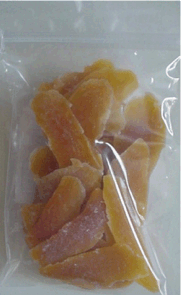
DRIED SWEET MANGO
"Pico" mango has been found to be the best source for mango candy.
Ingredients: Materials:
Mangoes (rare-ripe) Weighing scale
Sugar Stainless steel knife
Confectioner's sugar Stainless steel spoon
Sodium metabisulfite Cheesecloth
Procedure:
1. Wash rare ripe mangoes.
2. Peel and slice lengthwise, evenly thin.
3. Boil syrup and stir for 10 to 15 minutes.
(1 cup sugar to 1 cup water and add 0.2% sodium metabisulfite as
preservative)
4. Add fruit slices.
5. Set aside, cover it, soak it overnight.
6. Drain fruit slices from syrup.
7. Boil syrup again and add 1/2 cup sugar and stir it for 10-15 minutes and
soak again the fruit slices overnight.
8. Drain and wash fruit slices with clean water.
9. Dry in a cabinet dryer with a temperature of 60°C for 8-10 hours.
10. Roll in confectioner's sugar.
MANGO CHUTNEY
Materials:
4 cups sliced semi-ripe mangoes
1/2 pc. Ginger 1 small box raisins
8 pcs. native onions 3 cups brown sugar
2 pcs. peppers 4 tbsp. table salt
Utensils:
Stainless knife stove
Enamel bowl dipper
Measuring cup jars
Casserole chopping board
Procedure:
and other remaining ingredients become thick in consistency.
10. Cool with cover upside down. Source: ITDI, DOST
PRESERVED GREEN MANGO/CAMIAS
Procedure:
2. Sprinkle with salt (not more than 10%, not less than 5% in equal
3. Let stand overnight.
DRIED SWEET PAPAYA
There are places in this country where fruits abound, but there is no way of transporting them to market, thus they become rotten and are wasted away, or are given to hogs. In places where there is an oversupply of papaya for instance, the fruits can be preserved for as long as 10 months.
Materials:
Half-ripe papaya, 1 kilo
Kalamansi juice, 1 tbsp. for every cup of syrup
Sodium metabisulfite powder, for every 1/4 tsp.=+ 1 tsp. lime in
4 cups water
1 part sugar for 2 parts water
1 kilo sugar for every kilo of papaya
Procedure:
dry in the sun until it becomes tough.
PRUNES FROM BALIMBING
Materials:
2 kilos balimbing
1 kilo brown sugar
salt, toyo
1 tbsp. lime in 1 gal. water
Procedure:
Source: PCARRD, Monitor, September 1989
TOMATO CANDY
In summer time, tomatoes abound. Thus, it is good to preserve them for future use especially when they are not in season. One of the ways of preserving them is by making candy.
Materials:
Ripe, red tomatoes with thick flesh
White sugar
Jars
Procedure:
until almost dry.
Source: Food Technology Research and Development Program, ITDI, DOST.
PINEAPPLE CANDY
Materials:
1 pineapple (moderate size)
4 cups sugar
Utensils:
Casserole/karajay Solar drier
Chopping board Spoon
Measuring cup Sieve
Knife Candle
Stove Tray
Cellophane/Plastic bags
Procedure:
1. Peel the pineapple, remove eyes, core and wash.
2. Slice into cubes.
3. Prepare the syrup, 2 parts sugar to 1 part water.
4. Boil the pineapple in the syrup for 20 minutes.
5. Soak in syrup overnight.
6. Strain and wash well in water.
7. Dry in solar drier for 16-20 hours. Cool.
8. Roll over sugar and wrap in cellophane.
9. Put in plastic bags; seal open end of bag with the flame of a candle.
Source: NSTA Appropriate Technology Program
PINEAPPLE JUICE
Choose good ripe pineapples, not bruised or over ripe.
Procedure:
1. Slice into small pieces, extract the juice.
2. For every liter of juice, to avoid molds, add
1/2 per cent sodium benzoate
3 grams citric acid
Sugar may be added if desired.
3. Heat at 80°C for 5 minutes, constantly stirring.
4. Put in jars or containers while still hot.
This can also be done with sugarcane juice.
Source: ITDI, DOST
NATA DE PIÑA
Procedure:
stir well. Soak overnight.
Source: PCARRD-DA Farmnews. March-April 1991
SWEET POMELO RIND
Procedure:
To remove bitter/pungent taste.
Source: Selected R & D Completed Projects, NSTA 1982
SWEET CALAMANSI RIND
Procedure:
Add sugar up to 10°Bx every 3 hours.
color of this candy is green or olive-green. It is soft and has the taste of calamansi-menthol.
Source: Selected R & D Completed Projects, NSTA 1982
CHAYOTE CANDY
Materials:
1 kilo chayote
1/2 tsp. lime
1/2 cup sugar
Procedure:
Source: NSTA Projects, 1982
GUAVA JELLY
Materials: Utensils:
Mature guava Aluminum casserole
Calamansi Wooden spoon
Sugar Sinamay for straining
Denatured alcohol Muslin cloth
Measuring cup, jars
Procedure:
It is jelly if:
strainer before pouring into jars.
Note: Other fruits rich in pectin are: anonas, guayabano, granada, papaya, rimas, banana, santol, chico, sineguelas, and tomato among others. Source: FNRI 1989.
DUHAT JUICE
Procedure: ( Note: Use only ripe duhat fruits.)
water.
DUHAT JELLY
Procedure: (Note: Use only ripe duhat fruits.)
Source: Health & Home, vol. 13(4)
ORANGE MARMALADE
Materials:
Sevilla oranges Sugar
Procedure:
10. A screwed cap may also be used when the marmalade has somewhat cooled.
Source: A Connoisseurs Guide & Cookbook Simon & Schuster 1991
JUICE FROM THE NATIVE ORANGE
Procedure:
Leave about 1/2 cm. space from the rim.
Source: FNRI, DOST
GUAYABANO JUICE
The manner of making fruit juices is almost similar in all fruits. The only difference is the inclusion
of certain additives, or in the manner of preservation.
Materials: Utensils:
Ripe guayabano Measuring cup and spoon
Sugar Jars or can for preserving
Calamansi Muslin cloth bag, knife, casserole
Procedure:
10. Close the bottles well. Label. Source: FNRI 1989
SANTOL CANDY
Materials:
Santol fruit Utensils:
Sugar Aluminum tray, wooden spoon for stirring
Lye (commercial flakes bamboo or wire tray casserole (stainless or
of sodium hydroxide) porcelain) thermometer, knife
Procedure:
to be covered in the container.
VITAMIN ENRICHED COCO JAM
To enrich the usual coco jam with vitamins, the following proportion is used:
1 part sugar (brown)
1% Vitamin C (Ascorbic Acid)
2% - 7% powdered soybean, green peas, chick peas, rice
This mixture when cooked, does not last as long as when it is cooked in the traditional way of cooking coco jam, so it should not be stored.
Source: Completed R & D Projects, STII, DOST
CHEAP SOURCE OF VINEGAR
A student from the Panabo Provincial High School (Dean Cabote), as early as 1977, had proven that the stalk of the coconut leaves could yield vinegar. Just as the coconut blossoms can yield tuba because of the elements present in them, so also would the stalk, as the same nutrients are present in the same tree.
Procedure:
pieces.
VINEGAR FROM RICE WASHINGS
Materials:
White sugar
Yeast
Procedure:
Stir well to dissolve the sugar.
10. Filter and boil in a double boiler before bottling.
VINEGAR FROM PINEAPPLE JUICE
Vinegar can be made from ripe, over ripe or bruised pineapples or even from the peelings.
Procedure:
Transfer to suitable containers. If a clear vinegar is desired, add 2 beaten eggwhites for every 10 liters vinegar solution. Heat until the whites coagulate. Filter.
Source: ITDI, DOST
VINEGAR FROM BANANA PEELINGS
Materials:
For every kilo of banana peels (cavendish or saba), add:
3/4 cups sugar
1/4 cups ammonium sulfite
vinegar starter (or very strong vinegar)
baker's yeast
Procedure:
Source: InfoScience, vol. 1, no.3
DIFFERENT USES OF VINEGAR
According to researchers, vinegar is used, not only for food but for many other uses as well, such as:
frying.
vinegar in the boiling water.
that the eggwhite will not scatter.
in the water when cooking.
Other Uses:
SAUCE FROM BANANA PEELINGS
For every kilo of banana peelings (cavendish or saba), add:
12 tbsp. sugar 1/4 tsp. sodium benzoate
9 tbsp. vinegar salt, pepper to taste
Procedure:
Remove fibers.
Source: Info Science, vol. 1, no.3
PASTE FROM BANANA PEELINGS
For every kilo of banana peelings, add:
1 tsp. salt
Procedure:
Source: InfoScience, vol. 1, no.3
CHAYOTE CATSUP
Materials:
Chayote Sodium benzoate Salt
Garlic Vinegar Sugar
Onions Pepper
Procedure:
3. Boil in little water.
5. Mix well in enough vinegar, sugar and a pinch of salt.
6. Cook until thick consistency is attained.
sodium benzoate.
8. Put in a bottle or jar; cook in a double boiler.
Source: PCARRD Farmnews, May 1987
BEAN CURD (Tokwa)
Materials:
1 cup soybeans
Procedure:
floating grains.
while grinding.
The curdled tokwa can be a substitute for meat.
Source: The Philippines Recommends, PCARRD, 1991
MISO (SOYBEAN)
The preparation of miso (which comes in 3 kinds) depends on the length of time. It is fermented and stored.
Materials:
Wooden box 60 x 30 x 5 cm.
Pressure cooker or casserole
Grinder
1/2 kilo soybeans 300 grams salt
1 kilo rice starter (A. Oryzae)
5 kilos soybeans 2 kilos salt
3 kilos rice starter
C. Salty and Darker Miso
5 kilos soybeans 2-10 kilos salt
3 kilos rice starter
Procedure:
of the mixture.
3 months for average miso
6 months for salty miso
Source: The Philippines Recommends for Soybeans 1991
RICE-SOY NOODLES
To increase the protein content of the Filipino diet, researchers at FNRI (DOST) have come up with an enriched kind of n oodle that can somehow supplement their
Protein and energy needs.
Materials: Utensils:
Rice (880 grams) - or -------4 1/2 cups Bowl, Mixer, Kettle, Cup
Water (630 ml.) - or ---------2 3/4 cups Teaspoon, Noodle machine
Soybean flour (200 grams) or 2 1/2 cups Cornmill/grinder
Salt (30 grams) --- or ------ 6 tps. Solar dyrer/cabinet dryer
Cornstarch (50 grams) or 1/2 cup
Procedure:
Source: FNRI (DOST)
SOTANGHON FROM MONGO
The usual sotanghon is made from soybeans, but since this is important and more costly, researchers at UP Los Baños have produced sotanghon using mongo, without any distinction from the usual soybean sotanghon.
Procedure:
To make starch:
The portion that is not used contains much protein, which is used as hog feed.
To make noodles:
attained, that is the starch becomes fibery but does not snap.
Source: Division Ideas Magazine, August 1990
SPROUTED MONGO (TOGE)
Toge can be made from both mongo seeds or soybeans.
Procedure:
This can also be done in a container where water passes through and has enough space for growth of the beans. Wet the beans now and then as in the cloth in the "bilao."
Source: The Philippines Recommends for soybeans, PCARRD 1991
GELATIN FROM SEAWEEDS
Seaweeds must be harvested from the sea very early in the morning or while the
tide is still low.
Procedure:
bamboo screen for the purpose) for a week.
fresh water for 5-10 minutes, and dry again in the sun until it
becomes dirty yellow in color.
green in color.
To extract agar:
(or, more effective, in 3 1/2 liter water, 80 ml. 0.1 N sulfuric acid
(H2S04)
Source: PCARRD Monitor, August 1987
MEAT TENDERIZER
Soak the meat for a few minutes in papain-water solution, 1/10% to 1% before cooking. Source: Chemical Formulary by Bennet, vol. 23
HOW TO MAKE PAPAIN
Papain is made from green papaya fruits while these are still attached to the tree. The bigger is the fruit, the more latex is derived. More amount of latex is gathered if this is done 3 times a week in a month. The more cuts are made, the less is the flow of latex. The best time for gathering latex is between 8:00 am to 12 noon.
Procedure:
Source: Selected R & D completed projects, NSDB 1980.
HOW TO MAKE BALUT
There are two ways of making balut - one is for a commercial scale and the other for a small home industry. Both duck and chicken eggs may be used, but the usual eggs used are ducks' eggs.
Procedure:
For Small Scale Industry:
about 38°C and 6-8 inches thick.
heated hull and cover again with same thickness of heated hull.
The hull must be about 38°C.
with out germ plasm. At this stage, those with developing germ plasm are
the "balut sa puti".
cooked.
For commercial scale: The process is the same except that an incubator is
used instead of heated rice hull.
Source: Coffee and Cocoa Journal, February 1981.
SALTED EGGS IN CLAY (MUD)
Another way of salting eggs is by storing them in clay instead of in brine.
Materials: Utensils:
Eggs (duck or chicken) measuring cup
Salt, clay earthenware
Procedure:
being mixed until an even distribution is attained.
If it is not yet salty enough, let the rest stay longer in the pot.
FRESH EGGS AND THEIR USES
Eggs are fresh when:
Extends the freshness of eggs:
So, buy only eggs with clean shell.
Eggs absorb the odor of the room or its surroundings when this is in a closed place.
Uses of eggs in cooking:
Health benefits from eggs in the diet:
Children, pregnant women or nursing mothers as well as the aged need at least an egg a day to meet the needs of the body. Those aged 20-59 need only about half of this requirement.
Other characteristics of eggs:
MAYONNAISE
The basic ingredients for making mayonnaise are lemon juice or vinegar, salad oil or winterized oil not less than 65% or 2/3, egg yolk or whole egg, and sugar, salt and spices (paprika, mustard) and vetsin. However, substitutions maybe made.
Materials:
1 cup lard (or cooking oil) 28°C
1 egg yolk
1 1/2 tbsp. 4.5 vinegar (del Monte)
1/2 tsp. iodized salt
1 tsp. white sugar
Procedure:
bowl.
for about 5 minutes.
Source: CMU Journal of Agriculture, Food and Nutrition Official Publication.
PRESERVE FRESH FOODS
FRUITS AND VEGETABLES
Extend the shelf-life of fruits and vegetables.
Procedure:
sharp or pointed pieces in the sawdust that will hurt the fruits or vegetables
as it is in this way that rotting caused by bacterial organisms start.
sawdust again.
11 days, the fruits/vegetables will lose only 2% of their weight while
in the usual way of storage, the total loss of weight is 10% within the
same period of time.
Source: Philippine Farmers' Journal, July-August 1983
Other Ways of Storing Fruits/Vegetables:
tablespoon chlorox.
under the sun.
fruits/vegetables.
breaking apart.
crumple or lose the ability to keep the vegetables fresh. Winged
beans kept in this way stay fresh for about one and a half
weeks, but if not stored in this way, last only three days.
the process when the pot shows drying.
but place a platform for the vegetables inside to keep from
rotting because of wetness. Vegetables such as cabbage,
tomatoes, beans, eggplant, and mangoes can last for a week if
stored in this manner.
Source: PCARRD Farmnews, April 1984
PRESERVE TOMATOES
Procedure:
The level of water should be only 2/3 of the height of the jar to prevent the water from entering the jar.
EXTEND THE SHELF-LIFE OF TOMATOES
Research at the UPLB has shown that the ripening of tomatoes can be
hastened or delayed.
Ash. This increases the ethylene gas which hastens ripening.
ripening.
delay ripening, but the ripening will be natural, and the
tomatoes will be firm even if ripe, better than if stored in dry
ash. Source: Farming Today, July 1983
POWDERED TOMATOES
Procedure:
The resulting product is red in color and smells and tastes like fresh tomatoes. To cook, mix with water as needed.
Source: Selected R & D Completed Projects, NSTA 1982.
DEHYDRATED CARROT
Carrot is rich in Vitamins A and C. It is good to store it during its
abundance so as to make it available during scarcity.
Materials:
Carrots -- mature, bright colored, fresh
Starch flour -- 4 tbsp. in 4 cups water (stir continually while
heating)
Plastic bags
Procedure:
Source: FNRI, Oct. 1989
DEHYDRATED BELL PEPPER
Procedure:
Wash them very well in running water.
DEHYDRATED CELERY
Procedure:
Source: Selected R & D completed projects, NSTA
RIPENING OF FRUITS
One of the ways to hasten the ripening of fruits is by the Right Use of Calcium
carbide. The fruits must be in a box with the right temperature and right
humidity.
The wrong use of calcium carbide for artificial ripening of fruits is by wrapping
the calcium carbide in paper and putting it among the fruits. This burns
(hurts) the fruits.
When the fruit is mature and made to ripen artificially, its ripening is no
different from natural ripening, both in quality and in taste. And if calcium
carbide is placed properly, the color of the fruit is stronger and the shriveling of
its skin or peeling is delayed.
What hastens the ripening of the fruit is the ethylene gas that emanates from the
calcium carbide, and not the calcium carbide itself. Ethylene gas is not poison to
humans and gives no damaging effects.
Source: Philippine Farmers Journal, Nov.-Dec. 1983.
HOW TO RETARD THE RIPENING OF FRUITS
According to researchers at the UP Los Baños, the ripening of fruits can be
delayed from one to two weeks under the following conditions:
the ripening of fruits.
containers. It is in these ways that microorganisms enter the fruits and
causes rotting to start and lose weight.
put together ripe and raw fruits.
give off much ethylene.
Source: Farming Today, April 1982
RETARD THE RIPENING OF MANGOES
(Hot Water Treatment)
Hot water treatment (HWT) retards the ripening of mangoes without affecting
its taste; makes the color of ripening brighter and evenly, and does not require
the use of pesticides, chemicals because the fruits are not infected by bacteria or
pests.
Procedure:
similar, according to the quantity of mangoes to be treated.
One drum that contains hot water will be for immersing the mangoes,
And the other will be for maintaining the heat of the water used for
immersing.
this heat, it is necessary to use a bulb thermometer.
Source: PCARRD-DA Farmnews, March-April 1991
ETHREL: RIPENS BANANAS AND TOMATOES
Fruits must not be picked when immature because they will not ripen
naturally. However, there are instances when this is inevitable, such
as during a storm or unavoidable circumstances.
Researches were conducted at UP Los Baños have shown that immature
fruits can somehow be made to ripen with the aid of a chemical, Ethrel.
Procedure:
Bananas
Ethrel in this water.
while pouring.
This can be used up to 15 days provided the fruits being immersed are clean and dry before they are immersed. It was seen by the researchers that if the fruits are immersed in ethrel on the fourth to the seventh day (4th-7th) after harvest, the banana ripen in 2-3 days.
Tomatoes
Calcium chloride and ethrel:
Less ethrel is needed to ripen bananas, compared to calcium carbide. It
requires 20 grams carbide for every liter of water.
Source: Agricultural & Industrial Life
KAKAWATE LEAVES RIPEN SABA BANANAS
Studies made at the UP Los Baños showed that when raw saba bananas are put
in kakawate leaves, its ripening is hastened. This is because the kakawate leaves
emit bioethylene, a gas that ripens fruits.
It was also seen that when bananas are ripened with kakawate leaves, the weight
loss is only 5%, while those not treated loses 19% of its weight within 6 days.
Procedure:
Stack the banana bunches with kakawate leaves alternately.
Source: PCARRD (DOST)
DELAYING THE RIPENING OF BANANAS
IN MALAYSIA
Researchers at the Malaysia University and of the Malaysia Agricultural
Research and Development Institute have a way of delaying the ripening
of bananas. This is not their present method of wrapping the fruits in a
bag with polythene - this is good only until 11 days.
The new method is by the use of the chemical, Bynonyl, used to combat, molds,
but is not harmful to humans. They tried this on raw bananas called "pisang
emas." This method reduced the growth of molds and retards ripening besides
improving the quality of the fruits.
Procedure:
It is only then that the fruits will start to ripen normally.
Source: PCARRD Farmnews, August 1987
RIGHT WAY OF STORING SWEET POTATOES
Sweet potatoes or kamote can last up to 2-3 months if harvested and stored
properly.
Procedure:
to avoid falling off and having bruises. It is in getting hurt that rotting of
fruits begin.
RIGHT WAY OF HARVESTING FRUITS
For example:
Mangoes: 82 days from flowering and bearing fruits
When the fruits that are exposed are immersed in water, these grow further and become more darkly or strongly colored than those hidden (which grow slowly).
Tomatoes -- if to be transported far--harvest when the end of the flower becomes pinkish, which are formerly green: if to be transported nearby-harvest them when the fruits are colored orange.
sap on the skin, if they are to be harvested at the last hours of the morning
or before 3:00 p.m.
Sweet corn: pick early to retain its sweetness. When harvested late in the
morning, its sugar turns into carbohydrates.
free circulation of air in containers. Use old newspapers, thin polyethene
or plastic bubbles sheets as lining at the bottom of containers.
container. This is dissolved and made to be absorbed by perlite blocks
which in turn will absorb the ethylene emitted by the fruits.
Perite blocks
--- 1 part cement
--- 4 parts perlite beads water to make thin paste
RIGHT SELECTION AND STORAGE OF FRUITS
Bananas - good, mature bananas are rounded, have no sharp edges. It can withstand only up to 14°C storage.
Caimito - the green variety is sweeter than the purple ones. Choose slightly soft fruits (Hard caimito will not ripen). It can be stored at 7°C temperature.
Mango - good mango of any variety has full "cheeks" and slightly yellow at the base (near the stem). Avoid sick, bruished mangoes or those with hard lumps. Keep in a cool place.
Melon - mature melon is sweet. The peel is yellow and a little soft near the stem. It cannot stand very cold temperature. Immature ones are not sweet and will not ripen.
Papaya - good papaya has streaks of yellow at the base and has deep lines lengthwise. It can be stored at 10°C.
Watermelon - mature fruits are whitish to yellowish; it gives off a dull sound when knocked (filliped) with the thumb and index finger. Immature fruits give off a metallic sound when filliped. They will not ripen and are not sweet. It can be stored at 5°C. Source: Agricultural and Industrial Life, 1990.
EXTEND THE STORAGE LIFE OF CORN
Weevils and mildew are the usual enemies of corn in storage. The grains attacked by these do not germinate.
One way of extending the storage life of corn is by:
To prepare glue:
Put 1 part pomade or grease in
1 part powdered clay or lime
If there are weevils present in the grains inside the can, the carbon dioxide that will emanate from the grains will kill them. Source: PCARRD Farmnews, October 31, 1985
EXTEND THE STORAGE LIFE OF RICE
Rice can be stored without using pesticides. Instead, carbon dioxide which is not poison, is used as fumigant. Pesticides don't really control the insects in the rice sack as the spraying does not penetrate the interior of the sack. Thus, the pests in the middle part of the sack can keep on multiplying. And pesticides leave residues that are harmful to humans.
Procedure:
FISH AND MARINE PRODUCTS
MEAT
SIGNS OF FRESHNESS IN FISH AND MARINE PRODUCTS: FISH
SHELLS AND CRUSTACEANS
CRABS
SHRIMPS
Source: FNRI 1982
EXTEND THE SHELFLIFE OF FISH
The freshness of fish can be seen through its external appearance and odor, and in a chemical analysis.
Besides the mudfish and catfish, all fishes stop breathing the moment they are removed from the water, especially sea fishes.
Our fish products are in demand abroad, but they cannot pass the rigid quality control imposed by importing countries because of our family way of freezing, and so we export only dried and smoked fish.
The decay of fish is caused by bacteria and enzymes that are outside the fish, not within the flesh of the fish. These are in the water, the slimy substance around the fish, in the gills and internal organs.
For example, the tuna that comes from Mindanao carries with it 18 kinds of micro-organism in every gram of its shell/skin; the oysters caught in the Manila Bay contains thousands of this in every gram.
Thus, to delay the decay of fish, remove the gills and internal organs and wash very well to remove the slimy substance. In freezing, temperatures between 0°C-3.89°C causes crystal iciness in the muscles. If the fish is placed at 0°C as soon as this is removed from the water it will last for 7 days.
The faster the muscles become icy and the smaller that ice crystals that are formed in the muscles, the longer the good taste or quality remains. This is "quick freezing". The temperature must be reduced to -3.89°C from 0°C for not more than 2 hours for quick freezing. If it gets longer than 2 hours to have crystals in the flesh, this is "slow freezing" which is the usual way of freezing in domestic refrigerators.
Fish contains 15%-25% protein that has all the amino acids as in beef or chicken meat.
Source: Milkfish as food, NSTA 1978.
PRESERVE FISH EVEN WITHOUT ICE
It has been tested and found acceptable in India to preserve fish using certain preservatives.
Procedure:
add: 0.5% potassium sorbate and,
0.25% sodium benzoate
The fish put in this solution lasts for 72 hours.
0.5% potassium sorbate and
0.1% sodium bisulphite
0.25% sodium benzoate
The taste of fish preserved in this solution tastes better on
the 48th hour, and lasts as long as the fish is in solution.
Source: Fishery Technology, January 1988
PRESERVE SHRIMPS
Materials:
Sodium bisulfite -- 1 1/4 %
Water ---------------- 98.34%
Mix the above. Put in the shrimps here then drain: Keep in ice. Source: Chemical
Formulary (Bennet) vol. 23
PRESERVED TILAPIA
Materials: Utensils:
Rice (cooked) Knife, jar with a big mouth (sterilized) or put in
Angkak the sun
Procedure:
Source: PCARRD Farmnews, October 31, 1985
IMPROVED WAY OF PRESERVING SHRIMP CAKE
(ALAMANG)
Materials:
Shrimps, pestle, mortar
Procedure:
hours.
intrusion of stray animals.
Pounding:
Pound the dried shrimps in a clean pestle until fine and sticky (about 5
minutes).
Storing:
Wrap the shrimps in a bag and let it stay overnight.
Molding:
On the following day, mold into small cakes manually.
Drying:
Put under the sun for 2 hours to reduce moisture down to 39%.
Pounding:
Pound the shrimps in the pestle until fine.
Molding:
Mold the dried shrimps like balls, about one kilo each.
Cooling: allow the shrimp balls to cool at room temperature until dry.
Packing : use banana leaves for wrapping or polyethylene bags (plastic bags).
If properly done, dried shrimp cakes can last up to two years in storage.
Source: Farmnews, February 1989
FISH QUEKIAM
Materials:
1/2 kilo dalagang bukid 1/2 cup flour
1/4 kilo shelled shrimps 1/2 tsp. pepper
1/2 cup chopped turnip 1 1/2 tsp. salt
1/2 cup chopped onions 3 pcs. taupe (wrapper)
1/2 cup chopped celery
Procedure:
Sweet sour sauce:
3/4 cup water 1 tbsp. vinegar
1 tbsp. cornstarch 2 tbsp. soy sauce, vetsin
3/4 cup sugar
Mix all together and heat until the desired thickness.
Source: Fisheries Newsletter, Oct. 18-24, 1981
FISH FRANKFURTER
Materials:
1 1/4 kilo fish meat (labahita)
1/4 kilo pork fat
4 gms. accord powder (binder)
12 gms. frankfurter seasoning
1/2 kilo ice
Procedure:
smoking). Source: Fisheries Newsletter, August 18-24, 1981
CANNING OF BANGUS
One way of preserving bangus or any fish is by canning. But since not all have a pressure cooker and the use of tin cans need a special sealer, it is possible to can or preserve fish in the following manner:
Procedure:
FISH BURGER
Materials:
3 tsp. salt 1 cup chopped onions
or 4 tbsp. evap. milk
Procedure:
Source: Fisheries Newsletter, Oct. 16-24, 1981
FISH KROPECK
Fish Protein Concentrate (FPC)
Materials:
4 tbsp. powdered fish (FPC)
4 cups water
2 tsp. salt
1 1/2 tsp. fine pepper
Procedure:
Source: NSDB Appropriate Technology, Series 27
SARDINES
Materials:
100 grams size bangus 1/2 tsp. vetsin
1/2 teaspoon salt 4 tbsp. tomato sauce
2 tbsp. cooking oil 2 slices bell pepper
Procedure:
black lining in the belly.
Source: PCARRD Farmnews, January 1984
Boneless Bangus (Bangus Deboning)
Raw Material: Fresh bangus (preferably 3 pieces to a kilo)
Equipment/Utensils: Mosquito forceps, straight, cutting board, sharp knife, utility tray,
basin.
Procedure:
Pre-preparation:
removed.
SAUSAGE CASINGS
The usual materials for sausage casing is the intestine of the slaughtered hog,
sheep or cow. The intestines are lined up with five layers from within, such as:
digestion, absorption and circulation of substances to the various
parts of the body.
rich in collagen, the chief material in casing.
Cow serosa is thicker than hog serosa.
Procedure:
Carefully pull the intestines from the slaughtered animal.
Fat removal:
Carefully scrape the fat with a knife. Remove all fat as much as
possible because this will cause rancidity in the casings. This fat can be
used for cooking.
When pulling the intestines from the slaughtered pig or sheep, remove
as well the adhering hairs, from the intestines. If it will facilitate, the
intestines can be cut in pieces according to need.
Removal of other materials:
This can be done manually carefully or by means of a water hose for
cleaning as well.
Removal of slimy substance:
The removal of slime depends on the kind and size of intestine. It may
be cleansed by passing the intestine under a roller, or by scraping it to
remove the serosa. Bigger intestines are flushed with water or turned inside
out. After cleaning, soak the casing overnight in strong salt solution.
Grading and Storing:
The grading of casings is according to class, size and quality. The higher
quality (or export quality in the U.S.) is that which is free from defects like
holes, bruises or warts. After grading this is pumped with air or with water
to enable the measuring of the circumference.
Hog and sheep casings are marketed in lengths of 90 meters more or less,
and those of cow's by 30 meters. After grading, these are salted with fine salt
and stored further, and drained if wet. After draining, it is further shaken
to remove any remaining water and salted again if necessary.
Storage:
Casings packed in salt get deteriorated too. These have to be put in 4°C
temperature, but freezing must be avoided, as it could cause cracks that will
be the start for the growth of molds. Avoid also the growth of red molds that
thrive on salt. This will cause the decay of the casings.
Other casings:
1. Cow bladder - after cleaning, air dry them. When dry, they are
ready for marketing.
2. Hog or sheep intestine parts - these are joined together into various
shapes. To make the edges adhere together, these are passed through
heat and then joined together.
3. When cool and dry, they are packed and are ready for marketing.
Source: Edible Meat By-Products by Pearson and Dutson