Finland originally had several different tribal cultures. Thus the peoples in the different parts of Finland had a different view of the whooper swan, for instance. In the west of Finland it was considered a game bird, while it was sacred in the east. As firearms became more common, the swan began to disappear, starting in the southwest. By the 1950s, the whooper swan had, in effect, already become extinct in Finland. In the very furthest northern and eastern parts, there were still about ten nesting pairs, and on the other side of the Russian border, in Karelia, the ancient sanctity of the bird still kept it safe.
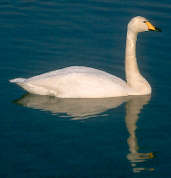
The white colour, large size and serene appearance of the whooper swan, Cygnus cygnus, make it quite an impressive sight and give it a natural symbolic value - the swan on the river of death, the swan song, a sacred bird or a more modern significance in advertising and trademarks.
The whooper swan was saved by the tenacious efforts of one man. He was Yrjö Kokko, a vet in Enontekiö in Lapland, whose greatest dream was to photograph a nesting whooper swan and generally document its life. After years of trying to achieve this, he finally succeeded and wrote the book Laulujoutsen ('The whooper swan', 1950) about his experiences. The book made Finns aware of the swan, and created favourable public opinion for its protection. The whooper swan population began to grow, enabling Yrjö Kokko to give the title Ne tulevat takaisin ('They are returning', 1954) to his next book on the subject. The number of whooper swans already increased significantly during Yrjö Kokko's lifetime (he died in 1977), and by now, it has spread all over Finland. Today, there are swans' nests even on the southern coast, where the whooper swan meets up with the mute swan (Cygnus olor), originally introduced to gardens and parklands and now spreading eastwards. Since the swan was made a protected species, the number of nesting whooper swans has increased a hundredfold in only 40 years; there are already about 2,000 nesting pairs in Finland and the number is still rising. It no longer takes years of trying to see a nesting swan; by now, some nests are very close to habitation.
The swans only set off on their autumn migration when the lakes have frozen. They winter in the Baltic region, and only if the Baltic sea freezes will they move to the North Sea.
The symbolic use of the swan has ancient traditions. In the rock drawings at Lake Onega, which are thousands of years old, the swan already features as a mythical being. The 'swan of Tuonela', the swan on the river of death in Finnish tradition, and the 'swan song' were favourite themes in art, particularly during the Romantic movement. Further, a white swan in flight silhouetted against a blue sky looks like the reverse of the Finnish flag, the blue cross against a field of white. The swan is currently one of the most popular animals in advertising, and the swan label is used in the Nordic countries to indicate that a particular consumer product is environmentally sound.
Background image: Swan by Ritva Salmi