
Pinewood Derby
Double-Elimination Method
There are different methods of judging a derby race, such as single-elimination, double-elimination, lane-rotation, and round-robin. Among these methods, however, double-elimination is the most commonly used method for pinewood derby. It requires less time than the other methods. It is one of the quickest and most efficient methods. It does not account for any imperfection in the track from lane to lane, and it is not as definitive as a "timed" race, but it is relatively easy to manage, and there is no time to keep track of. Just like most other packs, our pack uses the double-elimination method for our pinewood derby race.
In double-elimination, cars remain in competition until they sustain two losses. After a car sustains a second loss, it is eliminated from the competition. The easiest way of keeping track of which cars races against each other, and who the winners and losers are is by constructing a double-elimination "LADDER". Below is an example of a double-elimination ladder for a 4-car, 2-lane race. Using this as a model, you can construct a ladder for any number of cars and any number of lanes.
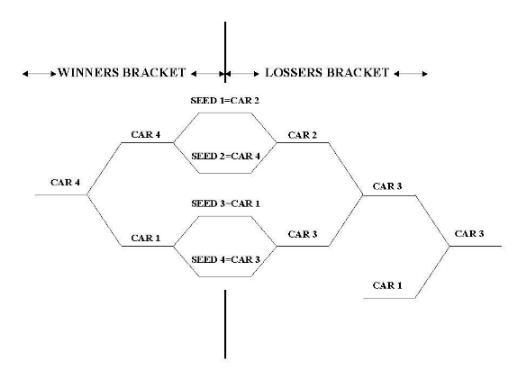
Let’s go over the steps for conducting a pinewood derby using the double-elimination race. Refer to the figure above as an example.
The example shown is for 4 cars; hence, n=4. The race uses a two-lane track.
In our example above, racer number 1, (i.e., CAR1), picked the number 3 from the hat; hence, he/she is seeded number 3.
Repeat this step until all players are seeded.
In our example, these are CAR2 and CAR4.
In our example, CAR4 wins and goes to the winners bracket. CAR2 losses and goes to the losers bracket.
In our example, these are CAR1 and CAR3. Here, CAR1 wins, and CAR3 losses.
In our example, there are only two more elimination rounds after the first round. In the second round, CAR4 races CAR1 in the winning bracket, and CAR2 races CAR3 in the losers bracket. CAR4 wins and remains undefeated. CAR1 loses and moves over to the losers bracket (first loss). CAR2 sustains its second loss and is eliminated. On the third round. CAR3 races CAR1 in the losers bracket. CAR3 wins. CAR1 loses and is eliminated (second loss). Because this is the last elimination round, CAR3 goes to the championship round to race against CAR4.
In our example, CAR4 and CAR3 will race in the championship round.
In our example, CAR4 needs to win only once; whereas, CAR3 needs to win twice for the championship.
The example below shows how a double-elimination race is conducted when you have an odd number of cars.
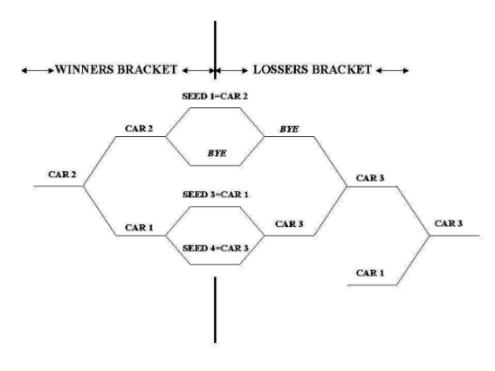
In the example, there are 3 racers. Each of them randomly picks a number from a hat, and is seeded accordingly. Because there are only 3 racers, one of the seed positions, SEED 2, will be empty, "Bye", and the racer (who is to race against this position moves to the next round.
 RETURN TO THE PINEWOOD DERBY HOME PAGE