Japanese is truly a charming language. Even barring any relation to English, the Japanese were nice enough to insert plenty of English words into their language to at least make it feel a little easier. The problem is that they don't always match up.
ex.
|
|
Japanese |
From English |
Meaning |
|
|
|
luku pea gamu gomu etchi hambaga hambagu
and lastly, 'bypass' |
look pair gum gum the letter "h" hamburger hamburger
bypass |
looks like twins plastic rubber or eraser horny hamburger a hamburger patty with caramelized onions and no bun (like Salisbury steak)
see below |
|
'Bypass' seems rather harmless. It's a road. It bypasses quite nicely even. I'm not sure if all Japanese bypasses are toll roads by nature, or they just happen to toll any somewhat efficient road in the country. They give bypasses several booths.
I was on my way to Odawara by bike. It's about 18 miles each way, so when I saw the sign offering a bypass, I figured it could speed things up a little. Shortly after beginning the route, the speed limit increased, the shoulder decreased until it was nothing but a bumpy gutter, and all my concentration went into avoiding three things: 1)not hitting a nasty bump unprepared, falling over and getting ground up underneath a car; 2) not letting my pedal scrape the curb, causing me to fall over and get ground up underneath a car; and 3) not getting tapped by a car's side mirror as it whizzes by, which would knock me into the guard rail, slide me off my bike, make me fall toward the traffic and cause me to get ground up underneath a car.
As a note, what Japan would consider highways are two lane roads with a 40 km/h (the residential speed limit in the US). The roads are narrow, the sidewalks are dubious propositions, and the over-sized buses are rampant. Freeways generally cost from two dollars every five miles and up to seven dollars if you're driving a semi. The bonus being no stop lights and you can speed up to 70 km/h (40 mph). The cars seemed to be going upwards of 50 mph, but the lanes were wide and spacious so I wasn't really getting closely buzzed by any of them.
It was a nice scenic ride along the coast. The ocean breeze kept the car exhaust away. Huge stretches of empty beaches reached all the way Odawara on the horizon, another 15 km off. A police car wizzed down the other side of the road heading off behind me, the loud speaker blaring something. Emergency vehicles don't settle with sirens in Japan; they let the bored coppers have fun and tell people to move out of the way and ridiculous. It beats the ambulances. Along with a siren, they play a taped recording that tells people to move out of the way, through the voice of a highly nasal prepubescent girl.
The police went their way. I went mine. A toll booth loomed up, another 500 m away.
At about 150 meters, I heard sirens behind me. They were saying something but I wasn't quite sure what: the usual stuff I imagined. With two lanes, they could pass me easily. I kept going.
They slowed down a little behind me and a few cars started pulling to the side. I figured I'd be nice and slow down a little. As soon as I began to hit the breaks, the crackly loudspeaker was punctuated with "Stop! Stop!" Everything they had been saying was directed at me. I just didn't understand any of it. They pulled to a stop behind me.
I made new friends.
One police man quickly jumped out of the car and stood behind the police car to direct traffic around it (the flashing lights are apparently not enough). Another stayed in the car, and two others ran out to me. I guess bikes weren't allowed on the road after all.
They started telling me something - lots of somethings. I only understood the basics, but I gathered that I was to be escorted to the toll booth where they had a tunnel to get me to a better road. The guy in the car felt it his duty to help the situation. He would occasionally butt in to the conversation on his car-mounted megaphone from forty feet away. We only began moving when they made certain that I understood the command "jitensha o oshite" or "push your bike" of which they repeated several times, and over the loud speaker as well. I'm not sure what he was saying, but the driver kept talking on the loud speaker all 150 meters to the toll booth.
After escorting me a safe distance past the toll booth, behind a blocked toll gate, they took my name, had me sound it out so they could write it in katakana, then asked my address. They seemed satisfied to just know the city name and postal code. They jotted it down on the Japanese police standard issue spiral bound notepad with no lines, where most of Japanese police work is done, and moved on to phone number, visa status, military status, and how I got on the road in the first place. As I note, I did all of this on a CA driver's license. It is a crime for a foreigner to be without passport, but they could care less. They even gave me directions to Odawara.
I gave many sorries before heading down the tunnel behind a nervously hurried toll booth operator to guide the way. The tunnel entrance was so narrow that I Had to lift the bike above my head to squeeze it down the stairwell. The tunnel itself was spacious, and filled with random cardboard boxes and traffic directing related paraphernalia. The toll booth operator hurriedly directed me to the other side. At the exit, I gave him a few more sorries. He told me be careful, and I was on my way to Odawara Castle.
The police never called later on. My name most likely ended up in some arcane filing system forever immortalized about 10km east of Odawara.
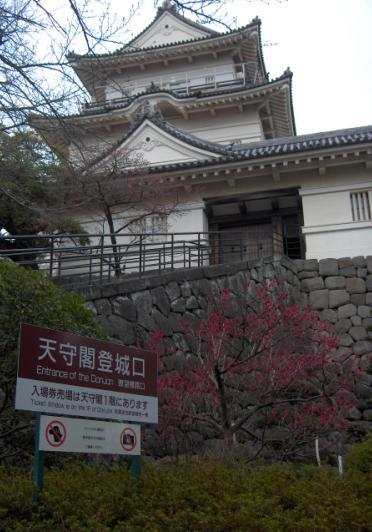
Here's a pic of Odawara Castle. I'll have to come back when the cherry trees are in bloom.
The sign says "Entrance of the Donjon," but it has nothing to do with 'dungeon'. 'Donjon' is the Japanese word for the main castle. I had to lay on the ground to get that sign and that castle in the same shot.