
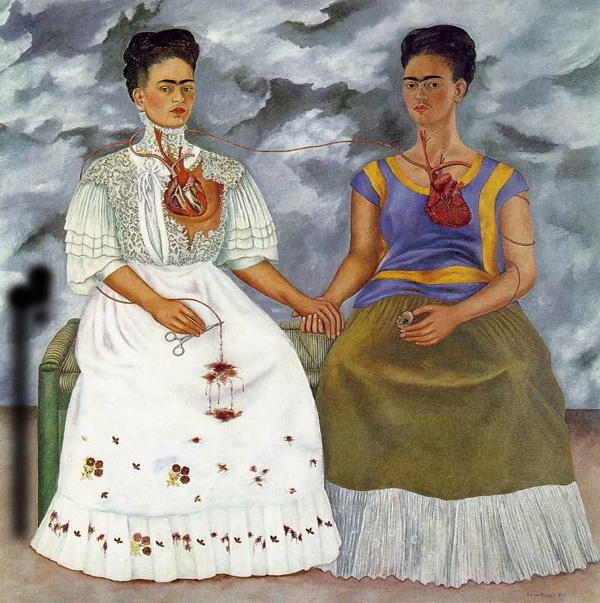
�Women have played a more prominent role in the history of Latin American art than they have in that of either European or North American modernism (Lucie-Smith, p.96).� Living in a nation dominated by commercially successful art, Americans are rarely exposed to artistic attitudes that incorporate differing philosophies or gender roles, and thus many are unaware of the artistic contributions of women artists like Frida Kahlo and Marisol (n�e Marisol Escobar) who are part of a Latin art tradition imbued not only with the influence of male-dominated artistic and political movements, but also a larger, universal movement that defines art and the creative impulse in a uniquely feminine way. These two artists, hastily identified in many a general art history textbook as a surrealist and pop artist respectively, actually transcend these genres and say more about the role of the woman as creator and relate the individual to society in a way that their male contemporaries rarely achieve.
Kahlo, who started painting at the age of 15 until her death in 1954 at the age of 44, lived the majority of her life in her native Mexico, while Marisol, born in Paris of wealthy Venezuelan parents in 1930, spent much of her childhood in France, the war years in Venezuela, and immigrated to the United States in the 1960�s (Marks, p.531). Nevertheless, both women were raised in the traditional Latin culture whose machismo was a major influence for the creative roles they adopted as women. Unlike European and American society, the rigidly defined gender roles of Hispanic culture give women the right to make statements about personal feelings and emotions, while men must be publicly stoic and not display the �weakness� associated with sentimentality. Hence, many artistic movements in South and Central America are pioneered by women artists, like the Brazilian modernist movement initiated by Anita Malfetti and Tarsila do Amaral (Lucie-Smith, p.96). Kahlo and Marisol personify the Latina artist in content and process and this is most evident in their works of portraiture and self-portraiture.
The grand tradition of Western art has taught us that men like to look at women. As the Guerrila Girls have argued, 89% of the nudes in the Metropolitan Museum of Art are female, while only 15% of the artists are. What we see in the works of these two artists (both of whom have been adopted as objects of admiration by the feminist movement) is not the expected American reaction to this situation, which would be retaliatory objectification of the male body. Rather, examination of these women artists reveals that men like to look at women, and women like to look at themselves. Through a brief examination of two works by each artist, Las Dos Fridas (The Two Fridas) and Ra�ces (Roots) by Kahlo and Self Portrait and Untitled Suite by Marisol, we can observe how introspection is both a powerful psychological tool and a vehicle for social change.
The Two Fridas is considered by those who place Kahlo in the surrealist camp to be the pi�ce de r�sistance, her hallmark work of surrealism, and is typical of the style that made her the poster child for the �native� surrealism that Andr� Breton claimed to have discovered in Mexico when he met Kahlo and her husband Diego Rivera. Breton, Rivera, and Marxist author Leon Trotsky together penned a manifesto on what constituted the new revolutionary art, concluding that ultimately what would liberate art would be total freedom from societal constraints. �In the realm of artistic creation,� they wrote, �the imagination must escape from all constraint and must under no pretext allow itself to be placed under bonds (Breton, et al, 528).� This is the Marxist/surrealist ideal that we see portrayed in this piece. Kahlo depicts herself as two separate women, holding hands and connected heart to heart by a large artery which the Frida on the left severs with surgical scissors. This displays quite vividly the explicit violence and a biological fascination with the human body dissected that is characteristic of European, male surrealism. The setting, too, is surreal. The scene occurs on a dream-like, bleak plain with an unremarkable horizon and menacing grey sky. Again, in Kahlo�s later work Roots, we see typical surrealist elements, at least superficially. �All surrealist visions of woman � by male and female artists � tend to identify her with the secret forces and regenerative powers of nature (Chadwick, 124).� Here, Kahlo depicts another surreal, �dreamlike� scene, set in a landscape reminiscent of the eeriest of Dali�s nightmares, in which roots protrude from her body and grow into the ground. Indeed, from a strictly formal perspective, a very good case can be made identifying Kahlo as a surrealist painter. However, while traditional canon-making has required that we group artists together according to critically validated styles, consequently eliding subjective differences in favor of objective similarities, the tradition of speculative self-portraiture � largely a 20th-century phenomenon � suggests far more subtle alliances. (Yau, 146)
Indeed, the factors that have led critics to label Frida Kahlo a surrealist, while formally and technically accurate, deny the most important impact of her work � the use of self-portraiture to �shove the face and body back onto the stage of history � a history that has all too consistently sought to eliminate the self, particularly when it asserts its existence as Other (Yau, 146).� Kahlo�s work, while largely relegated to second place during her lifetime when she was most famous as �Diego�s wife,� a sentiment that still prevails even among art scholars in her native country, is now internationally renowned for its resurrection of self-portraiture and revival of the psychological self as an acceptable subject of art (Tully, 128). Indeed, the psychological self-portrait undermines many modernist and postmodernist movements from formalist abstraction, which views the self as material fact rather than Kahlo�s uncertain conjecture, to contemporary realism which sees the self composed of positivist knowledge (Yau, 146).
Kahlo�s work with self-portraiture in an era when it was seen as contrary to the sweeping social idealism of her contemporaries also served to set the stage for artists of the second half of the century, who would dare to explore the self in an even more frightening post-war environment. Marisol had her beginnings in the postwar American movements that began with the New York School. She studied with Hans Hoffman and associated with the likes of Willem DeKooning and Andy Warhol (Marks, p.531). However, she soon broke with the New York School, finding inspiration in figural representation � specifically art and statuary of Pre-Columbian South America. Her most celebrated works were those she created in the 1960�s, becoming a sculptural pioneer by being among the first to incorporate the new process of �assemblage� of found objects into her wood carvings. Critics easily identify her style with pop art, calling it �as central to recent New York art as Impressionism was to the School of Paris� and �universally likable (Andre, 91).� Indeed, her whimsical assemblages of figures and incorporation of pop elements that we observe in works like 1962�s Self Portrait seem to be hallmarks of the postmodern pop enthusiasm of that era. Marisol uses casts of her own face in the tradition of Frida Kahlo, while combining them with found objects and industrial products. The early dada influence of the likes of Marcel Duchamp is evident, but one also sees in the inclusion of everyday objects the whimsical industrialism of pop art. These factors lead most viewers to identify with Marisol�s early work on a strictly visual, aesthetic level. Her work seems, at face value, to be nothing more profound than any other pop art icon. Even her more politically charged works manage to escape from the dark sarcasm of other artists by turning celebrities like Charles de Gaulle, Lyndon B. Johnson and even Pablo Picasso into simplified totem poles accentuated with decorative elements gleaned from traditional Latin artworks like Brazilian ex votos, or retratos, which were also an inspiration to Kahlo (Leffingwell, 80).
Looking at her work strictly externally, then, one sees nothing in Marisol more profound than the gentle satirical prodding of the typical �15 minutes of fame� pop artist of the 60�s, and her inventive and whimsical sculptures were very popular during the pop phase in New York. However, her subsequent works of the 1970�s and 80�s, while remaining true to her personal philosophies and aesthetics, alienated many of her pop admirers. She was �seen to have abandoned her successful pop art style for something too eccentric, and perhaps also too blatantly female, to demand serious attention by the mainstream art public and critics (Bernstein, 88).� Her subsequent works are quite obvious successors to Kahlo�s tradition of introspection and not at all subtle in their femininity. In the words of one critic, they �slip quietly (away from pop art) toward irreality (Traba, p.125).� Untitled Suite is an emotion-charged work that at once depicts the external, tactile self and the psychological condition of woman. These emotions weren�t new to her work, and it wasn�t the artist who had changed. In fact, Marisol�s work had been seen as �obsessive and narcissistic� from the beginning (Bernstein, 89). What had changed was society�s acceptance of this attitude as being valid artistic subject matter. In the 1960�s, introspective self-portraiture had been seen as a �charming, if ultimately limiting, feminine characteristic,� but in the 1970�s was viewed by some as counter-productive to the feminist movement (Bernstein, 88).
The paradox here lies in the fact that these works, considered vain by some and anti-feminist by others, are perhaps the most liberating of any American contemporaries. The Latin tradition with which Marisol�s works are imbued is so fundamentally and honestly feminine in nature that any strictly political feminist efforts pale in comparison. The true triumph of this internal feminism is that it achieves external change by tapping the power of the individual. In the same way Kahlo�s work transcends communism to produce true liberation of the individual, Marisol�s work transcends radical political feminism to produce true liberation of the woman � not just giving her the ability to become like a man, but rather giving her the power to exercise the truly feminine aspects of her character without societal restraint. Jean-Paul Sartre, the father of Existentialism, sought to prove that his philosophy, rather than being simply an over-worked excuse for narcissism, was actually a form of Humanism, and included in its very essence an increased understanding of the impact of an individual�s actions upon society. By postulating that God does not exist and therefore that Man is whatever he makes of himself, Sartre asserts that there is no human nature and thus nothing responsible for the ills of society other than actions of the individual. �In fashioning myself I fashion man� is his assertion (Sartre, 589). This notion of the understanding of self being fundamental to the functioning of society is elaborated upon by Swiss philosopher Jacques Lacan in his concept of the �mirror stage� in human development. He asserts basically that, as infants, we have no way of comprehending the reality of other beings until we can first comprehend that the image in the mirror is in fact a depiction of ourselves (Lacan, 611). These abstract philosophical postulations relate directly to the art of Frida Kahlo and Marisol in that the self-examination that these artists pursue is crucial to the development of a functional society. The capitalism despised by Kahlo and the chauvinism despised by Marisol are social constructs created when people allow social expectations and formulae for what their identity should be take the place of who they actually are.
This is all extraordinarily ironic when one examines the ideas and efforts of the male contemporaries of these artists. Diego Rivera, Kahlo�s husband, was a famed Mexican muralist who was known for his blatantly communist agenda for social reform. He is remembered today more for his aesthetic contributions to the municipal buildings of Mexico City, and the socialist revolution he predicted would be engendered by his art never came to pass; his revolutionary dreams are filed underneath his more �practical� contributions like the similar radical efforts of author Upton Sinclair (Marks, p.738). Kahlo, on the other hand, was noted during her life and in the few decades following only for the beautiful folk-art style of her renderings and her visually stimulating �surrealist� imagery, although she herself refuted ties with surrealism, saying �Surrealists paint their dreams, I paint my own reality (Barnitz, p.109).� However, her visionary message has now �elevated her to the level of feminist cult figure and sainthood� although in her dependence on Rivera she practically embodied what has traditionally been seen by militant feminists as �weak and submissive� behavior. On the contrary, her self-assured statements are actually a manifestation of true internal feminism that �inspires not with self-pity, but with strength. (Tully, 127).�
Marisol as well has done more for the liberation of the individual than many of her contemporaries who supposed freedom from materialism could be found in mocking it. Her sincere portraits were a reflection of her search for self, and portray her confidence in her womanhood and in her art. She says, �I�ve always wanted to be free in my life and art. It�s as important to me as truth (Gardner, 151).� Like Sartre and Lacan urged, these two remarkable women artists have liberated society by first liberating themselves from the bondage of dishonesty. Nothing is more revolutionary in their art than the straightforward, internal feminism they�ve discovered by looking at themselves.
Works Cited
Andre, Michael. �Marisol at Marlborough,� Art in America (December 1995), 91-92.
Barnitz, Jacqueline. Twentieth Century Art of Latin America. (Austin, 2001).
Bernstein, Roberta, �Marisol�s Self-Portraits: The Dream and the Dreamer,� Arts (March 1985), 86-89.
Breton, Andre and Diego Rivera and Leon Trotsky, �Towards a Free Revolutionary Art,� in Charles Harrison and Paul Wood, ed., Art in Theory 1900-1990 (Oxford, 1992), pp.526-529.
Chadwick, Whitney, �The Muse as Artist: Women in the Surrealist Movement,� Art in America (July 1985), 121-128.
Gardner, Paul, �Who is Marisol?� Art News (May 1989), 146-151.
Lacan, Jacques, �The Mirror-Phase as a Formative of the Function of the I,� in Charles Harrison and Paul Wood, ed., Art in Theory 1900-1990 (Oxford, 1992), pp. 609-613.
Leffingwell, Edward, �Latin Soliloquies,� Art in America (December 1993), 73-83.
Lucie-Smith, Edward, Latin American Art of the 20th Century, (London, 1993).
Marks, Claude, World Artists 1950-1980, (New York, 1984).
Sartre, Jean-Paul, �Existentialism and Humanism,� in Charles Harrison and Paul Wood, ed., Art in Theory 1900-1990 (Oxford, 1992), pp. 587-590.
Traba, Marta, Art of Latin America 1900-1980, (Baltimore, 1994).
Tully, Judd, �The Kahlo Cult,� Art News (April 1994), 126-131.
Yau, John, �The Phoenix of the Self,� Artforum International (April 1989), 145-151.