 Santo Phelipe Inhabitants: 180,000
Capital: Colomundo Government: military dictatorship Languages: Spanish, Phelipés, French, Dutch Religion: Catholicism (75%), Protestantism (10%), other (15%) Currency: Phelipan peso (0.05 euro) General information Santo Phelipe consists of the big island of Santo Phelipe and the smaller island of Isla Albero. The country is a dictatorship ruled by a junta. The majority of the population lives in poverty and the differences between rich and poor are very big. Another serious problem is the corruption on the islands. The most important source of income is tourism. Location Santo Phelipe lies for the coast of Venezuela, between Bonaire (the Netherlands) and Islas Los Roques (Venezuela), a little south of Islas Las Aves (Venezuela). 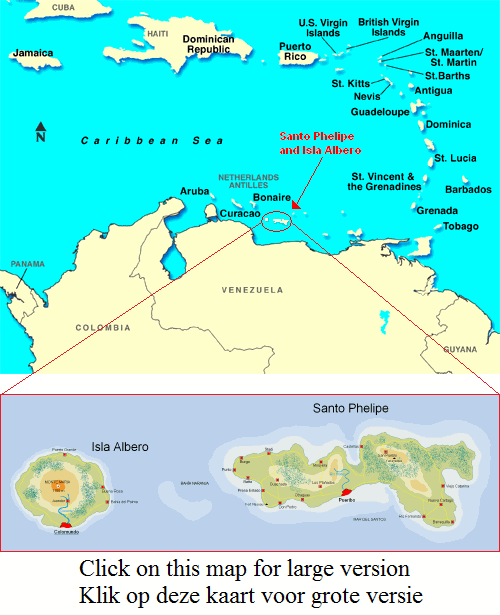 Population The majority of the population of Santo Phelipe is of mixed heritage. Because of the former slavery there are also many people of African origin and in many places there are still Native Americans (Caribs/Kalinago), the original inhabitants of Santo Phelipe. A minority of the population (6%) consists of Europeans: these are mainly Spanish, Dutch and Hiverians who remained in Santo Phelipe after the decolonisation. Culture Santo Phelipan culture is rooted in many different influences: Native Americans, Africans, Spaniards, Dutch and Hiverians have all left their traces on the islands. Not only in many customs, but also in the music and cuisine of Santo Phelipe. Furthermore, the city of Pueribo is known for her buzzing jazz scene. Besides carnival and most Catholic holidays, Día de la Independencia ("Independence Day") is celebrated on December 10, the day on which José Mendez declared the island of Isla Albero independent in 1960. In the former Dutch part of Santo Phelipe people also celebrate Sinterklaas on December 5. Religion The majority of the Santo Phelipans is Catholic, which was caused by the Spanish and (later) Hiverian domination. In the west of the island of Santo Phelipe, where the Dutch colony of Nieuw-Overijssel used to be situated, there is a Protestant minority. The other religions are Islam, Buddhism and nature religions. A small number of people is not religious. Languages The official language of Santo Phelipe is Spanish, which almost every citizen can speak. At home a small number of people speaks Dutch or French. Besides Spanish the most important language is Phelipés, which the majority of the population uses in daily life. Phelipés is a Creole language that looks a lot like Spanish. It also has many loanwords from African and Kalinago languages. Many place names on the islands are in Phelipés. Police and military In Santo Phelipe the police is a part of the military, just like the government and the courthouses. The Army of Santo Phelipe ("Ejército de Santo Phelipe") is large, but poorly trained and equipped. The air force has a small number of airplanes and helicopters and the navy has four small patrol ships. History of Santo Phelipe The pre-colonial period: The first inhabitants It is unknown when the first humans reached Santo Phelipe and Isla Albero, but the oldest inhabitants of the islands were the Arawak. Around the 15th century another people reached the islands: the Kalinago. They conquered most of the Arawak villages and soon both islands were under their control. The Kalinago were good warriors and ship builders. Unfortunately little is known about them, apart from a few Spanish sources. 16th century: The arrival of the Spanish In 1502 three Spanish ships appeared on the horizon; on board was the explorer Hernando Alvarez, who claimed both Santo Phelipe and Isla Albero in name of queen Isabella I. On both islands he founded trading posts, which would later grow into the cities of Pueribo and Colomundo. He also left a number of soldiers behind and convinced the Kalinago leaders to convert to Christianity. The expensive gifts he offered them for this probably outweighed their piety. Two years later Alvarez returned; as a reward for his good services he had been appointed governor of both islands. The locals, who had initially been impressed by these strange people and their funny inventions, began to grow wary of the Spanish: not only had they lost say over their land but many of them had also been enslaved to help build the new colonies. 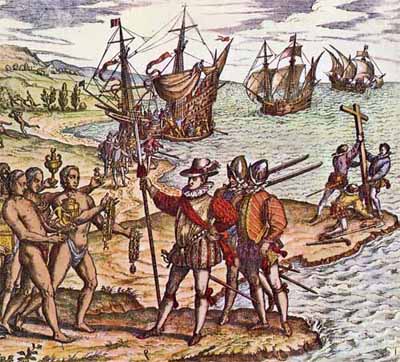 The arrival of Hernando Alvarez In 1511 things eventually went haywire: after Alvarez had ordered the death of a disobedient Kalinago leader, the natives rebelled against him. The small Spanish force was overrun and Colomundo went up in flames. Hernando Alvarez fell in the hands of the rebels; according to the "Crónica de Rebelión en Santo Phelipe" the following then happened: 'The savages put Alvarez in a cooking pot together with ten captured soldiers and ate them. From his skull they made a drinking cup.' Later research indicated that the cannibalism story had been made up and that Alvarez had died in a simple skirmish near Rio Fernando. The story of the noble explorer who was munched by savages had its effect though: reinforcements were sent under the new governor Santiago Lopez, who caused a massacre amongst the Kalinago and drove them into the jungle of Santo Phelipe. Here Yucayeque was located, the last bulwark of the Kalinago, which lay high up in the hills and looked over the jungle for miles. The Spanish victory Warawáo, a warlord of the Kalinago, managed to maintain himself in Yucayeque for decades. It took until 1573 before a Spanish host reached the bulwark and demanded the surrender of Yucayeque. Warawáo, who had succeeded in keeping the Spaniards out for a long time, realised that he could no longer win this fight and promised the Spaniards his submission. The last free Kalinago laid down their weapons and left the stronghold; most of them settled in the nearby village of San Pueblo, where their descendants still live today. 17th century: Dutch on Santo Phelipe During the 17th century the Eighty Years' War between Spain and the Netherlands was in full progress. In the Caribbean this was also noticeable and Dutch ships performed several attacks on the Spanish colonies there. In 1647 a small attack force of the Dutch West India Company (WIC) landed on Santo Phelipe and conquered the west coast of the island. After a few skirmishes the Treaty of Münster was signed in 1648, which ended the hostilities, including in those in the Caribbean: because of this, the west coast of Santo Phelipe became a Dutch colony while the rest remained Spanish. The border of the Dutch territory in that period lay somewhat parallel to the current highway between Stadi (Nieuwstad) and Don Pedro. The Dutch colony was called "Nieuw-Overijssel" and governed by the WIC. Along the coast a trading post named Batavia (nowadays Batta) was founded and in the south Fort Nassau was built, which had to serve as a bulwark against piracy. The governor of the new colony became Adriaan Janszoon van Roussellaere; under his leadership Nieuw-Overijssel grew into an important WIC base and multiple prosperous settlements emerged, amongst these were the current cities of Burgo (Dutch: Willemsburg) and Presa Estado (Dutch: Statendam). 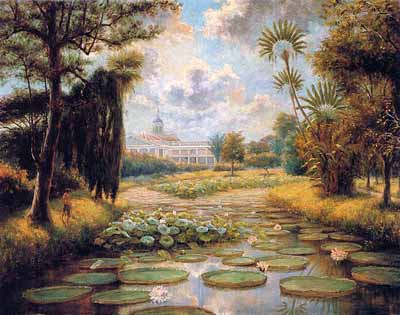 Hiverian plantation near Colomundo In the 17th century the Spanish might started to wane and the country was having financial problems. In 1668 Spain therefore decided to sell Isla Albero and Santo Phelipe to Hiveria, under protest of the native population and the Spanish colonists. The islands, with the exception of the Dutch colony Nieuw-Overijssel, got a new Hiverian governor. French was also made the official language, though Spanish remained the most important language on the islands and the place names remained largely unchanged. Hiveria founded sugar plants on the islands, where first Native Americans and later African slaves were put to work. The slave trade, which had already started under Spanish rule, also became an important occupation. Piracy Although the European homeland fully profited from the colonies, the poverty on the islands themselves was very high. Many Spanish and Hiverian colonists therefore started to conduct small scale piracy from hidden settlements in the jungle of Isla Albero. Escaped slaves also found refuge here. At the end of the 17th century Puerto Grande was founded, a notorious harbour from which pirates terrorised a large part of the Caribbean. Their leader, Pablo Devereux, was called "Halfleg" because he had lost his lower leg in a fight at sea. 18th century: The slave rebellion In the 18th century the islands had developed into transit ports for African slaves. Especially on the island of Santo Phelipe there were many slaves, who were usually badly treated. In 1712 this caused things to get out of hand: on the slave market of Pueribo a group of thirty slaves turned against its "owner" and killed him. Panic broke out and in the chaos almost two hundred slaves managed to escape. Tuamanguluka, a young, charismatic man from Western Africa, succeeded in convincing the slaves to attack the local barracks. The Hiverian colonial army had stored a large amount of weapons there, which all fell in the hands of the slaves. The soldiers, who had virtually surrendered without a fight, were shackled and put to work by Tuamanguluka, much to the amusement of the other escaped slaves. From the well defendable barracks the rebels organised plunder raids through the streets of Pueribo, in which many houses went up in flames and large numbers of slaves were freed. Within short time chaos had broken out in all of Pueribo and its inhabitants were at the mercy of the rebels. The end of the rebellion The remnants of the Pueriban garrison had suffered heavy losses in their attempts to restore order and retreated to the plundered building of the colonial administration, which governor Charles Dupont had fled to get reinforcements in Los Plañados and Otraguay. The day thereafter governor Dupont guided these reinforcements into the western part of the city and managed to break through to the administration building, which was being besieged by the rebels. The superior number of soldiers succeeded in driving off the crowd and relieved the Pueriban garrison. After this they set course to the barracks and recaptured it with the help of their cannons. Tuamanguluka was taken prisoner and hung at the Place du Roi François, but thanks to him hundreds of slaves had won their freedom: most of them escaped to the sparsely populated eastern part of Santo Phelipe, where the authorities could not retrieve them anymore. 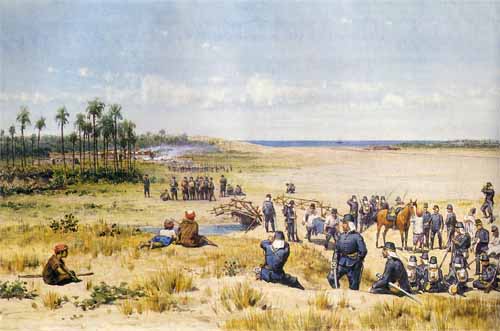 The Hiverian colonial army near Pueribo In 1750, the danger that the pirate bulwark of Puerto Grande posed to trade made the Netherlands and Hiveria decide to defeat the pirates with a combined fleet. They also wanted to conquer Puerto Grande. Along the north-eastern coast of Isla Albero they met the pirate fleet; it proved to be stronger than anticipated and in the following battle the Hiverian-Dutch fleet lost five ships. The "Étoile", "Incassable", "Westvrieslant" and "Trouwheijd" also suffered such damage that they had to retreat to the port of Colomundo. Six Portuguese warships, which happened to be nearby, came to aid and influenced the balance in disfavour of the pirates. The majority of the pirate fleet was sunk and Puerto Grande was shot ablaze. Although piracy continued from other places for a few decades more, the power of the pirate bulwark had been broken forever and ground forces of the Hiverian colonial army managed to take the city a week later. Power shifts The end of the 18th century is characterised by multiple power shifts: in 1794 for example, the Hiverian revolution broke out. The royalist governor Rochefort remained loyal to the old authority, but in August that year the death of the Hiverian king and the proclamation of the republic made him decide to lay down his function in favour of his successor governor Michèl, who was appointed by the new rulers. In 1792 the WIC ceased to exist and Nieuw-Overijssel was transferred to the Dutch authorities. Not long thereafter the European territory of the Netherlands was occupied by France, which made the British Empire decide in 1798 to temporarily seize control of the orphaned Dutch colony, if only to prevent that pro-French Hiveria would take it instead. In 1815 Nieuw-Overijssel was given back to the Dutch authorities again. 19th century: Volcanic eruption on Isla Albero The island of Isla Albero was formed by the 1100 meter (3,609 feet) high volcano Monte Maria, which is still active. In 1863 the Monte Maria erupted and Isla Albero had to be evacuated. Colomundo was largely spared but Juandor was almost levelled to the ground: 600 people lost their lives in this. Sea battle at Colomundo In 1881 the Fourth Frilandic-Hiverian War broke out between Friland and Hiveria. Although this war was mainly fought in distant Europe an incident occurred near Colomundo on June 6, 1881: Near the harbour the Frilandic ironclad "FS Anstarburg" got engaged in a battle with the "NRH Afrique". For two hours both ships bombarded eachother with cannon fire, until eventually the "Afrique" disappeared beneath the waves. The "Anstarburg" however, had suffered heavy damage to the screw propeller, which prevented a retreat. Captain Gaizberht Friþrikssun therefore decided to evacuate the ship and blow it up, so that it would not fall into enemy hands. The Frilandic captain and his sailors were picked up and would remain as prisoners on Isla Albero until the end of the war. Abolition of slavery At the end of the 19th century a discussion about the abolition of slavery was started in Hiveria. In the homeland this already caused some heated debates but in the colonies, where slavery played an even bigger role, the situation threatened to escalate even more. Here and there riots broke out and as a safety measure the slave trade was temporarily halted. Eventually president Jaquin decided to officially abolish slavery and the former slaves had to be released. 20th century: The end of Nieuw-Overijssel
On September 8, 1935 riots broke out in Willemsburg, Statendam and Batavia. Both governor Van Heemskercken and the Dutch government underestimated the problem, which allowed the revolt to spread. An entire week later it was decided to deploy the military, but it met such heavy resistance from the rebels that it had to retreat to Westpunt, where it would wait for reinforcements from Europe. However, on December 6, 1935 the cabinet-Colijn III decided that the poverty-stricken colony was not worth the effort and high cost of a military operation; Nieuw-Overijssel was sold to Hiveria with the motivation: "Why do it the hard way when you can simply sell it?" The Hiverians, who possessed a stronger colonial army, managed to quell the rebellion in a month. This took the lives of 21 soldiers and 260 civilians. Struggle for independence When after World War 2 an increasing number of European countries decided to give up their colonies, the Hiverian colonies also wanted their independence. The government in St. Gérard refused this, which caused uproar in both Colomundo and Pueribo. On December 10, 1960 José Mendez, a local politician, decided to unilaterally declare the island of Isla Albero independent. On Santo Phelipe this was prevented by a strong garrison of the Hiverian colonial army, which arrested and imprisoned every form of opposition. Yves Boutrebois, the president of Hiveria, sent reinforcements from the European homeland to retake Isla Albero and restore order. The operation was led by general Marc Quichet, who, just like president Boutrebois, was a real hardliner. After he had landed in Colomundo with his army, he arrested Mendez and ordered his troops to shoot at every house of which they suspected it harboured rebels. The massacre of Bahía del Palma After Colomundo had been brought back under control, the Hiverian soldiers moved northeast to take the rebellious villages of Buena Rosa and Bahía del Palma. When they were fired upon while entering Bahía del Palma, general Quichet decided to make an example by firing at the village with mortars and machine guns. Hereafter he ordered the houses to be burned down and a number of wells to be poisoned. The amount of innocent casualties that fell during this action, was enormous. Santo Phelipe independent
Civil war Less than a week after José Mendez had become president, he announced actions against the drug traffic on the islands. Figo Tarragona, who was known as the "cocaine king of Santo Phelipe", therefore ordered the assassination of Mendez: who died by a car bomb the day after. Both Tarragona and the communist party then tried to seize power, which caused unrest amongst many countries in the region. Especially the United States weren't enthusiastic about a government of drug lords or communists, so in secrecy the CIA supported a group of soldiers led by general Buenito Marcos. General Marcos conducted a coup and brought Colomundo, Pueribo, the western part of Santo Phelipe and the most important harbours under his control. However, the east of Santo Phelipe and the main part of Isla Albero remained in the hands of the communists and the militias of Tarragona. A civil war broke out that would last over a year and claim numerous civilian lives. It took until 1963 before both islands were fully under control of general Marcos and things started to settle down. 21st century: Dictatorship However, after the victory the junta was not planning to return power to the people and general Marcos proclaimed himself absolute sovereign over Santo Phelipe. The military dictatorship lasted until Marcos' death in 2003, after which his son Gonzalo Marcos wrote out elections. The joy about this was short-lived when it appeared that Gonzalo Marcos had won the elections with the incredible result of 100% of the votes. Marcos thanked the people for its trust, got rid of some political opponents just to be sure and proclaimed himself generalissimo for life. Because of this, Santo Phelipe is not unrightfully known as the biggest banana republic in the western hemisphere. Places in Santo Phelipe Many place names are in Spanish or Phelipés, the native language of Santo Phelipe. Some places also have a French name, which dates from the Hiverian period (1668-1961). Besides that there are many place names from the Dutch period (1647-1935) in the western part of Santo Phelipe. Isla Albero Bahía del Palma: the events in this little village played an important role in the independence war. Buena Rosa Colomundo (French: Colmonde): the capital of Santo Phelipe. Juandor: during an eruption of the Monte Maria in 1863 600 people lost there lives here. Puerto Grande: this place used to be a well-known pirate bulwark.
Banaquilla (French: Beaucité Nouveau) Batta (Dutch: Batavia) Castellas Don Pedro Guachada Los Plañados (French: Côtebourg) Mouyera Stadi (Dutch: Nieuwstad) Nueva Cartago Otraguay (French: Otrage) Pueribo (French: Françoisville): after Colomundo the largest city of Santo Phelipe. Rio Fernando San Pueblo Presa Estado (Dutch: Statendam) Viejo Catarina Punto (Dutch: Westpunt) Burgo (Dutch: Willemsburg) Terrain Mountains Monte Maria (1100 meters) Rivers Coriente Rio Brabu Other Bahía Naranja (Dutch: Oranjebaai) Mar del Santos Places of interest Fort Nassau: former Dutch fortress along the east coast of Santo Phelipe, nowadays opened to tourists. Monte Maria: active, 1100 meter (3,609 feet) high volcano on Isla Albero. Yucayeque: the ruins of the last Kalinago stronghold, where warlord Warawáo surrendered to the Spanish in 1573.  |