Aspirin
History
Aspirin
is a member of a family of chemicals called salicylates. One of the first and
most influential physicians, Hippocrates, wrote about a bitter powder extracted
from willow bark that could ease aches and pains and reduce fevers as long ago
as the fifth century B.C. In the 1700s, the scientist Reverend Edmund
Stone wrote about the success of the bark and the willow in the cure of the
"agues", or fevers with aches. With a bit of chemical detective
work, scientists found out that the part of willow bark that was (1) bitter and
(2) good for fever and pain is a chemical known as salicin. This
chemical can be converted (changed) by the body after it is eaten to another
chemical, salicylic acid. It was a pharmacist known as Leroux who
showed in 1829 that salicin is this active willow ingredient, and for many
years it, salicylic acid (made from salicin for the first time by Italian
chemist Piria), and close relatives were used at high doses to treat pain and
swelling in diseases like arthritis and to treat fever in illnesses like
influenza (flu).
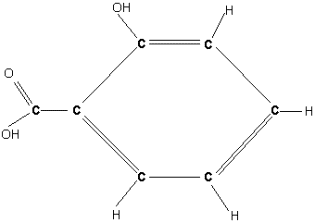
Salicylic Acid
Where
it is found
The
problem with these chemicals was that they upset the user's stomach fairly
badly. In fact, some people had bleeding in their digestive tracts from
the high doses of these chemicals needed to control pain and swelling.
One of these people was a German man named Hoffmann. His arthritis was pretty
bad, but he just couldn't "stomach" his salicylic acid. Enter this
man's son, German chemist Felix Hoffmann, who worked for a chemical company
known as Friedrich Bayer & Co. Felix wanted to find a chemical that
wouldn't be so hard on his dad's stomach lining; reasoning that salicylic acid
may be irritating because it is an acid, he put the compound through a couple
of chemical reactions that covered up one of the acidic parts with an ACETYL
group, converting it to acetylsalicylic acid (ASA). He found that ASA
not only could reduce fever and relieve pain and swelling, but he believed it
was better for the stomach and worked even better than salicylic acid.
The Enzyme Structure
The first 24 residues of COX-1 are a signal sequence. This domain is removed in the mature enzyme and will not be discussed here. Similarly , residues 25-32 do not yield interpretable electron density, and are not shown in the structure shown.
The remaining 551 residues of the enzyme (residues 33-583) comprise three distinct domains. The first of these, residues 33-72, form a small compact module that is similar to epidermal growth factor .
The second domain, composed of residues 73-116, forms a right-handed spiral of four alpha-helical segments along one side of the protein . . This domain of the protein forms a membrane-binding motif. The helical segments are amphipathic, with most of the hydrophobic residues (shown in green ) facing away from the protein, where they can interact with a lipid bilayer.
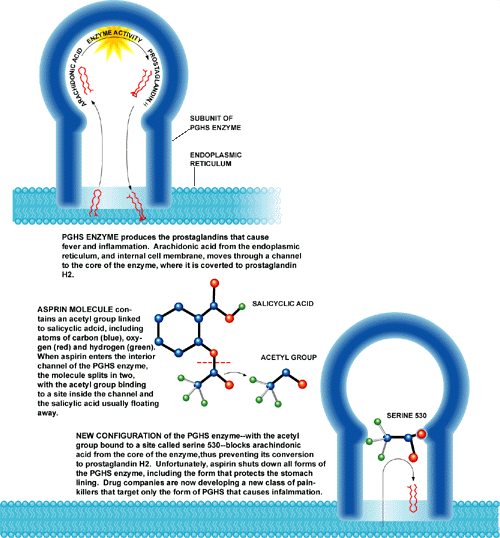
Turn off the hydrophobic residues and we will consider the third domain of the COX enzyme, the catalytic domain (in blue), a globular structure that contains both the cyclooxygenase and peroxidase active sites .
.
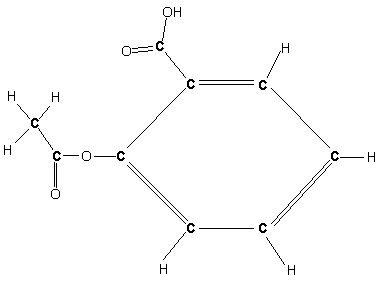
Acetylsalicylic Acid
Use and importance
Unfortunately, Hoffmann had to wait for fame. He finished his initial studies in 1897, and his employers didn't pay much attention to it because it was new and they were cautious and they didn't think it had been tested enough. By 1899, though, one of Bayer's top chemists, a scientist named Dreser, had finished demonstrating the usefulness of the potent new medicine and even gave it a new name: aspirin. It is believed the name comes from a plant relative of a rose that makes salicylic acid (several plants make this compound, not just the willow). The Bayer company could then support the tested medicine; they spread the word and marketed the new pill widely. Over the next hundred years, this medicine would fall in and out of favor, at least two new families of medicines would be derived from it, and thousands of research articles would be published about aspirin in the past 5 years alone! One of the most important pieces of research about aspirin came in the early 1970s, when a British scientist named John Vane and his colleagues showed how aspirin works (see below). His work was so important that he and his colleagues were awarded the Nobel Prize in Medicine in 1982. Dr. Vane was even made a British knight for his work!
3D model
|
|
References
http://www.heartinfo.com/news98/preeclamp31798.htm
http://cti.itc.virginia.edu/~cmg/Demo/pdb/cycox/cycox.html
http://www.howstuffworks.com/aspirin.htm
http://home.nycap.rr.com/useless/aspirin/aspirin.html
http://users.erols.com/blopatin/reference/aspirin/
http://cti.itc.virginia.edu/~cmg/Demo/pdb/cycox/cycox.html
http://www.sciam.com/1999/0599issue/0599working.html