"My command is this: Love each other as I have loved you. Greater love has no one than this, that one lay down his life for his friends."
John 15:12-13
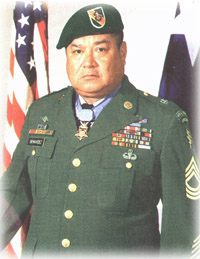
ROY P. BENAVIDEZ
Born: August 5, 1935 - Died: November 29, 1998
As the medivac chopper landed the wounded were examined one by one. Staff Sergeant Benavidez could only hear what was going on around him. He had over thirty seven puncture wounds. His intestines were exposed. He could not see as his eyes were caked in blood and unable to open. Neither could he speak, his jaw broken, clubbed by a North Vietnamese rifle. But he knew what was happening, and it was the scariest moment of his life, even more so than the earlier events of the day. He lay in a body bag, bathed in his own blood. Jerry Cottingham, a friend screamed "That's Benavidez. Get a doc". When the doctor arrived he placed his hand on Roy's chest to feel for a heartbeat. He pronounced him dead. The physician shook his head. "There's nothing I can do for him." As the doctor bent over to zip up the body bag. Benavidez did the only thing he could think of to let the doctor know that he was alive. He spit in the doctor's face. The surprised doctor reversed Roy's condition from dead to "He won't make it, but we'll try".
The 32-year-old son of a Texas sharecropper had just performed for six hours one of the most remarkable feats of the Vietnam War. Benavidez, part Yaqui Indian and part Mexican, was a seventh-grade dropout and an orphan who grew up taunted by the term "dumb Mexican." But, as Ronald Reagan noted, if the story of what he accomplished was made into a movie, no one would believe it really happened.
Roy Benavidez's ordeal began at Loc Ninh, a Green Beret outpost near the Cambodian border. It was 1:30 p.m., May 2, 1968. A chaplain was holding a prayer service around a jeep for the sergeant and several other soldiers. Suddenly, shouts rang out from a nearby short-wave radio. "Get us out of here!" someone screamed. "For God's sake, get us out!"
A 12-man team consisting of Sergeant First Class Leroy Wright, Staff Sergeant Lloyd "Frenchie" Mousseau, Specialist Four Brian O'Connor and nine Nung tribesmen monitoring enemy troop movements in the jungle had found itself surrounded by a North Vietnamese army battalion. With out orders, Benavidez volunteered so quickly that he didn't even bring his M-16 when he dashed for the helicopter preparing for a rescue attempt. The sole weapon he carried was a bowie knife on his belt. "I'm coming with you," he told the three crew members.
Airborne, they spotted the soldiers in a tight circle. A few hundred enemy troops surrounded them in the jungle, some within 25 yards of the Americans' position. The chopper dropped low, ran into withering fire and quickly retreated. Spotting a small clearing 75 yards away, Benavidez told the pilot, "Over there, over there."
The helicopter reached the clearing and hovered 10 feet off the ground. Benavidez made the sign of the cross, jumped out carrying a medic bag and began running the 75 yards towards the trapped men. Almost immediately, Benavidez was hit by an AK-47 slug in his right leg. He stumbled and fell, but got back up convincing himself that he'd only snagged a thorn bush and kept running to the brush pile where Wright's men lay. An exploding hand grenade knocked him down and ripped his face with shrapnel. He shouted prayers, got up again and staggered to the men.
Four of the soldiers were dead, the other eight wounded and pinned down in two groups. Benavidez bound their wounds, injected morphine and, ignoring NVA bullets and grenades, passed around ammunition that he had taken from several bodies and armed himself with an AK. Then Benavidez directed air strikes and called for the Huey helicopter to a landing near one group. While calling in support he was shot again in the right thigh, his second gunshot wound. He dragged the dead and wounded aboard. The chopper lifted a few feet off the ground and moved toward the second group, with Benavidez running beneath it, firing a rifle he had picked up. He spotted the body of the team leader Sergeant First Class Wright. Ordering the other soldiers to crawl toward the chopper, he retrieved a pouch dangling from the dead man's neck; in the pouch were classified papers with radio codes and call signs. As he shoved the papers into his shirt, a bullet struck his stomach and a grenade shattered his back. The helicopter, barely off the ground, suddenly crashed, its pilot shot dead.
Coughing blood, Benavidez made his way to the Huey and pulled the wounded from the wreckage, forming a small perimeter. As he passed out ammunition taken from the dead, the air support he had earlier radioed for arrived. Jets and helicopter gunships strafed threatening enemy soldiers while Benavidez tended the wounded. "Are you hurt bad, Sarge?" one soldier asked. "Hell, no," said Benavidez, about to collapse from blood loss. "I've been hit so many times I don't give a damn no more."
While mortar shells burst everywhere, Benavidez called in Phantoms "danger close". Enemy fire raked the perimeter. Several of the wounded were hit again, including Benavidez. By this time he had blood streaming down his face, blinding him. Still he called in air strikes, adjusting their targets by sound. Several times, pilots thought he was dead, but then his voice would come back on the radio, calling for closer strikes. Throughout the fighting, Benavidez, a devout Catholic, made the sign of the cross so many times, his arms were "were going like an airplane prop". But he never gave into fear.
Finally, a helicopter landed. "Pray and move out," Benavidez told the men as he helped each one aboard. As he carried a seriously wounded Frenchie Mousseau over his shoulder a fallen NVA soldier stood up, swung his rifle and clubbed Benavidez in the head. Benavidez fell, rolled over and got up just as the soldier lunged forward with his bayonet. Benavidez grabbed it, slashing his right hand, and pulled his attacker toward him. With his left hand, he drew his own bowie knife and stabbed the NVA but not before the bayonet poked completely through his left forearm. As Benavidez dragged Mousseau to the chopper, he saw two more NVA materialize out of the jungle. He snatched a fallen AK-47 rifle and shot both. Benavidez made one more trip to the clearing and came back with a Vietnamese interpreter. Only then did the sergeant let the others pull him aboard the helicopter.
Blood dripped from the door as the chopper lumbered into the air. Benavidez was holding in his intestines with his hand. Bleeding almost into unconsciousness, Benavidez lay against the badly wounded Mousseau and held his hand. Just before they landed at the Medivac hospital, "I felt his fingers dig into my palm," Benavidez recalled, "his arm twitching and jumping as if electric current was pouring through his body into mine" At Loc Ninh, Benavidez was so immobile they placed him with the dead. Even after he spit in the doctor's face and was taken from the body bag, Benavidez was considered a goner.
Benavidez spent almost a year in hospitals to recover from his injuries. He had seven major gunshot wounds, twenty-eight shrapnel holes and both arms had been slashed by a bayonet. Benavidez had shrapnel in his head, scalp, shoulder, buttocks, feet, and legs. His right lung was destroyed. He had injuries to his mouth and back of his head from being clubbed with a rifle butt. One of the AK-47 bullets had entered his back exiting just beneath his heart. He had won the battle and lived. When told his one man battle was awesome and extraordinary, Benavidez replied: "No, that's duty."
Wright and Mousseau were each awarded the Distinguish Service Cross posthumously. Although Master Sergeant Benavidez's commander felt that he deserved the Congressional Medal of Honor for his valor in saving eight lives, he put Roy in for the Distinguished Service Cross. The process for awarding a Medal of Honor would have taken much longer, and he was sure Benavidez would die before he got it. The recommendation for the Distinguish Service Cross was rushed through approval channels and Master Sergeant Benavidez was presented the award by General William C. Westmoreland while he was recovering from his wounds at Fort Sam Houston's Hospital.
Years later, his former commander learned that Benavidez had survived the war. The officer also learned more details of the sergeant's mission and concluded that Benavidez merited a higher honor. Years of red tape followed until finally on February 24, 1981, President Reagan told White House reporters "you are going to hear something you would not believe if it were a script." Reagan then read Roy Benavidez's Citation for the Medal of Honor.
Benavidez however, did not regard himself as a hero. He said of his actions. "The real heroes are the ones who gave their lives for their country, I don't like to be called a hero. I just did what I was trained to do."
In addition to being a recipient of the Medal Of Honor, MSG Benavidez was the recipient of the Combat Infantry Badge for his Viet Nam war service, the Purple Heart Medal with 4 Oak Leaf Clusters, Viet Nam Campaign Medal with 4 Battle Stars, Viet Nam Service Medal, Air Medal, Master Parachutist Badge, Vietnamese Parachutist Badge, Republic of Viet Nam Cross of Gallantry with Palm, and other numerous decorations.
Upon retirement Master Sergeant Benavidez lived in El Campo, Texas, with his wife, Lala, and three children, Noel, Yvette and Denise. He was a member of the: Medal of Honor Society, Legion of Valor, Veterans of Foreign War, Special Operations Association, Alamo Silver Wings Airborne Association, and Special Forces Association, The 82nd Airborne Association, West Point Honorary Alumni Association, and countless other organizations.
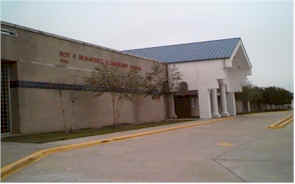
Roy P. Benavidez
Elementary School
Houston, Texas
Master Sergeant Roy Benavidez died on November 29, 1998. Over 1,500 people attended his funeral to say goodbye. He is buried in the shade of a live oak tree at the Fort Sam Houston National Cemetery, a fitting final resting place for someone who gave so much of himself to this great nation. In addition to his heroic actions in combat, he will also be remembered for his work with youths. He spoke at schools and colleges and even runaway shelters. He promoted patriotism, staying-in school, encouraged continuing education, and drug free programs for students. Vision Quest, an organization known for working with problem youths, named a youth boot camp Fort Roy P. Benavidez in Uvalde, Texas after him. Master Sergeant Benavidez was further recognized by the naming of the Roy P. Benavidez Elementary School in Houston, Texas.
In August 1999, the U.S. Army dedicated the $14 million Master Sergeant Roy P. Benavidez Special Operations Logistics Complex at Fort Bragg, NC.
On September 14, 2000, the U.S. Navy Secretary Richard Danzig announced that the U.S. Navy plans to name a new ship after Master Sergeant Roy P. Benavidez. The ship, scheduled to be christened next summer as the USNS Benavidez, will be the seventh in a class of large, medium speed roll-on/roll-off sealift ships. Army Secretary Louis Caldera made these remarks on the Navy's announcement:
"Master Sergeant Roy Benavidez was a true American hero, rising from humble origins in South Texas to become an Army legend. Wounded over 40 times as he saved the lives of eight fellow soldiers under heavy fire in Vietnam, he always said he was only doing his duty to his fellow soldiers and to the country he loved. The Navy's recognition of his selfless service is truly an appropriate tribute to Master Sgt. Benavidez's memory, and to the ideals of our nation that he epitomized."
If you would like to read more about Master Sergeant Roy Benavidez's life, before, during and after the Vietnam War, then I recommend that you read his book co-authored with John R. Craig, "Medal of Honor - A Vietnam Warrior's Story" (Brassey's, Inc, 1995).