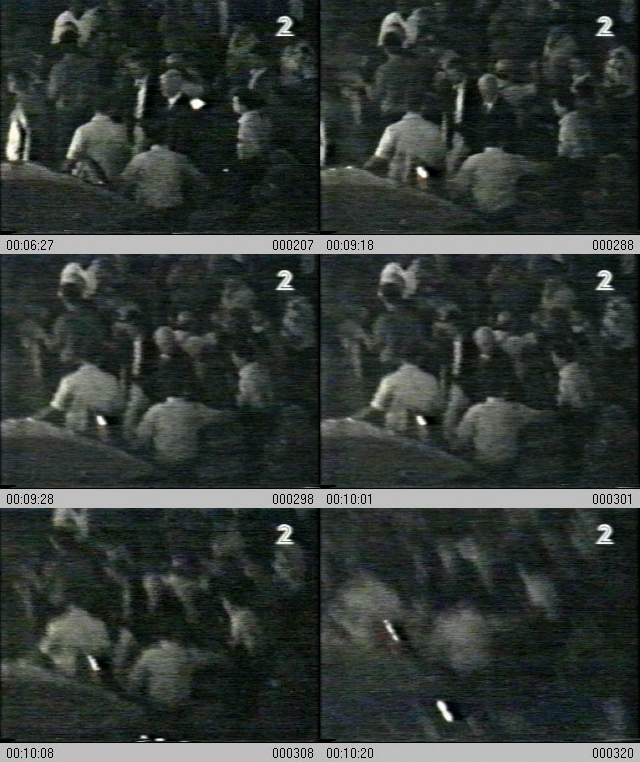
The Kempler video
Amir's lawyer said he had received a letter from a lady who maintained that the man who was said to have videoed the murder (Ronnie Kempler, appearing on TV) wasn't the same man who appeared in court. As wild as the woman's accusation sounds, the fact is that Kempler seemed to be a last minute replacement for another "filmmaker." Indeed, when the amateur film was first announced, the name of the filmmaker released to the media was not that of Kempler, but of a Polish tourist with a lengthy unpronounceable, long forgotten name. Ronnie Kempler�s case, a man who worked for the State Comptroller and who himself was a reservist in the security service, wasn�t furthered when it was revealed that he lived in the same block of flats as Danny Yatom, then the director of the Prime Minister office. Not long after, prime minister Shimon Peres appointed Yatom as director of the Mossad! Yatom subsequently resigned under the Netanyahu administration, following the botched operation in Amman, known as the �Mishal affair�.
Kempler made only a brief TV appearance on Rafi Reshef's 5 o'clock actualia program in January 1996 before disappearing from the limelight.
Reshef: Why did you wait so long to release the film to the public?
Kempler: A few reasons. I didn�t want to be known. Also, I thought it was forbidden to show the film so soon after the murder. The public needed time to digest it as a historic film...But after the Shamgar Commission got it, I kept hearing on the street that I�m the sucker of the country. That really aggravated me, so I got a lawyer and decided to make some money selling it.
Reshef: Did anyone observe you filming?
Kempler: Yes, the bodyguard... I�m sure I saw (singer) Aviv Gefen look right into my camera.
Reshef: Why did you concentrate so much of the film on the killer?
Kempler: I felt there was something suspicious about him. I let my imagination run away with me and felt murder in the air. It wasn�t so strong when Peres was there but when Rabin appeared, �wow.�
Reshef: There has been much speculation why you happened to be the only one in the right place to film the assassination. How do you explain it?
Kempler: I felt someone caused me to be in that place.
Reshef: What, are you a fatalist?
Kempler: When I stood on the balcony, I spent a lot of time in the dark and to my regret, my imagination began to work overtime. I begin to imagine many things, even God forbid, a political assassination... I have no explanation why I had this feeling. I�m not sure it wasn�t something mystic.
Reshef: Did anyone try to interfere with you?
Kempler: There were undercover officers around. One told me it was alright to film but I had to stop when Rabin appeared. An undercover policeman came up to me and asked me a few questions and asked to see my ID. I showed it to him and he walked away. He stopped, turned back and shouted, �What did you say your name was?� I shouted it back. He said,�Good.� And that was that. The police had all the details of my identity.
By the time Kempler was called to testify at Amir's trial, his story about the
undercover agent had changed. Someone or perhaps more than one thought that
Kempler�s explanation to Reshef about why he was permitted to film in such a
sensitive security location was too weak, so he painted a new, tougher picture.
Kempler: There was an undercover cop who told me not to film. I told him he has no right to tell me not to film. I asked him if something secret was going on? I told him again he has no right to tell me not to film. And if he does it again, I would take down his particulars and issue a complaint to the police.
Asked by the defence if the video he recalls to have filmed and the one showed on TV are one and the same, Kempler hesitated and said that it "contained no changes or alterations." By the end, he had to admit thouth, that "There are gaps and there are differences."
Defence: We don�t hear everything in the film but we hear lots, including shouts. So why don�t we hear the shouts of "They�re blanks."
Kempler: Don�t ask me. I�m not the address.
Defence: Yoram Rubin testified that he fell on Rabin, why don�t we see that in the film?
Kempler: I�m not a video or camera expert. I�m not the address for questions like that.
A few years later, on 19 November, 1999 he gave a rare interview to Uriya Shavit in Ha'aretz newspaper in which he basically repeated his story told on TV.
Roni Kempler, the amateur photographer who filmed the Rabin assassination with a video camera lent to him by a friend, has another chilling videotape in his possession. He keeps it at home, alongside stacks of other videotapes recording public events and family occasions. The videotape shows Yitzhak Rabin appearing at Kikar Malkhei Yisrael (now Kikar Rabin) for Armored Corps Day on October 12, 1995. At the time, journalists asked Rabin if he feared an attack by someone from the extreme right. "I feel fine and secure, even when there are negative things going on. I went through enough during my military service so as not to be afraid of such things," replied the prime minister. In the same place, just 23 days later, he was murdered. Kempler's Armored Corps Day videotape demonstrates that there was much reason for concern. He was able to film Rabin then from a distance of just a few meters. The tape shows the prime minister surrounded by journalists; the security around him looks spotty - perhaps even more spotty than it was on the night of November 4.
Kempler, tall and unknown to the security forces, stood right near Rabin and no one made any attempt to keep him away. His camera was practically touching the prime minister. His lens captured Rabin's flushed, alert face. Kempler kept the lens trained on Rabin until the prime minister turned around so that his back was to the camera.
Today, when Kempler views this tape in the living room of his north Tel Aviv home, he is filled with a tempest of emotions, though he is unwilling to elaborate on them. Four years after the murder, Kempler, who works in the civil service as an auditor, is extremely wary. Choosing his words carefully, he seems to want to use the October 1995 tape to convey a vivid and distinct message - a message focused on repudiating the charges of conspiracy. It's as if each successive frame flickering across the screen is proclaiming, "Just look at the incredible sloppiness and neglect that prevailed here!"
Last Sunday, as Kempler tuned in to Razi Barkai's "One on One" show on Channel One, he couldn't believe his ears. MK Dalia Rabin-Pelossof sat across the table from retired Supreme Court president Aharon Shamgar, who headed the commission that investigated the lapses in security leading to her father's assassination, and she posed a series of "open questions" regarding the murder. When the host asked her to talk about the conspiracy theory, she mentioned Roni Kempler's name. "There is no marked-off or sterile area and they don't check the roof," she said. "And, suddenly, this Kempler can film from the roof. Where did he come from?"
Dalia Rabin's comments, particularly the insinuation contained in that question, thrust Kempler back into a state of distress he thought he had put behind him. Kempler's videotape of the assassination was broadcast on December 19, 1995, after he had sold the rights to it to Channel Two News and Yedioth Ahronoth. In the weeks following the broadcast, the formerly anonymous, then 37-year-old Kempler became a hot gossip item. Immediately after the broadcast, totally baseless rumors began to surface, hypothesizing that Kempler was probably some kind of secret agent, possibly working for the Shin Bet. His decision to sell the videotape for money also drew criticism from some quarters.
For weeks, Kempler was subjected to harassment and threats. He subsequently decided to maintain absolute silence on the issue, steadfastly turning down dozens of offers from the media. This silence only fueled the imaginations of the conspiracy theorists, spurring them to claim that Kempler had "been made to disappear from Israel." Though utterly untrue, this presumption made it easier for him to carry on with his normal life.
Kempler feels that Dalia Rabin's recent words constitute a serious offense to him. Her statements, he says, cast suspicion on him by implying that he had some kind of connection to the assassination; they may even have put him in danger. Disturbed as he is by the situation, he agreed to break his silence and, for the first time, to allow a journalist to visit him at his home.
It's not my job to disprove theories"Dalia Rabin hurt me," he says. "I don't want to say what I think about her and about her motives. True, my story is peculiar, but I'm a regular citizen who was caught up in a dramatic and tragic situation, and most of my activity after the fact was aimed above all at helping the authorities and the courts to uncover the truth. I was hurt by the way she referred to me as 'this Kempler,' by her contemptuous attitude. And also by the fact that she plainly cast suspicion on me in the eyes of the public - as if I'm part of the conspiracy theory, even though she reiterated several times that she doesn't believe in it."
Kempler hastened to send Rabin a personal letter in which he asked her to issue a correction to her statements. "I was quite astonished to hear what you said yesterday..." he wrote. "It ought to have been clear to you that these questions were thoroughly examined by the government commission of inquiry, and I presume that you could obtain the detailed minutes of the commission, as well as of my cross-examination at the trial of the killer, Yigal Amir. The main thing that disturbed me was the scornful tone of your words, which, to me, border on incitement, and I was especially pained to hear this coming from you, of all people."
Why haven't you come out before now to refute the 'conspiracy theory'?
"First of all, I think the theory is wholly imaginary. It's true that there are things that are hard to understand, but it's still a long way from there to a conspiracy. I don't think that it's my job to refute conspiracy theories."
Have you ever met with Dalia Rabin?
"The day before the videotape was shown on television, I was supposed to meet with Dalia Rabin and Yuval Rabin at the office of attorney Dov Weisglass. They said that they wanted a meeting and they didn't give any reason why. A short time before the meeting was due to take place, they sent word that the meeting was canceled - without giving any explanation."
Dalia Rabin does not believe that she did anything wrong when she referred to Kempler as an "open question," and she was surprised to hear that what she said had caused any problem. "It's nothing new," she emphasizes. "I've been asking all of these questions for three years already."
But the Shamgar Commission report doesn't leave any room for speculation about Kempler.
"In my opinion, the story of Roni Kempler has not yet found a definitive answer. The story that someone went up on the roof and filmed the entire series of events does seem odd."
Do you harbor some doubt that Kempler's filming of the assassination was thoroughly innocent?
"I don't know. How would I know?"
Why did you refer to him as 'this Kempler?'
"It was a kind of referral to the fact that another person went up there on the roof. I have nothing against Roni Kempler. I wasn't aware that he had been threatened in the past and I don't wish to harm him. All I want to do is to pose questions."
Zik has his sourcesDalia Rabin isn't the first to raise questions about Roni Kempler. For the past four years, he has been a favorite subject for the "investigations" of conspiracy theory devotees. Arutz Sheva broadcaster Adir Zik has been the most persistent in stirring up suspicions against him. Many people feel that Zik was a major inciter against Yitzhak Rabin in the months preceding his murder. Zik still broadcasts a "personal program" on the right-wing pirate radio station each Friday at 9 A.M. He continues to reiterate his claim that Roni Kempler is a Shin Bet agent who recorded the murder at the behest of the Shin Bet and that the Shin Bet smuggled him out of Israel following the publication of the videotape. He is convinced that Kempler is the one "little mistake" that the Shin Bet made in the otherwise perfect crime it concocted. Like other conspiracy theorists, Zik also tried to contact Roni Kempler by telephone. Kempler hung up on him.
Zik laid out his "suspicions" about Zik in an article entitled "Shampanya, Yayin Nesekh" ("Champagne, Heathen Wine") that was featured prominently in the NRP-affiliated Hatzofeh newspaper in November 1997. Until the most recent developments, Zik's article - which provoked an avalanche of harsh responses - constituted the most conspicuous penetration of the conspiracy theory into the mainstream media. In the article, Zik posed "58 questions" in connection with the Rabin assassination. Most had to do with Shin Bet undercover agent Avishai Raviv (whose code name was "Champagne"). But Roni Kempler also merited prominent mention in the questions relating directly to the night of the murder:
"Question # 36: Why did Roni Kempler, who had just received a new video camera as a gift, film the dark, rear section of the rally 'in order to check the camera' rather than the well-lit stage? Who is the 'friend' who gave him the camera?
"Question # 37: Why did he [Kempler] keep returning to focusing on a shadowy and unimportant figure (Yigal Amir) who was sitting there?
"Question # 38: Why didn't he immediately publicize the fact that he possessed a film of the murder? Why did he wait a number of weeks before publicizing this? Was the film [first] checked by the Shin Bet? Is Roni Kempler also a Shin Bet agent?
"Kempler is a Shin Bet agent. The Shin Bet hid him somewhere abroad after the murder and later brought him back to Israel."
So Zik continues to maintain to this day. "Now they come and try and refute us by saying, 'Those idiots - they claimed that he wasn't in Israel and look - he is in Israel.' But the truth is that he was smuggled out of Israel and then brought back - because, after all, how much could they punish the guy?"
When asked if he has any proof to back up his assertions, Zik replies that he cannot reveal his sources. "We followed Kempler," he avers, and now "I'm putting myself in danger and risking my life. I'm fighting against the system. I'm sure they're listening to us right now, too." He was not surprised to hear Dalia Rabin's comments. "I've known for some time that Dalia Rabin has questions. This process proves that the members of the Rabin family are smart people."
You have no problem with the fact that your broadcasts put Roni Kempler's life in danger?
"I'm putting him in danger? He is a Shin Bet agent. He is endangering me. This man is no innocent saint. If someone is a thief, shouldn't that be revealed?"
It's important to emphasize that Zik does not represent the position of Arutz Sheva. But even he feels that the conspiracy theory has not garnered the wide acceptance it deserves. "I think that, among the Haredi public, 80 percent think that I'm right, but the closer they get to the NRP, the less they believe me. These are people who were born with a genetic brain defect," he says.
Nonetheless, there are those who continue to permit Zik to sow these seeds of doubt. "I don't believe that there's anything to it," says Arutz Sheva news division chief Hagai Segal. "I tend to accept the simplest explanation: the guy was just there and he was filming. But I respect Adir for his activism on this issue. Who knows? Maybe in the end it will turn out that I'm wrong and Adir is right."
Simple answersWhy does Kempler inspire speculation, even among those who would not count themselves as conspiracy theory advocates? Perhaps it has something to do with the combination of the situation he was sucked into and his introverted personality. At the conclusion of the rally in Kikar Malkhei Yisrael, Kempler went up on the roof of Gan Ha'Ir and focused his camera on what was soon to be the murder scene - the exit from the municipal building parking lot onto Ibn Gvirol Street. There was no apparent logical reason for Kempler to have directed his camera precisely at that spot. After the videotape was broadcast, Kempler did not help to dispel the shadowy conjectures regarding him when, in an interview with Yedioth Ahronoth, he said that he felt that "an inner voice" propelled him to keep filming what has happening in the parking lot. Today, four years later, he says that he no longer feels that the hand of fate was there to guide him.
Then as now, Kempler remains quiet and reclusive, an anti-hero straight out of central casting. "I said all that I had to tell: I was cross-examined at the killer's trial. I answered the people who were interested, even on the street," he says. "As far as I'm concerned, I've had it. It's enough. It's all documented and what's important are the things that I said then, not what's being said [about me] today."
All in all, five questions can be raised about Kempler's recording of Rabin's murder. He provides perfectly reasonable answers to all of them.
1. Why did Roni Kempler go up on the roof of Gan Ha'Ir with his camera at the end of the rally?
Kempler was, and still is, an amateur photographer, who often videotaped family occasions as well as public events - not necessarily political ones. When he comes to an event with his camera, he doesn't film in a particularly selective manner. He filmed Rabin at a series of events prior to November 4. On November 4, he filmed the entire rally; at the end, he went to the parking lot and waited there to get a shot of Rabin and the rest of the VIPs. When he saw that the crowd was too big to allow him to film, he went up onto the roof of Gan Ha'Ir and filmed from there.
2. Why wasn't Kempler evicted from the roof before Rabin descended the stage, and why was he allowed to keep filming?
Kempler wasn't the only one who was not evicted from the roof of Gan Ha'Ir. Other people were standing there as well. He was able to stand there and film due to the general security breakdown. In the Shamgar Commission's report, in the section relating to "issues that did not have a direct impact on the development of the event," it says: "The security guard on the roof of Gan Ha'Ir - who was stationed there just before the prime minister descended the stage - did not try to remove the crowd that had gathered there, but just to make them stand back at a further distance: Given the length of the roof and the lack of lighting on it, there could not have been efficient supervision of all the people there."
3. Why did Kempler focus on Yigal Amir in his filming?
Kempler previously claimed that Amir's figure particularly stood out on the sidewalk next to the parking lot. At Yigal Amir's trial, in response to a similar question put to him by Amir's defense attorney, Kempler said it was because "I tried to think who among the people that I was seeing might be involved in something. For some reason, he (Amir) caught my eye. Something about him seemed odd."
Furthermore, the impression that Kempler "specially focused" on Yigal Amir derives in part from the fact that, in most broadcasts of the videotape, only a few minutes of the tape he shot of the rally are shown. The original videotape is more than an hour in length and Yigal Amir appears in it only briefly.
4. Why did more than a month pass between the time of the murder and the sale of rights to televise the tape?
Kempler wanted to give the videotape to the commission of inquiry that would inevitably be established to investigate the events surrounding the assassination before selling the broadcast rights to it, and this is what he did. After the commission of inquiry asked the public to present it with any documentary material about the assassination, Kempler sent the commission a letter by registered mail describing the videotape in his possession. His cooperation with the Shamgar Commission earned him an official letter of thanks.
Today, Kempler says that the commission of inquiry "left no stone unturned" in its investigation. When asked if he sees any basis for a new investigation, he replies: "I don't believe so, because I trust the Shamgar Commission 100 percent. I'm not the authority to determine whether there are grounds to open the investigation anew. I'm aware that people see the videotape recording the murder and everyone has his own interpretation. Photographic evidence is subjective. Personally and subjectively, what bothers me is the part with Yigal Amir, where he's standing there for such a long time near the bush and no one bothers him at all. It shocks me."
5. So why did Roni Kempler "disappear"?
He didn't disappear. True, his phone number is unlisted and he doesn't live in the apartment that is registered in his name, but he never left home, his family doesn't hesitate to speak about him, his phone number at work is listed; He's only been abroad twice in the past four years.
I got to see Julie AndrewsText: According to prevailing estimates in the press four years ago, Yedioth Ahronoth and Channel Two paid Kempler approximately $350,000 for the rights to his videotape, and agreed to give him 50 percent of the royalties from the sale of the tape to foreign television stations. In return, he turned over the tape to them without keeping an original copy for himself. In addition, he signed an exclusive contract with Yedioth and Channel Two, stipulating that he would not talk to any other media about topics directly related to the videotape. On the night the tape was aired, 82.5 percent of all television viewers watched Channel Two news.
Shalom Kital, director-general of Hevrat Hahadashot, says that dozens of foreign stations purchased rights to air the videotape. For reasons of business confidentiality, he cannot specify the amount of money generated by sales of the tape, but estimates have it that these sales to foreign stations more than covered the cost of the initial investment - that, in fact, they brought in hundreds of thousands of dollars in profits. The Italian public television station RAI 3 reportedly paid $110,000 dollars for exclusive rights to air the videotape in Italy. Television stations in Germany, Spain, Holland, France, England and Japan reportedly paid similar amounts to acquire broadcast rights to the videotape. If these reports are even partially true, Kempler's profits from the sales of broadcast rights to the videotape amounts to about NIS 1 million after taxes.
With the perspective of four years, Kital has no doubt that he made the right decision in purchasing the tape. "We're talking about shocking historical material. I think that, from the moment it was recorded, it had to be brought to the public's knowledge," he says, adding: "A man came with a tape and asked for money. Our policy is not to buy documentation, but there's an exception to every rule. I didn't judge this by the usual standards."
Kempler also has no second thoughts. "Do you know anyone who has regretted getting money - and when it was all done legally?" he asks. "I think that I acted properly. The result was that I also had more control as to how the videotape was treated."
Has the money led to a big change in your life?
"Not big. Here and there I allowed myself some more luxuries."
Can you give me an example of what you were able to permit yourself?
"The experience I remember best and that thrilled me the most was when I saw Julie Andrews starring in the musical 'Victor Victoria' on Broadway in New York. I sat in one of the first rows and I saw her from up close. It was a tremendous experience to sit so close to the stage. Four years ago, I never would have dreamed of buying a ticket in the front rows. Andrews radiates so much grace and gives her all to the audience. It was incredible to see how wild the audience in America went. I've never seen any Israeli actor or actress get so much applause."
What else?
"I went on an organized tour of Spain with a terrific guide and stayed in a classy hotel. I was very excited by the Prado Museum. I saw the 'Las Maninas' - something that every photographer must see. There was another picture there that made me cry, but I'm keeping that one to myself."
Have you had any interesting encounters?
"I got to meet the widow of an Israeli photographer who took tremendous, historic pictures. She was very excited when I told her that I was the photographer who filmed the Rabin assassination. She showed me her husband's extensive collection and if I would have had the nerve, I would have gotten up and kissed her."
Can you explain why you love photography so much?
"That's a hard question for me to answer. Better to ask a psychologist. When I'm filming, I feel like I'm painting. The camera is like a paintbrush, but it's much more complex than that. What I can say is that when I do go to film - and there are dead periods and busy periods - I get good pictures. It comes to me easily. I simply find [what I'm going to film]; I don't go looking for it. Sometimes, certain photographers are standing next to me - standing there waiting for something to shoot - while I'm clicking away and amazed at how they can stand there stuck and not see what's right before their eyes."
What's the most recent event that you've filmed?
"The Love Parade. It was a very lively event. People don't recognize me anymore. And if they do recognize me, they respect my desire for privacy."
Have you been filming less since the Rabin assassination?
"After the murder, I couldn't film anything for about two months. I couldn't hold a camera in my hand. Later, I bought a video camera for the first time. Since then, I've started to film a lot more. Today, I'm pleased to see lots of amateur video camera enthusiasts filming alongside me. In some way, I feel like I contributed a little bit to that. After the assassination, in many video stores, they told me that demand for video cameras was up thanks to me. If that's true, then I'm happy.
The above article was a "necessity". After about four years of silence, it was necessary to interview Kempler again and remind the public of his innocence. OF course how simple and logical his explanations are can be gauged by anyone. Kempler of course could have remained enwrapped in his anonymity for ever after but circumstances forced him to be exposed again. Few people realize what purpose articles that come 'out of the blue' fulfill in terms of shaping or biasing public opinion. This time the emergency was caused by journalist and broadcaster Adir Zik who maintained a concentrated campain to unearth the truth behind the Rabin murder. It was necessary to 'reply' to the public the Kempler version of events. Dalia Philosoph calling him 'that man' was obviously an excuse. Above all, it was necessary to reinforce the perception that Kempler was an amateur photographer and as such, tried to gain financial profit from his good fortune of being in the right place, at the right time.
Let's recall that despite the fact that a police video camera crew was in place on the night, it is Ronnie Kempler's amateur video that became famous. Unknowingly, Kempler runs into a blind alley with his story. He maintains that he had given his details to the security man, that the police saw him filming and knew his identity. If so why didn�t they call that night, immediately after the murder, to get the film? Surely they, unlike Kempler, did realize what kind of evidence was in the possession of this amateur film maker. Apparently, contrary to Kempler's story, they did call.
Another witness testifies to that. Far from waiting a month, the video was apparently in the hands of the security forces within days of the event - if not earlier. Barry Chamish interviewed the source:
"The caller was in her late twenties. She had read the Hebrew website and ordered my books and video. When they arrived, she called to thank me and added:
'I have some personal experience that drew me to your site.''What experience?'
'In 1995 I was a new recruit in Galei Tzahal [Army Radio station]. Part of our training was news analysis. It wasn't even a week after Rabin's murder that we were shown the murder film in class.'
'You mean it was in the army's hands within a week? Why did they show it to you?'
'I don't think they knew how incriminating it was. But I saw that the whole thing smelled. Most of us did. I never forgot how obvious it was that Amir was let in.'
'So you saw the film before it was edited for tv?'
"I guess so, but I won't be able to tell you what they cut. We saw it without knowing what to look for.'
It would be safe to assume that the showing of the film in a closed, controlled environment served several purposes. First, it had to be a dry run during the presumed deliberation of whether to screen it on TV to the wider public. Second, it was a comments and reaction gathering. By screening it to budding news analysts and journalists, the operators could gather comments of what they made of it, an exercise which served as a testing bed and a microcosm of reactions expected from the public at large. It was probably after gathering the various class reactions that it what decided what incriminating frames should be removed from the video.
Kempler had since shied away from the media and sank again into anonymity. If the need will arise again, we weill no doubt read another interview with him, or watch another rare TV appearance 'out of the blue'.
*
Below are the digitized frames from the Kempler video, up to the moment the picture becomes blurred by the movement of his hands. ("Why did you stop shooting at that point?" "Because I've seen enough", he replied. Some amateur cameraman!). The frame are shown in batches of three, from the gun flash, through Rabin turning his head to the left, to the point of blurring. As explained elsewhere, the timer on the left has no correlation to real time, it is a reference timer generated by the digitizing software.
IF YOU HAVE ANY
INFO PLEASE
SEND YOUR COMMENTS
