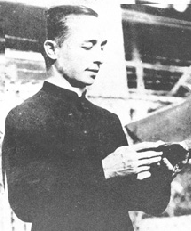
HINASSO-KU PUT I CHE'CHO-HU (yan INALIGAO) nu PALE DUENAS
Pale’ Jesus Baza Duenas is, like most Chamorros for the past several centuries, an unfortunate victim of that so deadly, yet too easy sin of omission. For centuries of Spanish, Japanese and American rule Chamorros have been victimized through constant and persistent marginalization with regards to the history of Guam, and the story of Father Duenas, or perhaps the absence of a decent story with regards to him intimates to that.
Apart from populist discourse on his behalf, Pale’ Duenas gained discursive prominence due to the ideological agendas of two factions following World War II, the church and the US military. The church, following the war, during those all important years of rebuilding needed a hero to which the people could rally behind. Pale’ was extremely important for the first decade after the war, almost perfect is the parallel between his sacrifice and the sacrifices the Chamorros must make to rebuild the church.
For the US military, Pale’ became an ideological point behind which the new and almost unexpected patriotism from Chamorros could be dolefully transformed into a radically undemocratic but deeply colonial acceptance of returning American rule and brand new policies of expansion and military build-up. Stories about Duenas were numerous and always played up the fact that he died for his country, died protecting Tweed, died in the “ultimate sacrifice.” For both these institutions the Chamorros were supposed to prepare to sacrifice a lot, and in many ways they did.
What became of this bumrush of discourse pushing Duenas in all sorts of directions was the selective memorization of the most dramatic points only. The myth/oral iconography and history of Duenas was reduced to summary form, in which only those pieces with material value to either the church or the Military were retained historiographically.
The majority of mentions with regards to Duenas in nearly every text is relegated to a sparse several sentences about his pre-war chronology (Born in 1911, went to school in the PI, became 2nd Chamorro catholic priest…) The bulk of what is written about him is naturally connected to the only reason Guam is given a second thought in much of America, World War II. And even with regards to that, his death, less than his actions it is his spectacular “martyrdom” which receives at least 10 of his 15 minutes of fame.
After conducting extensive research, it is obvious that aside from his death, the real tragedy is the shifting his heroic status to serve the agendas of others, and never allowing it to be felt by the people which the “rhetoric” surrounding him said he died to protect, and who many oral interviews indicate he did die to protect. That spirit might of gone a long way to help create some sort of national/local/regional consciousness amongst the Chamorros after World War II, which might of strayed wildly from conservative, flag-waving, white-washed, children-enlisting, super-patriot mentality which emerged from a much shattered island in August 1944.
While Pale’s support of the United States during the Japanese occupation cannot be denied, what needs to be done to the history of Guam concerned with this period is a re-contextualization, a re-focusing of events, actions and deeds. The oft-invoked and ever-present aura of the re-arrival of the American troops, was a technique of psychological resistance on behalf of the Chamorros, and is painted in history and in our minds as an act of loyalty on behalf of the colonizing nation, however a much harsher reality and self-criticism must soon take over. Regardless of the unknown collective desires both spoken and unspoken of the Chamorros, their cries of Uncle Sam to return, and their quiet struggles and hardships of resistance were not acts of dependency or loyalty but of solidarity. Acts of a common people, trying to resist a common fate, holding out not for the sweet lying embrace of American pseudo-democracy, but for a better fate. A better life, not necessarily an American life.
During the course of my interviews, always circumventing Pale’s life, yet sulking constantly behind the words was the constant double-thinking of a mind still in the process of colonization, yet always resisting and never being able to achieve that existential valley of “bad faith.” World War II represented more than just a shift in the geography of the island, but a tumultuous shift in the landscape of the minds, as the new generations were being brought up in increasingly effective colonizing spheres such as the school, the hospital and so on. For the generation coming of age, the end of the war brought before them a new consciousness, a new belonging. Each successive generation attending school had been more and more susceptible to the American colonial propaganda, which instructed them in their deficiencies, and lame leftover Pragmatically pathetic pronouncements as to how they can be ameliorated, since they were fortunate enough to be part of the Greatest Country in the World. The end of the war, and the physical actualization of the (supposed former) tools of indoctrination such as freedom, loyalty and patriotism allowed the new generations, as well as some from the old to bypass the engrams which had previously functioned to block anything of the sort as, “Guam was of course a colony, and we are nationals, and not really Americans, just subjects. So while I may put on a face once in a while to show everyone I’m going along, I know better and will continue to be all Juan Mala’ about these silly Amerikanu siha.”
I was never able to discuss with anyone from his schooling years his perceptions, and the church hordes hideously it seems whatever writings of his they have, so whatever his beliefs were prior to the war is mostly unknown to me. But a few months before the war, and during the war, a paper and oral trail begins which creates a unique portrait of Pale’ Duenas, as well as clues to the perspectives and feelings of thousands of Chamorros. Several interviews reveal that although Pale’ advocating strongly for people to have faith in the return of the Americans, it was because he truly believed that Americans were our savior. Those interviewed who commented on this, for the most part, believed staunchly that only God could save the island, but the idea of returning Americans to save us was the perfect way by which the embers of faith and hope could be maintained and not let die out.
Many Chamorros, though not expressedly vocal about it during the war, but spoke of it before and for some time after, were extremely disappointed, extremely angry or just disillusioned by the American abandonment of the island months before the Japanese invasion. Pale’ knew well of this, and it angered him as well.
In addition to this, the expulsion of the Spanish priests before the war, angered and disappointed many as well, Pale’ included to some effect. Some, went so far as to say that Duenas as well as others predicted doom for the Americans because of this dubious policy, others say that he merely was disappointed and disapproved.
Needless to say, Pale’ was constantly torn between his duty to his people and his church, although in a Manichean manner which is nearly invisible to the naked eye. Few would admit to Pale’ being anti-American even in indirect ways, however always slithering about what is said, is the unspoken discourse of disappointment and sadness with regards to the United States policies and actions, and in many interviews with regard to Pale’ this heaviness over a conversation was often evident. Pale’ was not as jingoistic as history has portrayed him, because unlike most in the this post-9/11 world in which the letters WTC can send a whirlwind of people rushing home to put flags in their front yards, his patriotism was a device. It was not the unthinking brand which is peddled by major networks and the Bush administration, but a calculated use of an already well-known and well used sign (America), but with a slightly different signifier (faith). Regardless of what people believed they were appealing to in their persistence, perseverance and faith, whether God or General Douglas Macarthur, it was only Chamorros and Japanese here, and therefore the appeal of Duenas was to Chamorros, to rely on their strengths, themselves.
This is hardly an appeal to atheism, but rather a wishful hope for a people to look at how truly strong they are, how much they have truly endured, and much credit they have given to everyone except themselves.
Duenas truly represented the true power of ideas (in his use of American symbology and propaganda to create Chamorro solidarity and hope), the power of the fearless spectacle (to create hardened resistance and hope, by his sometimes seemingly fearless confrontations with the Japanese), and the tragic nature of a myth colonially colluded into working against the very people from which the myth sprung.
The Tweed tale is a vital part of this analysis. Dr. Evelyn Flores is currently doing research into Tweed and Chamorro reactions to him following the war, but when I first learned of her work several years ago, she seemed to be handicapping herself by seeking little outside the safety of the text (meaning, her work is sheltered primarily within the book, “Robinson Crusoe USN, as well supplements to the book completed on behalf of the PDN in the 1980’s and 1970’s.) From her preliminary presentations her work seeks to work with the text and have the oral interviews deconstruct the text. While I do not agree with her methodology (I say, throw away the text), I do agree with some of her findings with regards to the sentiments of Chamorros following the “liberation.” Tweed to her became after the war to a large number of Chamorros a symbol of the new US aggression and as well as the icon for the gap between the American promise and the new reality. It also allowed them to escape the inherent subordination of their colonial subject position, by allowing them to be critical, and cathartically express themselves, but without directly or explicitly voicing their concerns in a revolutionary or anti-American way.
From my research I picked up this sentiment long before Guam was re-invaded. The Tweed issue is a muddy one, as it can be used as prima faca evidence for any number of charges. Who is the primary recipient of Pale’ sweat, blood, loyalty and life from the Tweed tragedy? Was it truly for America? Was it for the people? Was it for himself? Was it for his God? There were no clear lines drawn from my interviews, instead an abstract painting was created, in which dozens of images overlapped leaving the viewer him/herself the ultimate judge of intention in this case.
But, for me, I am not ready to pass judgment, and perhaps will never feel comfortable doing so. The one thing which I enjoyed greatly from this experience, and one thing which I never thought I would be happy with near the end, is the fluidity of it all, the nature of a history based primarily on oral culture. It is an exciting and breathtaking experience which humbles me at every turn. Constantly throughout my writing and note-taking I would generalize Pale’s actions, and then prioritize people’s recollections as to which were the most trust-worthy, which were probably the most accurate, cross checking all into some unified field theory of Pale’ Duenas. But all the time, I would constantly chastise myself. Sa’ hafa sigi ha’ macolonize I hinasso-mu!, I would often ask myself, why were the epistemological standards and restraints put on and inside me, the Centre’s panopticon of knowledge so hard to shake and shake loose? Why couldn’t a history of Pale’ not to mention our island be more similar to just the everyday discourse of life, why did it have to be institutionalized into something less familiar, more imported?
Constantly I reminded myself of my discovery, the institutionalization of Pale’ has led to his marginalization. The church, the military, the government, they are not interested in truth, nor the impressions of a race, they are only interested in survival, and Pale’ unfortunately at times, little more than a spare shotgun shell waiting down the barrel of an sawed off-institutional ideological apparatus.
Near the end of my research my idealism began to ebb and fade. The more I prodded in certain directions the more resistance I found. Some of it for understandable reasons. There were several people in Inalahan in the closing days of the war who had worked against Pale’ for the Japanese, and although I know for the most part their deeds, their names were never given. I did not push too far in this direction as their names were not important, I did not wish to vilify anyone.
Much more resistance was encountered however from people heavily associated with the church. The propaganda model created behind Pale’ Duenas for the US military was easily abandoned a few years after the war as soon as it became apparent that it wasn’t necessary. Chamorros could easily function in their colonial subject-position without the need of collaborative role-models such as Rizal or Nathan Hale. The church however, for more eponymous reasons couldn’t do away with the presence of Duenas, as his name graced its Prep School for the young manakhilo’ men of the island. They could however do almost all knowledge of him save for the bare facts which could help their causes. The fact of the matter is, Duenas’s name means more now as a football team to the people of Guam, than a hero or martyr, and unfortunately, this is most likely exactly what the church wanted. Even now, as the church prepares to, or is in the process of his beatification, secrecy guards much of the proceedings as well as documents pertaining to his life.
The resistance to new research of Duenas shows an unfortunate side-effect of indigenous scholars coming into awareness of their own cultural capital(ism) is the staking out of territory and the crystallization of culture into categories and commodities. Similar to the abortion debate of the early 1990’s, the discourse over Pale’s which brushes against the sphere of the church is fraught with phatic cries of authority and territory. Cases in point, were the “letters” and writings the church holds which were written by Duenas. These letters they assured me, were merely gossip, mostly just news and small talk between writers, nothing which could rock the foundation of the Catholic Church of Guam. So countless times, to countless individuals I asked to be given permission to see them. Half said the letters don’t exist; the other half were divided over whether anyone not associated with the church could have access, and whether they weren’t allowed to be viewed publicly as the beatification procedures had begun. The history of Guam in so many cases has already been decided and any movements in the direction of revisionism can be serious up-hill battles.
In the end, I learned much about Pale’ Duenas, and viewed from as many angles as the interviews presented to me his hero status held, and on many different fronts, and in my eyes he remains worthy of the rhetorical historical spot he now holds, but also he waits beneath the floor of St. Joseph Church and in each heart of those who would know his tale deserving of so much more.