|
|
The Freedom Files |
|||||
|
|


Winner of the Advocates for Self-Government Lights of Liberty Award!
The Freedom Files
"Laissez-faire, laissez-passer, le monde va de lui-meme."
DIY since 2001…
Click here to comment or see what others are saying about this Freedom File.
“The needs of the many outweigh the needs of the few, or the one…”
 Hello
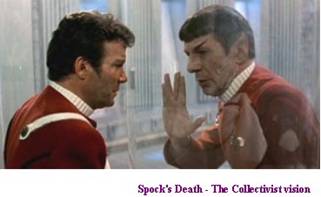
Freedomphiles! The above was said by Spock, Captain Kirk’s odd number two, in
Star Trek II: The wrath of Khan,
as the life slipped out of his Vulcan body on the engineering deck of the USS
Enterprise, having sacrificed his life for the rest of the crew.
Hello
Freedomphiles! The above was said by Spock, Captain Kirk’s odd number two, in
Star Trek II: The wrath of Khan,
as the life slipped out of his Vulcan body on the engineering deck of the USS
Enterprise, having sacrificed his life for the rest of the crew.
In 1966, a new show that no one expected to do much of anything significant, Star Trek, premiered. Mr. Spock was Gene Roddenberry’s flawed formulation of what he imagined the perfectly rational man would be. The planet Vulcan was once a violent and barbaric planet – in Roddenberry’s world, this was most likely representative of his view of modern humanity – and it was through self-discipline and near-religious dedication to logic and reason that the Vulcans overcame this dark past.
 Roughly
twenty years before Roddenberry created his Universe, there was a philosopher
and novelist named
Ayn Rand making a
reputation in this country as a compelling new voice. From Soviet Russia, she
knew the evils of collectivism first hand. She left the Soviet Union in 1926
on a temporary Visa, and she never returned. She looked upon the New York
skyline and marveled at the achievements of a free mind. To her, New York,
with all its skyscrapers, was a monument to the nobility of man. Dedicated to
the principles of reason and logic, it would seem Rand was the prototype of
Roddenberry’s Spock.
Roughly
twenty years before Roddenberry created his Universe, there was a philosopher
and novelist named
Ayn Rand making a
reputation in this country as a compelling new voice. From Soviet Russia, she
knew the evils of collectivism first hand. She left the Soviet Union in 1926
on a temporary Visa, and she never returned. She looked upon the New York
skyline and marveled at the achievements of a free mind. To her, New York,
with all its skyscrapers, was a monument to the nobility of man. Dedicated to
the principles of reason and logic, it would seem Rand was the prototype of
Roddenberry’s Spock.
Nothing could be further from the truth. Ironically, coming from the same foundation in logic and rationality, Rand and Roddenberry came to two distinct and polar conclusions, Roddenberry’s exemplified by the above quote, and Rand’s exemplified by the comment, “Since men are neither omniscient nor infallible, they must be free to agree or disagree, to cooperate or pursue their own independent course, each according to his own rational judgment. Freedom is the fundamental requirement of man’s mind.”
The flaw in Spock’s death scene is located not in the principle of objective reasoning, but in Roddenberry’s ability to think rationally. It was a major flaw that underscored much of his utopian vision of the future – namely, that a logical, reasoned mind would naturally accept collectivism as a positive state for it to flourish and grow.
Collectivism (Socialism, Fascism, Communism, Nazism, etc.) requires that you relinquish the one thing that makes you unique to the greater good, the collective, or the State. It is the idea that there is no self; that your body and your mind are not yours, but societal tools toward a greater evolution, or more aptly put:
“The needs of the many outweigh the needs of the few, or the one…”
A reasoned mind such as Spock’s would have never come to this conclusion when he sacrificed himself for his friends and coworkers on the Enterprise. More than likely, he still would have reached the same destination, but the path would have been much different in the purely logical mind of a solidly rational man.
To a purely logical man, or as I’ll call him – True Spock – no life would be more important that any other or group of others. True Spock would understand he was not omniscient, and that he couldn’t judge which lives on that ship were worth sparing and which were not. He would know that trying to make that decision would be the pinnacle of hubris, and that he could never know who on that ship might go on to do great things and who would not. It could be any or none of them – it could be him. Therefore, there would have to have been a greater reason to sacrifice himself for the others than that collectivist platitude.

True Spock would have understood that there was only one rational option available to him. You see, he would possess that knowledge most important to the development of a wise, reasonable mind – he did not know the needs of the many or the few – he only knew the needs of the one: himself. His need, at that moment, was to continue living.
Yet there is one truth that Spock, Roddenberry, Rand, or even True Spock could not avoid – he was going to die. Whether he acted or not, the result would be the same. The real choice Spock faced was whether the whole crew died, or just he.
So you see, Spock didn’t sacrifice himself for the Enterprise – his life was lost either way – he just made better use of his death. That is a completely rational decision, not based on some ethereal communal responsibility, but on logic, reason, and objective fact.
That is a reasoning that Rand could have gotten behind – because the needs of the many do not outweigh the needs of the few, or the one. We’ve spent thousands of years trying to shake that sweet-sounding but dangerous axiom. For instance, did the needs of the many Europeans for cheap labor outweigh the needs of the few Africans to be free? Did the needs of the many Soviets for land outweigh the needs of the few Poles, Czechoslovakians, or Afghanis?
No, of course not.
Rand railed constantly against this kind of saccharine doublespeak, which makes for good sound bites, but when extrapolated to its natural end is cruel and destructive. What it says is that your life is not your own, but merely a means to a greater societal end. It means that you have no rights beyond the needs of the many.
It means that you are a slave.
This is the theory behind public-interest politics. The financial needs of the many, through welfare – corporate and social – foreign aid, wake-work projects, and farm subsidies outweigh the needs of the one to keep the money he earns. The moralistic needs of the many to be free from temptation outweighs the needs of the one to be free to make non-coercive, peaceful choices about his own life – like the choice to smoke pot, visit a prostitute, gamble, or get off watching a Jenna Jameson flick.
 Rand understood this amazingly well: “Since there is no such entity as ‘the
public,’ since the public is merely a number of individuals, the idea that
‘the public interest’ supercedes private interests and rights, can have but
one meaning: that the interests and rights of some individuals take precedence
over the interests and rights of others.”
Rand understood this amazingly well: “Since there is no such entity as ‘the
public,’ since the public is merely a number of individuals, the idea that
‘the public interest’ supercedes private interests and rights, can have but
one meaning: that the interests and rights of some individuals take precedence
over the interests and rights of others.”
This seemingly meant nothing to Roddenberry, for he appeared to be one of the many collectivists then and now that appear to believe the socialistic dream just hasn’t been done right yet. This despite the fact that every time it has been tried – and no matter how benevolent the intentions – the needs of the many axiom has always led to tyranny, misery, and oppression.
The only way to have a happy, free, and prosperous society is to secure to each man that which is his own – namely his property and his rights – to shake off the chains of tyranny of the majority and proudly, defiantly declare: “The needs of the one outweighs the needs of the few, or the many!” It is only through this freedom that we could even hope to live in a world that even remotely resembles Roddenberry’s utopia.
It is this inverse interpretation that sums up Rand’s Objectivist philosophy – man is an end unto himself, that truth is not subjective or malleable, and that man’s only responsibility is his own happiness, seeking his own rational self-interest, while preventing none from doing the same.
Telling Rand that the Needs of the Many argument is true would be like telling Jerry Falwell that God only loves gays, liberals, and feminists – it is antithetical to their world view.
Rand goes a bit far in the rational self-interest argument, though, when she speaks of her atheism and the evils of altruism. She was a staunch atheist, criticizing mysticism in all its forms. While I applaud her skepticism and commitment to objective truth, I would be hesitant to jump on the castigative religion bandwagon.
To Rand, man’s ultimate happiness relied on nurturing and expanding his natural gifts, while staying true to his principles and ideals. She believed in elevating man, rather than basking in his inadequacy and begging forgiveness.
In her 1943 novel, The Fountainhead, a young, idealistic architect named Howard Roark designs a temple to man, which causes a huge controversy and spurs a lawsuit against him. Sitting on the witness stand, Dominique Francon, the female lead in this story, presumably speaking for Ayn, said:
“Howard Roark built a temple to the human spirit. He saw man as strong, proud, clean, wise, and fearless. He saw man as a heroic being. And he built a temple to that. A temple is a place where man is to experience exaltation. He thought that exaltation comes from the consciousness of being guiltless, of seeing the truth and achieving it, of living up to one’s highest possibility, of knowing no shame and having no cause for shame, of being able to stand naked in full sunlight. He thought that exaltation means joy and that joy is man’s birthright…But Ellsworth Toohey said that…the essence of exaltation was to be scared out of your wits, to fall down and grovel. Ellsworth Toohey said that man’s highest act was to realize his own worthlessness and beg forgiveness…for the realm of the spirit is beyond the grasp of man. To enter that realm, said Ellsworth Toohey, man must come as a beggar, on his knees.”
 Growing
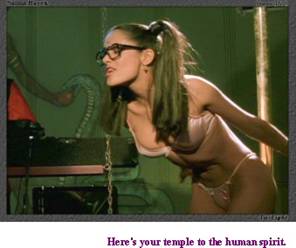
up Catholic, I have more than a little sympathy for that viewpoint. As Latina
hottie Salma Hayek said in her oddly mesmerizing cadence as the muse
Serendipity in Kevin Smith’s brilliant film
Dogma, “You don’t celebrate
your faith – you mourn it.”
Growing
up Catholic, I have more than a little sympathy for that viewpoint. As Latina
hottie Salma Hayek said in her oddly mesmerizing cadence as the muse
Serendipity in Kevin Smith’s brilliant film
Dogma, “You don’t celebrate
your faith – you mourn it.”
What I mean by that is that a great portion of all religious exertion is dedicated to tearing down man, telling him that while he has a free-will, he can never be good. He is flawed from the start – a born sinner – and that only by prostrating himself before God and begging for forgiveness can he hope to receive his Heavenly reward, which, of course, he never deserved in the first place.
That, paired with the objective fact that you cannot prove the existence of God, led Ayn to have a negative view of all religion, thinking it, at best, an unproductive distraction, and at worst, an untenable evil.
This viewpoint is a rare flaw in her philosophy because it ignores the simple fact that all organized religion is made up of individuals, whether it’s the Roman Catholic Church, Islam, or even the Hot Tub Mystery Religion, and for some of those individuals, their “exaltation” comes from serving God.
 Take,
for instance, Mother Teresa. Who could possibly think she lived a wasted
life? Perhaps Ayn Rand did, but her values and talents were different than
Mother Teresa’s, so for Ayn to judge her based on the things she herself
valued would have been antithetical to her own philosophy.
Take,
for instance, Mother Teresa. Who could possibly think she lived a wasted
life? Perhaps Ayn Rand did, but her values and talents were different than
Mother Teresa’s, so for Ayn to judge her based on the things she herself
valued would have been antithetical to her own philosophy.
Mother Teresa lived – as Ayn put it – “up to [her] highest possibility.” True, she dedicated her lives to others and to God, but she did this by choice. Her calling was to be altruistic – I doubt she would have been happy any other way.
This is why I think altruism is a myth. The only time it is truly bad is when you are doing it out of a sense of responsibility and not because it is what makes you happy. But does this happen? If it does, I’ll bet it is more rare than you think. Ayn Rand was not a big fan of altruism because it sacrifices the self. An egoist, Rand could think of nothing more appalling than altruism, for it is truly the attitude that leads to collectivism: “Every major horror of history was committed in the name of an altruistic motive.”
But, like I said, altruism doesn’t exist, except as a motive for tyranny – it is something elites expect of others, but rarely what motivates an individual. Let’s continue to examine Mother Teresa – was she an altruist? I don’t think so. I don’t think she – or anyone else, for that matter – would dedicate their lives to others if they didn’t gain satisfaction from it.
The same holds true for individual sacrifice. As I have said about a zillion times, people always act in what they perceive to be their best interests. Take, for instance, a father who steps between his daughter and a bullet. Did he do this because he had to? Did he do this because it was his responsibility? No. He did it because he wanted to. He did this because he places a higher value on the life of his daughter than on his own. It’s a pure value judgment – not altruism. If he did not value his daughter’s life more than his own, he wouldn’t have done it – simple as that.
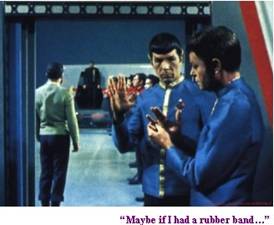 It’s
not altruism, but forced altruism, that is dangerous and an affront to
liberty. He can step in front of that bullet all he wants, but he better not
push me in front of it. Likewise, no one should have forced Spock to
die for the Enterprise, but he made his own value judgment and made his
decision based on that. Sure, he could’ve spent his last five minutes as a
corporeal entity shooting the shit with Kirk and teaching Bones how to do the
secret Vulcan handshake, but he valued the lives of all those people – or
perhaps just one of them – more than those extra five minutes.
It’s
not altruism, but forced altruism, that is dangerous and an affront to
liberty. He can step in front of that bullet all he wants, but he better not
push me in front of it. Likewise, no one should have forced Spock to
die for the Enterprise, but he made his own value judgment and made his
decision based on that. Sure, he could’ve spent his last five minutes as a
corporeal entity shooting the shit with Kirk and teaching Bones how to do the
secret Vulcan handshake, but he valued the lives of all those people – or
perhaps just one of them – more than those extra five minutes.
The same principle holds true for negative decisions. Say your friend calls you on Tuesday and asks you to help him move on Saturday. Your first instinct is to say no. You work hard all week and you know how tired you’ll be on your one day off. Plus, Glitter is premiering on Showtime that day. You really just don’t feel like doing it. But, you think, who was it that helped you move last year? Who was it that helped you paint you bedroom? So you say yes. Or you make up an excuse to get out of it. Or you flat-out tell them you don’t feel like doing it.
You might be tempted here to label the first decision as altruistic, and the second two as rational self-interest choices. I don’t think so. Clearly, in the second two choices, you are doing what you really want to do. One is more honest than the other – who would admit wanting to see Glitter? – but their end is the same.
The first seems like a great sacrifice, and you’ll probably keep that in mind as you carry his stupid Matchbox 20 collection to the truck. But was your decision self-sacrificing and altruistic?
 No.
You weighed your options, and made the best decision you could based upon your
values. Perhaps you like the feeling of self-sacrifice (which doesn’t make it
much of a sacrifice, does it?), or you don’t want your friend to think badly
of you. Maybe you just can’t take the guilt. In any of these instances, you
are just deciding what you value more, and going with that. It is not
altruism.
No.
You weighed your options, and made the best decision you could based upon your
values. Perhaps you like the feeling of self-sacrifice (which doesn’t make it
much of a sacrifice, does it?), or you don’t want your friend to think badly
of you. Maybe you just can’t take the guilt. In any of these instances, you
are just deciding what you value more, and going with that. It is not
altruism.
In the first instance, you value the feeling of contentment or righteousness you get in sacrificing an afternoon with psychotic superstar Mariah Carey for your buddy. Or perhaps you value your friend’s opinion of you more than rest. In the third option, the guilt you would feel in not helping your friend is worse than the irritation you’ll feel carrying forty pounds of Magic: The Gathering cards up twelve flights of stairs on your day off.
You see, in any of these instances, you are doing the one thing that will maximize your happiness. You are not being altruistic – you’re just making the best choice for you under the circumstances.
And this is the same process that True Spock used.
Now that I’ve exploded the myth of altruism and hopefully given my Objectivist Freedomphiles something to chew on, I want you all to remember that rationality is a great virtue, objective reasoning the only truth-finder, but there is a place in the world for irrational emotionalism – just not in any intellectual pursuit.
If you find happiness in the sit-stand-kneel of Sunday mass or in giving yourself for the public good, more power to you. Just don’t try to force others to share your values. It is your job as a human being to find out what you enjoy most and do that to the best of your ability, and it is everyone else’s job to do the same thing – and these will be various and specific. Whether you think the locus of origin is God, the Earth, Mother Nature, King Kong, or your own self, your mission is the same.
 The
only caveat I can offer is be aware that faith is irrational. It can be a
wonderful, empowering, life-affirming pursuit. It can inspire people to great
accomplishments. But faith is a pursuit of the heart – not the mind. It is
an irrational belief in some invisible thing greater than yourself, not an
intellectual pursuit of objective truth. So when pursuing debate, discussion,
and intellectual growth, remember to leave the faith-based arguments to
faith-based discussions – because, whether you’re Spock, Rand, or Roddenberry,
matters of the heart, when allowed into the mind, will infect your rational
capacity and limit your ability to reason.
The
only caveat I can offer is be aware that faith is irrational. It can be a
wonderful, empowering, life-affirming pursuit. It can inspire people to great
accomplishments. But faith is a pursuit of the heart – not the mind. It is
an irrational belief in some invisible thing greater than yourself, not an
intellectual pursuit of objective truth. So when pursuing debate, discussion,
and intellectual growth, remember to leave the faith-based arguments to
faith-based discussions – because, whether you’re Spock, Rand, or Roddenberry,
matters of the heart, when allowed into the mind, will infect your rational
capacity and limit your ability to reason.
Until Next Time, Make Every Day a Good One,
- Rick
If you liked
what you read, please forward this to a friend.
If you've been forwarded this and would like to be on the list, have comments
good or bad, would like more information about Libertarianism, or have
received this in error and would like to be removed from my list of freedom
lovers, e-mail me at:
Click here to comment on this in the Freedom Forum . . .
|
©2003 Rick Davis |
Freedom Files Archives • Freedom Lyrics • Freedom Links • Freedom Pictures • Freedom Forum |
