| A curiosity |
| If you took a closer look at the map of Germany, in SE corner just where German, Czech and Polish border meet, you could find a name of a region - die Lausitz. That's where they live. Nobody knows, how many Sorbs are there left. Numbers range from 20 000 to 150 000. Everything depends on who do you think the Sorb is. If you put into consideration the ability to speak one of their languages on a daily basis: Lower Sorbian/Lusatian (North of die Lausitz) and Upper Sorbian/Lusatian (South of die Lausitz), you could count just several thousands, if that. Lusatian Sorbs are a disappearing minority. Or nation, to be more precise - as we've mentioned before, they don't have any state, in which they formed "majority". |
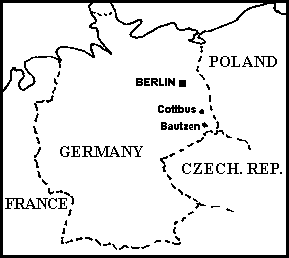 |
| Source: http://www-user.tu-cottbus.de?sorben/inhalt08/austral/lusatia/htm |
| They are probably the least known nation living in Europe. You can't find their state anywhere, simply because it doesn't exist. They are the smallest Slavonic nation - Lusatian Sorbs. |
| Lusatian State |
| They are the last descendants of numerous Slavonic tribes that used to live between rivers Elbe and Saale and Oder. All those tribes were conquered and forcibly christianised by Germans, and as a result of that - slowly germanised (for more info follow this link) Being small Slavonic island in the German sea they went through tough times in their history. They suffered hostility, persecutions, religious intolerance and persistent attempts to turn them into the Germans. Yet, for a number of reasons, they survived and today - in the time of free market and democracy - one could think that nothing really can threat them. Unfortunately - and paradoxically - now more than ever they face total extinction. Less and less youngsters want to be bothered in using their native language, which is in fact the most important factor of Sorbian national identity (along with folk culture). Even in privacy of home language is spoken seldom. Sorbian people have created a few organisations (e.g. Domowina) and projects (e.g. Witaj-project) to protect and promote their national identity, language and culture. It seems however to be not enough. There's no Lusatian state and the only homeland of Sorbs is German Republic. During communist era Sorbs were highly subsidised minority, being at the same time regime's tool to show how keen on human rights it allegedly was. It happened only twice when Lusatian Sorbs seriously undertook the initiative of building their own state. This topic is a rarely raised issue amongst Sorbs and others interested in Lusatian matters. Despite all the hesitation and controversy it may cause, and against political correctness this page tells the story of a dream that didn't come true. Tells the story of how Sorbs wanted to build their own independent republic and how they lost that game. This page will try also to promote the idea that in the matter of fact only free and independent Sorbian State - regardless of size - would be capable to stop the process of germanisation, reverse the menace of destruction of the nation and take a proper care of Lusatian Slavs and their future. |
 |
| The first attempt: 1918 - 1919 |
| Practically since always Sorbs and their land - Lusatia - were part of Germany. Before their tribal state could even turn into medieval monarchy, they were conquered and forcibly christianised and constituted German duchies ever after. In 19th century, during national awakening, Lusatian representatives tried to win some concessions and basic freedoms for their people (like freedom of using Sorbian language in schools or churches). They didn't achieve much and gaining even the very basic rights was a longstanding process. Harsh reality made Sorbian people pragmatic and realistic. Geopolitical location didn't make it any easier. Living in one of the strongest (both military and economically) countries on the continent, being small in number, living mixed with German neighbours rather than in close settlements, not having traditions of independent state - they couldn't really do much. However, towards the end of the World War I international situation changed dramatically - Germany and Austria-Hungary were defeated, revolution spread across Russia, suppressed nations of Central and Eastern Europe and Balkans were gaining independence one after another. Social and political unrest didn't go unattended by Sorbian leaders. One of them - Arnost Bart - making reference to Wilson's principle of self-determination of the nations, as well as unfulfilled declaration of Saxon government given in 1848, demanded granting the Sorbs their national rights and freedoms. |
| Info box Very brief history Slavonic tribes started to settle down in the area of today's Lusatia around 600 AD. They were mentioned for the first time in old Frankonian chronicles in the early 30s of 7th century. Until 990 AD we have hardly any written records of their history. In 990 AD they were conquered by the Germans and since that time they remained part of German political organisms (except short period of 1018-1031, when Lusatia was joined to Kingdom of Poland). In XIV Lusatia became part of Czech Crown. It was one of the reasons why Sorbs survived as Czech rulers weren't particularly interested in germanisation of Slavs there. In 1635 Lusatia (except city of Cottbus, the capital of Lower Lusatia) became Saxon princes' feud. In 1815 major part of Lusatia was given to Prussia, which proceeded harsh policy of germanisation of all Slavs within its borders. Since that time Lusatia is divided into Lower Lusatia and Upper Lusatia, more or less reflecting the division between Sorbian languages. In 1918-1919 Sorbian political leaders made an effort to create free Lusatian state. This attempt failed, and later - during fascist era - all the Sorbian social and political organisations were banned. Sorbs were supposed to cease to exist just as any other non-German nation. After the war, in 1945-1947 Slavonic leaders made another effort to liberate their nation once again - and once again failed. For the price of total control they were granted certain concession during GDR period. After reunification of Germany in the early 90s Sorbs still lived divided between Saxony and Brandenburg and struggled with new post-socialist reality. |
| In November 1918 Serbski Narodny Wubjerk (SNW) or Sorbian National Committee has been created. It was supposed to be a provisional parliament, government and organiser of national movement. Along with it, Serbski Zwjazk (SZ) or Sorbian Association was formed as a mass (app. 36000 members; quite a lot for such a small nation) organisation for all the Sorbs. At the beginning of December 1918 Bart published Sorbian National Committee's political programme: it demanded unification Upper and Lower Lusatia into one state (Land), still within Germany, granting national and social rights to its people, partition of the big semifeudal land held by German land-owners and protection of Lusatian craft. The document did not say anything about separation from Germany, yet it was emphasised that the Lusatian movement is independent from Poland and Czechoslovakia. One of the reasons why Lusatian politicians decided not to tear off their ties with Germany was that the Lusatian Sorbs - unlike Poles, Czechs and Slovaks - did not have any significant protectors in the West. Nobody could really back them up, so they avoided enraging German authorities. However even mentioning the "Lusatian case" caused great irritation of Berlin and Dresden governments. This attitude was a basis for publishing in 22nd of December 1918 "The Proclamation to the Sorbian Nation" in which SNW for the first time demanded creation of the independent state for Lusatian Sorbs. Referring again to Wilson's declaration that every nation has the right to self-determine its future Lusatian leaders announced that Lusatian Sorbs are a separate nation and like any other nation they deserve the right to decide about themselves. Moreover, proclamation called for dealing with the "Sorbian question" on forum of the international peace conference. Such a declaration was surprising not only for the Germans but also for most of the Sorbs themselves. It presented completely new attitude towards problems of the nation. Authors insisted that only Lusatian State could successfully prevent the Sorbs from germination. They argued that creation of the new state is not only necessary but also possible: politically, economically (there is a number of natural resources spread across Lusatia), "territorially" (although Lusatian State would be one of the smallest in Europe there are states like Luxembourg, Andorra or Monaco which prove that territorial size is not the issue - at least not that big issue) and ethnically. According to plans state was about to cover the historical area of Lusatia with population of app. 280 000. This strip of land meant to connect the new state with Czechoslovakia. Unofficial name for it was Sorb-Lusatian Republic - it was to be declared as a national state of Lusatian Sorbs protecting their national identity and growth, having its own internal and external (foreign) policies, guaranteeing rights also for the German minority within. The state was expected to stay fully connected with religion - Christian values were to be given priority. The most important groups in state's social and political life meant to be middle class and peasantry. Farmers were the biggest social group in Lusatia hence their interests were to be on agenda of state affairs. The reaction of Sorbs was diversified - one must not forget, that the whole issue was a project of a small group of national leaders and did not emerge from the people. So after the first wave enthusiasm independence movement was diminishing quickly. The Germans' reaction was unanimously hostile - press and government launched a series of attacks on "traitors" and "separatists" and fought the movement by any means possible. Germans felt that they were surrounded by a bloc of enemies: France and Belgium from one side and Poland and Czechoslovakia from another. Moreover, growing crisis, political and social chaos, threat of bolshevism made Germans even more paranoid. Any suggestion or mention about Sorbian State added to hostility. For Entente the "Sorbian question" did not existed at all and the chances of presenting Sorbian opinion or suggestions on an international forum were slim if none. Neither any significant help from neighbouring Slavonic state could change the situation: Poland was still engaged in war, whereas Czechoslovakia tried to play the Lusatian card to win certain concessions for itself. Saxonian authorities in Dresden categorically opposed any interference of any foreign power to "Wendish question" (Wends - name given to Sorbs by Germans). It claimed either that there's no such a thing as "Wendish question" or that it is totally internal Saxon affair. Bart and the others knew that even with Entente's support there was a long way to go, before anything could be accomplished. Thus creation of Lusatian State was treated as a strategic aim and objective. Political realism forced them to seek some kind of compromise with Dresden and Berlin. So from their first programme the "programme minimum" has been extracted. It comprised of demands of: administrative unity and autonomy for national territory of Lusatian Sorbs, creation their own parliament and armed forces, filling positions in administration only with people who could speak Sorbian, guarantee the self-government in the cities (predominantly German) for Germans, binding state and Church where Sorbs lived, teaching religion in schools, creation national school with Sorbian language, teaching Sorbian history and culture, organising seminars for Lusatian teachers, protection of property of the Church, schools and local communities, supporting small and medium sized farms, privatisation of the farms, protection of local industry, lowering taxes and their even spread, simplification of the administration etc. However even this moderate programme was far too much to be accepted by German authorities. They didn't bother to talk with Lusatian leaders. They talked with Sorbs "faithful and loyal to Saxony" instead. Promises given to these Sorbs - if made - were unbinding and unclear and did not change the situation of the nation at all. Special Committee of Wends Faithful to Saxony was formed - its members were usually germanised Slavs or "real renegades", as they were called by SNW. That was not all - borders control was tighten (especially one with Czechoslovakia), political leaders and activists were under constant police surveillance. In Lower Lusatia, where national movement was much smaller and weaker, Prussian government undertook similar steps. Local priests and teachers were obliged to report the atmosphere amongst common people, methods and reach of national agitation, promoters of national movement etc. Along with Dresden Berlin was preparing to allege Czechoslovak intervention to protect Sorbian nation. For Sorbian leaders the most important thing was to present their demands during peace conference. They counted on support of France and other Entente's states. All these calculations proved wrong. On the 5th of February 1919 Czechoslovakian president Benes presented Sorbian postulates to the Committee of Ten on the peace conference. He wanted however to win for his country certain concessions in more important territories by playing Lusatian card. He was misleading Lusatian politicians by declarations that Lusatia might be incorporated to Czechoslovakia where it would be granted autonomy. In current situation everything seemed better than staying as a part of Germany. Realistically there were hardly any chances of joining Lusatia with Czechoslovakia or creating an independent Lusatian state. The winning Great Powers did not put the interest of small nations into consideration. British expert on Central- and East European affairs presented Entente's attitude clearly: "Lusatian Sorbs? - total absurd!" Reanimation of dying nation was definitely not in the interest of stability in Europe, because it would be a dangerous precedent for other small stateless nations in Europe (Scots, Basques), moreover - it could lead to bolshevisation of Germany. Too strong Czechoslovakia was not awaits, either. Bart had no idea about the real state of the Lusatian issues and organised on the 22nd of February 1919 mass demonstration during which he ensured gathered people that the question of independent Lusatia is already won and that all politicians are working on ensuring the prosperity of the future state. It shows not only how little the Sorbian leaders knew about political reality of the time but also made a great embarrassment to Czechoslovakia, which couldn't longer hide the sad truth about Lusatian projects and its fate. Bart was informed that "Sorbian question" has been lost (one of the main reasons given was that there were too many Germans living in the state-to-be). On the 23d of March 1919 SNW sent another memorandum to Wilson in which it suggested creation at least a united Lusatian land within Germany and giving it a protection of League of the Nations. There was no response to this letter, so on the 11th of April 1919 another, even more modest memorandum was sent - again, with no result whatsoever. Peace treaty with Germany (7th May 1919) didn't say anything about Lusatia - there was only a general clause saying that Germany should treat national minorities accordingly to the way the German minority is treated in neighbouring countries. SNW leaders sent some more pleas (17th May, 4th June, 7th June), but - again - with no response. Defeat broke down the national movement of Lusatian Sorbs, Lusatian Association was quickly getting smaller in number, in predominantly protestant Lower Lusatia national movement simply vanished. Bart was trying to save the minimum of the minimum but achieved nothing. Returning from abroad on October 1919 was arrested and sentenced to prison for treason. He wrote later to his comrades from SNW a letter, expressing his bitterness on whole matter, asking them for faithfulness and loyalty to German State and peaceful coexistence between Slavs and Germans. Several months lasting struggle for independence failed. The reasons for that were, firstly - lack of broad support for the idea amongst majority of Sorbs, secondly - fierce German opposition, and thirdly - lack of international support, or even interest. After losing their battle Lusatian Sorbs had to come to terms with it and try to organise their lives in new Weimar Republic. It wasn't long before the very existence of theirs was endangered by ruthless fascist rule. In Hitler's plans all the Slavonic nations were supposed to be turned into Germany's slaves, and then wiped out. Lusatians were the first for the obvious reason - they were in Germany already. World War II was a traumatic event for most of European nations, Sorbs including. Fascist Germany's defeat brought new opportunities for this nation. |
|
| The second chance: 1945 - 1947 |
| During second World War some 20 thousand (out of 100 thousand) people were killed in Lusatia, but effective persecution lasted since 1933 (Hitler's NSDAP gaining power in Germany). During those 12 years Sorbian national life was endangered more than any time before. Hitler aimed to kill off all the Sorbs who refused to identify themselves as "Wendish speaking Germans". Should war lasted a few years longer, there wouldn't have been any Sorbs any more... One has to bear in mind that liberation of Lusatia came from Red Army - this fact implicated all the political plans and activities. It was soon realised that nothing can be done in Lusatia without previous Soviet authorities' consent. "Domowina", national Sorbian organisation, was the first antifascist organisation to be revived in Lusatia (10 May 1945). It won sympathy of the Soviets not only for its antifascism but also for fairly radical economic programme, with proposals of ban on large private land ownership and monopolies (both held by Germans). Its main figures were: J. Cyz, J. Meskank and P. Nedo - all actively involved in national life before the war. The day before Luzisko-Serbski Narodny Wubjerk (or LSNW - Lusatian-Sorbian National Committee) was created in Prague. It was a strong centre of national movement. Its leaders - M. Krjecmar, K. Kocka, B. Solta, J. Cyz, I. Smoler - were also pre-war political, cultural or social activists. In July 1945 LSNW moved to Budysin (Upper Lusatia's capital) and started organising local National Committees (Narodne Wubjerki). Many Domowina members joined these Committees, which acted as an initial administrative body for the future state. On the 26 of January 1946 both Domowina and LSNW created Lusatian National Council, with five LSNW's leaders on top. Since then Domowina focused on cultural and educational activities, whereas LSNW and Lusatian National Council remained political representatives of the nation. Both organisations represented nationalistic and liberal-democratic orientation. They were hoping for support of democratic states and superpowers, especially the USA. They hoped for Soviet support as well, but in this case whole matter was a bit more complicated. Nationalism and democratic liberalism were completely opposite to what USSR represented and opted for: internationalism, collectivism and communism. LCNW right from the start insisted on secession of Lusatia from Germany and joining with Czechoslovakia. Memoranda send to Czechoslovak president Benes, Soviet Union leader Stalin clearly presented this desire, justifying them with historical reasons (for many years Lusatia belonged to the Czech crown) and recent events (extermination of the Sorbs by Nazis). Surprisingly this demand wasn't published right away to the public in Lusatia - Czechs knew about the idea (and were very keen on it) earlier than Sorbs themselves. However pro-Czech orientation wasn't the only one - some leaders preferred either to see Lusatia remaining as part of Germany, or being incorporated to Poland (Poland was now - after its western borders correction - direct neighbour of Lusatia), or as a separate state. Polish option dated back to the secret contacts between some Lusatian leaders and polish Resistance (Home Army). The idea was to incorporate Lusatia as an autonomous Slavonic state to Poland - it was thought to be a barrier between Poland and Germany. In Poland itself one of the ideas of post-war order in this part of Europe was to create a large, Wets-Slavonic state consisting of Poland, Czech, Slovakia and Lusatia, under Polish leadership (which resembled ideas of first king of Poland, Boleslaw Chrobry, who was trying to unite Western Slavs). Pawol Nedo, Pawol Cyz and Dr. Jan Cyz were main supporters of the Polish option, which wasn't as strong as the Czech one. There was yet another factor to be put into consideration: the new Polish western border, on Oder and Nise rivers meant, that eastern part of historic Lusatia belonged to Poland now (east of river Nise). These Polish claims had to be respected by Sorbian leaders and they had to resign from reclaiming those territories for sake of good relationship between them and Poland. This wasn't a question in Czech option. Pro-German option was the weakest one - for obvious reasons . The idea was to leave Lusatia as part of Germany, but under United Nations control. Poland, Czechoslovakia and USSR were about to be designated to exercise this control. However, being strongly supported by German communists (which were gradually taking over control in part of Germany occupied by USSR) and Soviet occupation administration this programme quickly developed. Soviets claimed that Sorbian question may be solved only within democratic German state. To prove that, German communists presented political programmes that seemed to be democratic and liberal, but in the matter of fact were misleading and only masqued their true intentions of gaining full power. Communists more and more infiltrated Domowina and this led gradually to split with LSNW. But as far as national principles were concerned Domowina wasn't that easily manipulated. It still demanded joining Upper and Lower Lusatia into one administrative unit, right to set up Sorbian schools, cultural institutions, youth organisations, separate socialist party, its own press and media. Rising tension between East and West resulted in evolution of Lusatian leaders' plans. They slowly gave up idea of joining with Czechoslovakia, but still demanded secession of Lusatia from Germany. And so idea of independent state revived again. On the 7th of January 1946 in special declaration LSNW demanded recognition of Lusatian National Council as a Lusatian government, inviting Sorbs to the UN, allies' guarantees of independence of Lusatia, right of presenting Lusatian claims on UN forum, excluding Lusatia from the occupation zone). It was handed on 20. August 1946 to Foreign Ministries' Council in Paris. There was a second postulate that saw Lusatia as a UN mandate territory administrated by the UN or USSR. To ensure that effectiveness of this solution all the administration would have to be ceded into Sorbian or Soviet hands and border security units would have to be created. Sorbian schools, Sorbian national party, removing Germans who were settled in Lusatia as a result of forcible migration from Poland and Czechoslovakia - these are only examples of issues raised in the declaration. Whereas Czechoslovakia actively supported Sorbian efforts, Yugoslavia was also friendly towards Sorbs, Poland remained neutral, and the only potential supporter in the West was France. France was interested in weakening Germany as much as possible, therefore it would be keen on Lusatian secession. Great Britain, seeing growing Soviet power and threat was against the whole issue. Washington was interested only in economic potential of Lusatia without referring to political questions. In spring 1947 France gave up its policy of weakening Germany and joined the Western Bloc that was being created by the USA and the UK to stop Soviet expansion in Europe. Hence Sorbs had no active supporters in the West, or in the East. During 1946-47 seven memoranda concerning Lusatian issues were send to different Foreign Ministers conferences (like those in February-April 1946 in Moscow, November-December in London) - none of them was successful. Creating separate Sorbian state had pros and cons. Geopolitical situation was better after the WWII, the new state would have borders with Czechoslovakia and Poland, and these states would have a their western borders more secure. Lusatian territory was about 7 000 sq. km, it consisted less then 2 percent of German territory as whole. There were approximately 800 thousand inhabitants, of which more or less 100 thousand were Slavs. The most significant difficulties were: small number of Sorbs scattered irregularly amongst German population, political and economical weakness, German newcomers from Poland and Czechoslovakia who could successfully sabotage any attempts of creating Lusatian state. The fact that Lusatia was entirely in the Soviet occupation could be interpreted in both ways - neither United Kingdom nor the United States could actively undermine Sorbian efforts, yet Soviet Union itself wasn't interested in solving Sorbian question according to the will of Sorbian leaders (it wouldn't win sympathy of the Germans if it was supporting Sorbs fighting for their state, for secession from Germany). Sorbian struggles were quite popular amongst common people in Poland and Czechoslovakia, but official circles were more cautious and hesitant. Poland wasn't still sure of its new territories in the west and Czechoslovakia was involved in other cross-border conflicts. Both didn't have enough power to come up with a definite solution, both were also more and more Soviet satellites with no manoeuvre whatsoever in foreign policy. Hence Sorbs became again a scapegoat of foreign policy and geopolitical situation. No one really cared about them and their claims. The initial enthusiasm was quickly replaced by cold calculation, and Sorbian leaders day-dreaming where crushed by mundane reality. |
| Source - all text is based upon: W. Balcerak: Panstwa narodowe Europy Srodkowo-Wschodniej w XX wieku, Mazowiecka Wyzsza Szkola Humanistyczno-Pedagogiczna w Lowiczu, Instytut Historii PAN, Lowicz-Warszawa 2000 |
| Source - all text is based upon: M. Cyganski, R. Leszczynski: Zarys dziejow narodowosciowych Luzyczan, tom II, lata 1919-1997, Panstwowy Instytut Naukowy, Instytut Slaski, Opole 1997 |
|
| Conclusion |
| It is a sad fact that after struggle lasting longer than one millenium, the smallest Slavonic nation of Lusatian Sorbs faces extinction. Their situation resembles situation of American native Indians - exterminated by hostile newcomers, wiped from their land, closed in reservation - they slowly die(d) out. Sorbs often say that many times many people predicted their disappearing, yet they are still alive and kicking. Nowadays they have more opportunities, they live in a free, democratic country, they can use their language, they can organise themselves in political or cultural groups... Nothing endangers their existance, however it is clearly visible that "biological substantion" of the nation melts. In author's personal opinion it is just the matter of time when Lusatian becomes a language spoken only by a bunch of hobbysts and the memory of this Slavonic nation dies. It is worth remembering that there are actually two main factors distinguishing Sorbs from their German neighbours: the language and culture. There are no physical differencies between a German and a Slav - so once the language is not spoken anymore, how can a human being say: "I am a Sorb"? By the sheer fact of having Sorbian ancestors? Memory of ancestors dissapears within three, four generations. If today there is a Sorbian child who cannot speak Sorbian language, it is hardly possible that its offspring will consider itself "Sorbian". By the same token culture - being another significant mark "who's Sorb, who's not" - does not fulfill it's funtion properly. Germans call Lusatians "Eier-Mahler" - egg-painters (because of tradition of paining eggs on Easter) - this despiseful term only shows the most important feature of Lusatian culture - backwardness. This is a rustical culture, culture of peasants, very traditional folklore, that has nothing really to offer for contemporary youngsters. Young people are the only ones who could save the nation from disappearing, yet the nation does surprisingly little to attract young people to Sorb culture and language. One cannot expect, that having all the good and attracitve things of todays global culture like computers, internet, pubs, clubs, techno and love parades, travelling and tourism, living nearby buzzy and busy Berlin, being exposed to universal English-speaking countries culture one would dream of nothing else than living in a remote, swampy corner of Germany, without prospects for good education and good work or fulfilling career, painting Easter eggs and learning language hardly spoken by anybody in this world. The author is strongly convinced that only national state can take a proper care on national culture of any nation given. It is also understandable that no nation can be forced to fight for independence it it does not desire to do so. In other words people like Basques deserve independent state, but apparently most of them feel good being part of Spanish or French nations. There is no point in forcing them to anything if they don't want to. Sorbian language and culture (and even Sorbs themselves) would undoubtedly better off under their own rule. This doesn't mean, of course, that Federal Republic aims to germanise them, hence Sorbian state is the only way. Germany apparently did the wisest thing of all - they just gave up forcible germanisation letting the time to do the job. Sorbs MUST recognise the fact that in the world changing into one global village there is really little space (if any) for them left. Return to nature, interest in everything that is regional, local - is just another fashion which will disappear as quickly as it appeared. Sorbian leaders cannot then count on some natural power that will bring people back to "being Sorbian". Amongst the greatest enemies of Sorbs are: apathy, pesimism and inactivity. Not getting invloved actively in tries of rescuing what has remained from Sorbian nation is the greatest sin. From author's point of view the new discussion on possibilites and solutions for Sorbs is more the necessary. Of course, initiative must come from Sorbs, because no-one can solve their problems better then they. Author believes that reviving discussion about an independend Lusatian state is justified. First of all we have to repeat - if the majority of Slavs remains not interested or inactive, any initiative undertook may be easily destroyed. Well-thought-out programme presented in an convincing manner by well organised group of people can be a starting point to any further action. What we would have to think about is a kind of manifesto clearly stating what are our aims and how are we going to achieve it. Delivering this message to broader public at this stage would be crucial, as it might win or lose support among masses. Secondly - it must be realised that Sorbian state - and ONLY Sorbian state can take care of Sorbs. How come, for example, one could expect the English to cherish France and the French without imposing English culture, language, political, social and ecomical systems? Books of history are full of examples of nations which used to be under other nation's rule and what were the sad effects of such a situation (usually either assimilation of the conquered nation, or extermination, or a little bit of both; unless independence was gained). There are numerous problems, one of them Sorbs being in small number. Different statistics give different figures - usually something in-between 50 to 100 thousand. Not much for a nation, but there are smaller nation (and have their own states). There are at least as many germanised Sorbs (i.e. speaking only German, but in certain conditions ready to come back quickly to their roots). The other problem: living fully mixed with Germans, when there isn't any place where Sorbs would constitute a majority. Many of those Germans were resettled to Lusatia from Czech Sudetenland and from Silesia, Pomerania and East Prussia in Poland. There is no way they, their children and grandchildren could be expelled in the same way that happend after WWII. They can only be persuaded to move somewhere else. On the other hand if we could imagine what would happen if all the Germans suddenly left Lusatia? Deserted cities, half deserted villages, empty factories, schools... total utopia. But this only shows what kind of problems would the Sorbian state face for saving itself becoming another German-speaking country in Europe. Economical and political weakness should also be put into consideration. Sorbs do not have any significant economic power. There are no Sorbian companies or banks, no capitals, no fortunes. There is not a single political Sorbian party (although there have been attempts to create one), Sorbs are in the mainstream of German political life. Besides, there are too little of them to form any lobbying or pressure group (immigrants from Turkey, for that instance, do have human potantial to organise themselves into lobbies). Thirdly - one should realise that even if the biggest Sorbian territorial claims were satisfied, it would constitute less then 2 percent of Federal Republic. It isn't much (could be less) when a existance of a nation is on stake. Last, but not least - if there are states like Vatican, Monaco, Andorra, Liechtenstein, San Marino or Luxembourg exist, why Sorbian state wouldn't? One could argue that there was no Sorbian state in the past - true, but this doesn't really matter that much. States are being created, partitioned, destroyed, united and so on, because they are human invetion. Something created by humans can be destroyed by humans and vice versa. There was no Israel for two millenia, yet it was no obstacle to create the state. There was no independent Ukraine before the beginning of 90's - but there is Ukraine now. Lack of statehood tradition is a point but not strong enugh - people easily can create one. Author hopes that this site, when seen by more and more interested people, will initiate some discussion over the question of independence for Sorbian nation. Nowadays internet is marvellous new tool to spread new (and old) ideas, and let's hope this is going to be the case in this matter. |
| Only me, the author of this site is responsible for any information given and its accuracy. Also opinions and comments are of mine - I take full responsibility for them as well. I hope this site will keep changing, and that new and valuable and interesting things will be added (especially maps, forum and links). Martin Burchard |

|
| this site was visited: |
| times |
| Email: [email protected] |
   |
|
| Links |
| Below you can find just a few most important links to web pages about Sorbs and Lusatia. Hopefully this part will gradually grow bigger and bigger. |
| http://www-user.tu-cottbus.de/Sorben - main page, available in four languages (Upper Sorbian, Lower Sorbian, German and English), which has links leading to general info, dates and events, worthwiles, culture, language, education, institutions, media, letters, club, other address, etc. http://home.t-online.de/home/320051871311/dom.html - Domowina's homepage; Domowina is the main cultural and social organisation of Lusatian Sorbs http://www.internecy.de - Sorbian "cyber-village"; forum, further links, downloads (mainly Sorbian fonts) http://www.bautzen.de - homepage of Upper Lusatian capital - Bautzen/Budysin; English version available http://members.aol.com/soraboj/sbindex.htm - site on Lusatia full of useful information in Esperanto http://www.diewenden.de - homepage of "Ponaschemu", Lower Lusatian organisation |
| History: 16 June 2002 - page launched 17 June 2002 - counter and email added 18 June 2002 - first links added; maps of Lower and Upper Lusatia added 20 June 2002 - map 'Republic of Lusatia" in "A curiosity" put 23 June 2002 - "Action" added 9 October 2002 - 1623 map of Lusatia added for comparison |
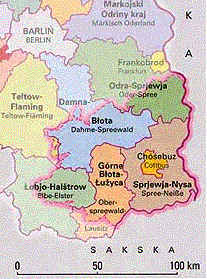 |
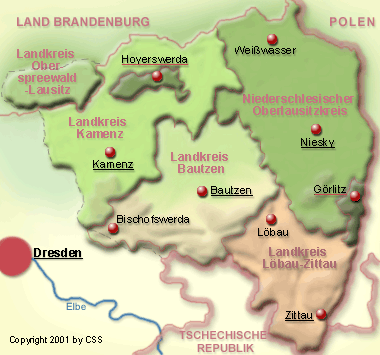 |
| A map of Upper Lusatia |
| A map of Lower Lusatia |
| Source: http://www.Oberlausitz.de |
| Source: http://www.ponaschemu.de |
|
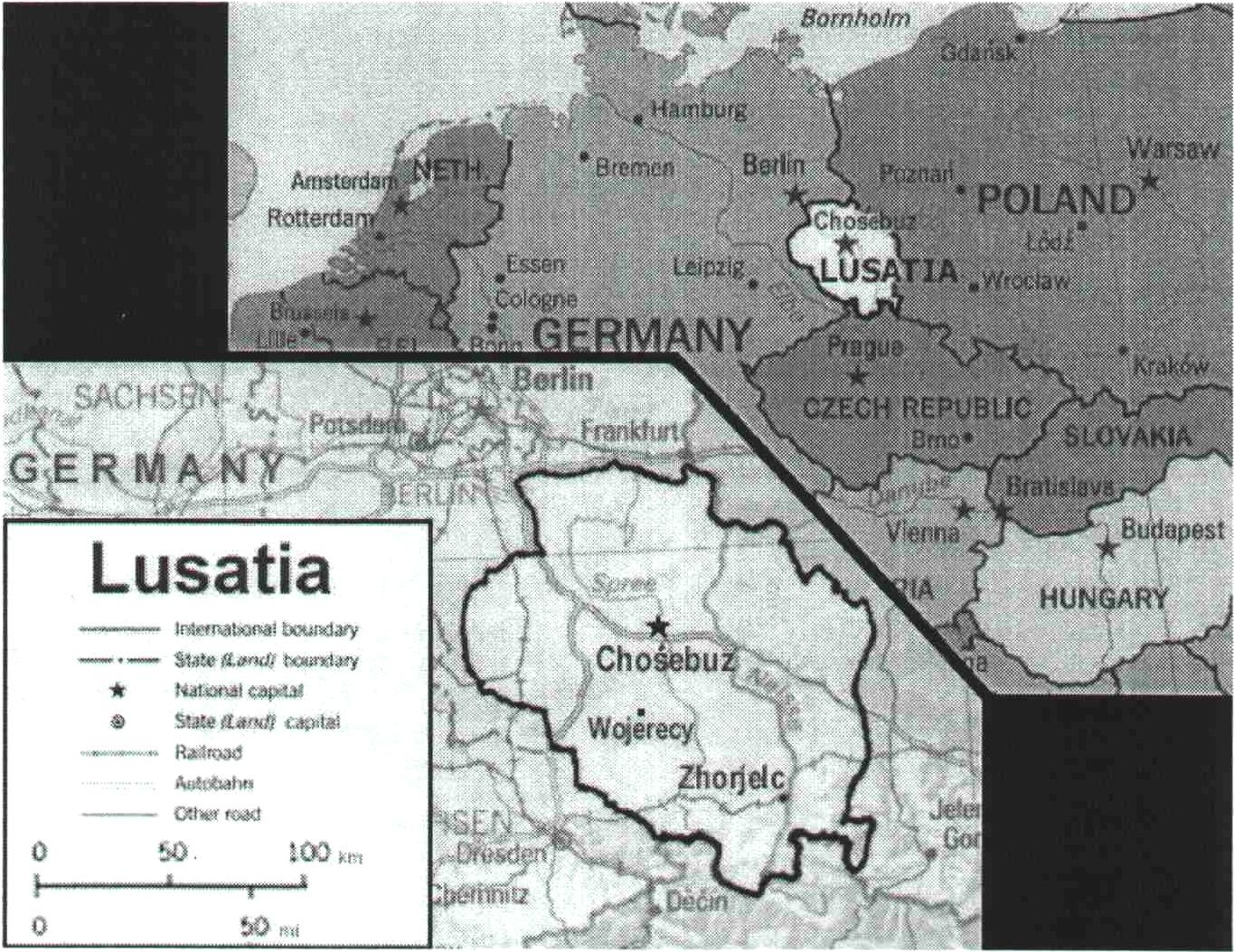
| Below you can find a picture that was in the internet quite a while ago. It comes from dead link http://hyperresults.com/lusatia/ and presents the map of the Republic of Lusatia. This Republic - as you can see - consists of territories of Germany and Poland, thus showing historical boundaries of the Lusatia (see 17th century coloured map below). I apologise for appalling quality - I found this map in my archives, and it was just a photocopy. The results of scanning this photocopy you can now "admire". |
 |
|
| Action! |
 |
 |
 |
 |
 |
| There are no words strong enough to emphasise that at the end of the day Sorbs, and ONLY Sorbs can be masters of their own fate. If there is no will amongst THEM to change the poor conditions they are in, no one could possibly do anything to make any progress whatsoever. Sorbs MUST fully REALISE that their nation is in great danger and that what is being done now is not enough. Wide spread action should be undertaken to promote more active attitude of every single Sorb � because for this small nation every man counts. Only strong political organisation, with a good programme and clearly stated objectives, along with devoted and situation-aware leaders would be able to deliver the message: Sorbian nation is in danger of extinction and it is up every Sorb, and every friend of Sorbs to do something about it. First of all it has to be fully realised how difficult the situation of the Sorbs is. Current miserable and pathetic condition originated from many sources. Conquest and planned germanisation are the biggest evils of all. The first is just sheer historical fact, though one of the greatest significance for Sorbian nation, the latter however is a conscious policy that was exercised to either destroy or fully absorb conquered Slavs. The scary thing is that germanisation as a process and a policy did not stop and still is in operation. German Republic does not actively persecute Sorbs because the official policy is about protecting national minorities of any kind in the Republic�s territory. Persecution is taking place, though. Closing Sorb schools, cutting down funds for cultural and social activity, silent agreement to further dense industry investments in the region, leading to direct destruction of Sorb villages, lack of political representation � this all and many more petty little annoyances make struggle for national perseverance (not mentioning development) hardly possible. Even treating Sorbs as a national minority instead of separate independent nation, adds to all the difficulties. The most dangerous factors are as follows: 1. Small number � statistics say about 60 000 Sorbs, but it is wide known fact that merely half of them, most probably even less, actively uses the Sorb language. Actually, no one really made any research as to how many Sorbs there really are and exactly what part of Lusatia they still do occupy. Small number may be seen as a great disadvantage, because it creates the feeling of being overwhelmed by number and weight of problems facing this nation, may cause their frustration, lack of self-confidence, feeling of insecurity or insignificance, obscurity, etc., 2. Living scattered between Germans � the Germans outnumber Sorbs a few times, five, ten, maybe more. Lusatian settlements are mixed with German, they do not constitute some close, compact areas where Sorbian would be in majority or the only language spoken (although there are some areas, like Upper Lusatian catholic region of Rozant, where Sorbian language is still actively used and where proportion of Germans to Sorbs is not that unfavourable), 3. Germanisation � less and less Sorb children speak the language, less and less identify themselves with Sorbian culture. Moreover, it hardly ever happens that a child speaks Sorbian as a first language. Sorbian is being replaced, it becomes second language, and soon it may be widely found obsolete. The lost of contact with Sorbian maybe the matter of one generation, whereas losing national identity � another one or two. There are 99.9% chances that all the Sorbs are already bilingual. Switching to one language is just a matter of time. And most probably it won't be switch back to Sorbian... 4. Economic weakness � Sorbs are mainly beneficiaries and job takers rather than net payers or employers. They do not possess any significant economic power; they do not have any larger business, bank, etc. Fragile base of economic existence makes them vulnerable to economic difficulties, such as mass unemployment and forces them to make move to any place where the job is. It means losing any contact with Sorb environment � hence accelerated loss of national identity (which is not cherished anywhere else but in Lusatia). 5. Industrial danger � plans for industrial development, based in Lusatia interfere greatly with the task of preventing Sorb culture from extinction. Many villages had to be destroyed to make a room for dense industrial enterprises. Inhabitants were resettled to different places where process of losing national identity was particularly fast (in massive blocks of flats, or even somewhere else in Germany). It is now believed that an economic reason was not the only one behind decisions made in former DDR (as well as now) about placing devastating industry particularly in Lusatia, 6. Lack of modern culture � one has to pay great tribute to Sorbian folk culture that it preserved the nation so well. Apparently however the time of folk and rustic culture has come. Less and less young people would choose to live in Lusatian province having so many opportunities anywhere else. It requires really big dosage of patriotism to give up all these opportunities in career, education etc., to stay in Lusatia where the chances of finding good job are slim, where live goes in the same old manner, slowly and without perspectives. Sorbs are ridiculed for using their language in a public place; they are being treated as peasants. This must obviously cause a great deal of frustration and embarrassment, and the only cure is to swap from old traditions to modern culture. There are no things like national broadcast station or TV, there are no wider known music bands or artists, and there is even no national football team... These seem to be more than obvious for a participant of widely recognised culture (like Anglo-American or French), yet they lack in Lusatia. The problems and dangers for Sorbs may be multiplied to a thick book, this should give us however a good insight in the whole situation. To suggest anything now is extremely demanding, nonetheless we should be discouraged by a number of problems. This site treats about two attempts of Sorbs to create their own state. And this is not for no reason, really, as FURTHER ATTEMPTS SHOULD BE MADE. The following must be recognised by all Sorbs: They are endangered nation. The German Republic does not provide (nor is interested) proper conditions for national preservation and development. There are legal tools which, wisely used, could make a big change in live of the Sorb nation. Only turning Sorbs from minority to nation, from subject of policies to a policy maker, from second or third class people to the first class citizens can prevent this nation from further destruction and create a RISE FROM OBSCURITY. Only political solution, like creation of the new Land Lausitz, some kind of political (in addition to formal cultural that is being exercised now) autonomy, or even � full independence of whole or a part of Lusatia, can stop and revert current process of dying off of the nation. Once this message is delivered to every Lusatian house and its implications are fully understood, then and only then further initiatives can emerge. Below you can find a short description of all three POSSIBLE political solutions. This is the easiest task to achieve, as it does not directly express national ambition (which are hardly any at the moment) of the Sorbs, and is fully internal German issue. It is about creating the very new and separate 17th Land (region) in Germany. It would comprise of lands of historical Lusatia. German constitution allows such a solution, provided that it is accepted in referendum. The articles are as follows: Article 29 (New delimitation of L�nder boundaries; amended 19 August 1969 and 23 August 1976) (1) A new delimitation of federal territory may be made to ensure that the L�nder by the size and capacity are able effectively to fulfil the functions incumbent upon them. Due regard shall be given to regional, historical and cultural ties, economic expediency, and the requirements of regional policy and planning. (2) Measures for a new delimitation of federal territory shall be effected by federal statutes, which shall require confirmation, by referendum. The L�nder thus affected shall be consulted. (3) A referendum shall be held in the L�nder from whose territories or partial territories a new Land or a Land which redefined boundaries is to be formed (affected L�nder). The referendum shall be held on the question whether the affected L�nder are to remain within their existing boundaries or whether the new Land or Land with redefined boundaries should be formed. The referendum shall be deemed to be in favour of the formation of a new Land or of a Land with redefined boundaries where approval is given to the change by a majority in all the territories or partial territories of an affected Land whose assignment to a Land is to be changed in the same sense. The referendum shall be deemed not to be in favour where change; such rejection shall, however, be of no consequence where in one part of the territory whose assignment of the affected Land is to be changed a majority of two-thirds approve of the change, unless in the entire territory of the affected Land a majority of two-thirds reject the change. (4) Where in a clearly definable area of interconnected population and economic settlement, the parts of which lie in several L�nder and which has a population of at least one million, one tenth of those of its population entitled to vote in Bundestag elections petition by popular initiative for the assignment of that area to one Land, provision shall be made within two years in a federal statute determining whether the delimitation of the affected L�nder shall be changed pursuant to paragraph 2 of this Article or determining that a plebiscite shall be held in the affected L�nder. (5) The plebiscite shall establish whether approval is given to a change of L�nder delimitation to be proposed in the statute. The statute may put forward different proposals, not exceeding two in number, for the plebiscite. Where approval is given by a majority to a proposed change of L�nder delimitation, provision shall be made within two years in a federal statute determining whether the delimitation of the L�nder concerned shall be changed pursuant to paragraph 2 of this Article. Where approval is given, in accordance with the third and fourth sentences of paragraph 3 of this Article, to a proposal put forward for the plebiscite, a federal statute providing for the formation of the proposed Land shall be enacted within two years of the plebiscite and shall no longer require confirmation by referendum. (6) A majority in a referendum or in a plebiscite shall consist of a majority of the votes cast, provided that they amount to at least one quarter of the population entitled to vote in Bundestag elections. Other detailed provisions concerning referendums, popular petitions and plebiscites (Volksentscheide, Volksbefragungen) shall be made in a federal statute; such statute may also provide that popular petitions may not be repeated within a period of five years. (7) Other changes concerning the territory of the L�nder may be effected by state agreements between the L�nder concerned or by a federal statute with the approval of the Bundesrat where the territory, which is to be the subject of a new delimitation, does not have more than 10,000 inhabitants. Detailed provision shall be made in a federal statute requiring the approval of the Bundesrat and the majority of the members of the Bundestag. It shall make provision for the affected communes and districts to be heard. (Taken from: http://www.lib.byu.edu/~rdh/eurodocs/germ/ggeng.html) Point (3) states this possibility as clearly as possible. The action in this case would be to convince majority of inhabitants of Lusatia (Sorbs and Germans) that such a Land is needed, that taking control of their own local issues would allow to solve any problems in a quicker and more efficient manner. From Sorbian point of view situation could dramatically be changed. They wouldn�t be any longer an insignificant minority with no right to express its aims and desires. They would form a hefty proportion of the population of new Land, and could gain in this way a real political influence (local parliament and government, although still German, would definitely have Sorb members). National rights would be so much easier expressed and implemented. Coexisting with German neighbours Sorbs would feel more at home. Language policy wouldn�t depend any longer on Berlin�s caprice; Sorbian could be given a chance of becoming a real official language of the Land, hence increasing its prestige. It has to be added that current division of Lusatia is not a traditional one. Whole Lusatia, after conquest and incorporation to Germany formed for many centuries a separate unity that was just in 1815 divided between Saxony and Prussia. This division is then reversible. The next step would to launch a discussion about creating such a Land. This discussion should not only convince most of Lusatian Germans and Sorbs to the idea, but also lead directly to referendum in which people of this territory could express their will. German constitution recognises peoples will as a basis of all the laws in the Republic. Any obstacles should be therefore regarded to as typical political debates. It would have to be strongly emphasised that the new Land does not create any danger for the German Republic and its democratic order, and is just a new way which German citizens would like to organise their lives in. This idea is basically about giving the Sorbs certain political concessions on certain territory. It would affect either whole Lusatia or its part (e.g. where �Sorbian element� is the strongest) and mean things like: a separate parliament and a government, a right to retain a fraction of taxes in the region, a right to create own police and security system, a right to separate educational system, etc. There are plenty of examples of states that gave a certain group of its citizens autonomy, such as Spain to Basques. The most important feature of any autonomy is self-government that usually excludes right to have a separate foreign policy and currency, and obligation to stay in line with the very principles of economic, social and legal state�s policies. Difficulty for Sorbs remains, however, the same: there is no such a place where Sorbs are in majority, therefore where a political autonomy for Sorbs only could be realistically exercised. This one is a tricky bit. To all the problems, like small number of Sorbs, large number of Germans, and similar, the problem of fierce state opposition would have to be added. Realistically chances of independence of all Lusatia are close to none. Presuming that Germany agreed and granted Lusatia independence � it could prove very quickly, that the problems the new state faced would be overwhelming. It would turn to yet another German state (like Austria or Switzerland) in Europe. Germans living there most definitely would seek ways of returning to Germany, detesting idea of being govern by a Slavonic minority. New Sorbian authorities would struggle with re-sorbisation of Lusatia (one cannot reverse in a few decades process that lasted for centuries), and so on, and so forth. A certain cure for this situation could be creating a very small Lusatian state, just like San Marino (which is not only landlocked but surrounded by Italy, yet it functions perfectly). It would be just a several sq. km. patch, a merely visible dot on a map, which could comprise of a few towns and several villages. Catholic region of Upper Lusatia, where the culture and language are preserved the best seems to be an ideal �candidate� for this experiment. Local German population could be �swapped� for Sorbian from other regions of Lusatia. This wouldn�t sound well for Germans, as it resembled resettling from Czechoslovakia and Poland, undertaken after WWII. It would be matter of delicate diplomacy, though, to organise the whole process to run smoothly. Such a tiny state obviously would depend on Germany, it doesn�t mean that it could not exist at all. Small states can support themselves through tourism, for that instance. The objective of creating this mini-state would be clear � to prevent Sorbian nation from total annihilation. It could also be living centre of national life, supporting Sorbs living outside its boundaries. Maybe the rest of Sorbs would assimilate after a while, but the nation WOULD SURVIVE. And this is what this struggle should really be for. Now it is up Sorbs how will they deal with their future. We should encourage them to take more responsibility for themselves. We should encourage them to be more politically active. We should help them in anyway we can, so that we know that Europe does not lose one of its most important feature � national diversity. It would be a great pity if another nation found its place on the bins of History. |
| Land Lausitz |
| Independence |
| Political Autonomy |
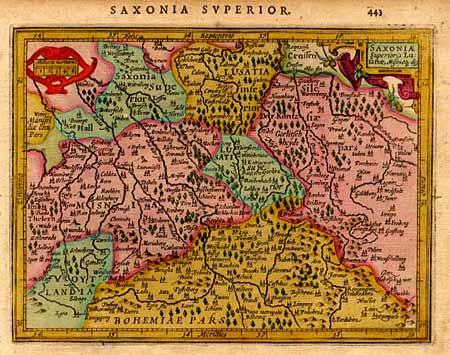
| This 1623 map shows the "historical" Upper (small green patch in the middle) and Lower (yellow patch just above) Lusatia . You can therefore roughly compare the above project with the historical facts. You would probably notice that lands east of river Neisse were not considered here as a part of Lusatia, but as a part of Silesia. This map is a download only, that's why it is not of a superb quality. |
 |
| http://freepages.history.rootsweb.com/~rgrosser/lusatia/ |