| Fredonia State Women's Blackhorse Rugby | ||||||||||||||||||||||||||||||||||||||||||||
|
|
||||||||||||||||||||||||||||||||||||||||||||
| Home | Rugby Rules | Alumni | Roster | Schedule | Pictures | Links | ||||||||||||||||||||||||||||||||||||||
|
|
||||||||||||||||||||||||||||||||||||||||||||
| The Sport of Rugby | ||||||||||||||||||||||||||||||||||||||||||||
| Although it is very similar to American Football, the sport of rugby can be very confusing to the average spectator. Unless you have some background information, it is easy to get lost watching a game. This page is designed to give those who are not as in-tune with the sport some background information concering the actions of players, way the game as scored and some good background hints so you can easily enjoy watching your next match. | ||||||||||||||||||||||||||||||||||||||||||||
| Background Information | ||||||||||||||||||||||||||||||||||||||||||||
| Traditionally rugby union is played on a field or pitch with 15 players aside. A singular, all-powerful referee oversees each match. Talking back to the ref is simply not tolerated, which is very different from a majority of today's sports. The ball is slightly larger and more round than a football, which assists in handling and kicking. A match is played out in two 40-minute halves, with a five-minute half time. Only the referee on the pitch keeps time, no stadium clock exists in rugby. Complete matches usually begin and end in the span of just ninety minutes. Stoppages are permitted for injuries only. As match play moves past full time, the referee may allow play to continue until a turnover or a score occurs. | ||||||||||||||||||||||||||||||||||||||||||||
| Substitutions, until just recently, were permitted solely for replacement of players deemed unfit to continue, with the referee having the final say. This law helped develop rugby's image as a tough man's sport. Today, up to six subs are allowed, but once subbed for, a player may not return. Endurance remains a premium. | ||||||||||||||||||||||||||||||||||||||||||||
| Aside from selecting substitutions, and offering a few moments of advice and direction at half-time, a rugby coach has absolutely no input into the game once it has begun. He generally takes a seat in the stands. The selected team captain is solely responsible for communicating with the referee, and directing plays. The match is continuous, with all players committed to running, passing, kicking and tackling for the full eighty minutes. Such a sport is played by rugged, confident individuals. | ||||||||||||||||||||||||||||||||||||||||||||
| Possession as in any field sport, is the name of the game, with each turnover creating a rapid transition from an attacking offense to a curtain defense. The level of fitness among today's top club and international rugby players is unsurpassed by any team sport, as eight big forwards (averaging 6' 3" tall and 250 lbs.) are called upon to remain in constant support of their swift back line at all times. While dominant stars do emerge, rugby is truly a team sport. Individual power, speed and stamina alone cannot overcome superior team skills for success in the game. | ||||||||||||||||||||||||||||||||||||||||||||
| Scoring | ||||||||||||||||||||||||||||||||||||||||||||
| There are four different methods in which a team can score for points: Try (5 points) Conversion (2 points) Penatly (3 points) Drop Goal (3 points) |
||||||||||||||||||||||||||||||||||||||||||||
| A rugby try is similar to an American football touchdown, but with two key differences. When the ball carrier crosses the goal or tryline, play continues. The player must ground the ball, in full view of the referee, (often in the midst of warding off tacklers,) in order for a try to be awarded. The team's goal kicker must then kick the conversion from the mark of the try along a line perpendicular to the tryline. He brings the ball out along the try line as far as he chooses, where he then can place or drop kick it between the posts. (Rugby goal posts are located on the tryline.) When a penalty is awarded, the captain may elect to take the points and give his kicker a shot at goal. The ball must then be kicked through the exact mark given by the referee, again as a placed or dropped kick. This could be a hard price to pay for being caught offside, playing the ball while on the ground, or being guilty of dangerous play (high tackling, etc.). Any player, may at any time, from anywhere on the pitch, attempt a drop kick. Although difficult and risky (since a miss generally results in a turnover), this form of scoring has broken many a heart. Often used as a last resort in response to a solid defensive stand, an outstanding kicker can break an opponent's back with a swift and accurate blow. Many games have been won in this dramatic fashion, often at the final whistle. |
||||||||||||||||||||||||||||||||||||||||||||
| Rugby Terms | ||||||||||||||||||||||||||||||||||||||||||||
| One of the most challanging things to learn about rugby is not the game itself, but all the phrases and vocabularly that go along with it. Here is a guide to the most common terms used in rugby, and a short description of some of the various plays. Scrumdown ~ The scrumdown, or scrum, of which it is more commonly refered, occurs when there are minor infractions during the course of the game, such as a knock-on. Both team's packs come together and form a mini-wall of power. The front rows of each line up with their heads touching, then push as hard as possible as the ball is rolled in down the middle. The hooker from each team then tries to kick the ball backwards through their scrum so the scrumhalf from their team can pick it up and give it off to the backs. Line-Out ~ A lineout occurs when a ball is taken off the pitch out of grounds. Both teams will then gather a small group of players up, and two rugby players will lift a third by his or her shorts above their heads. The opposing team will do the exact same thing next to them, forming a tunnel in between the two. Lastly, the ball will be thrown in from the side straight down the tunnel. It is up to the person in the air to catch the ball and pass it out to their team. Ruck ~ Rucking occurs when the player who is in possession of the ball at the time is tackled to the ground by the opposing team. Next, both teams will come from behind and try and push the other team off the ball. The spot in which the player with ball possession fell creates the line of scrimmage, and neither team is allowed to pass across the line until the ruck is over (when the ball is released to the backs.) Maul ~ Mauling is the same concept as rucking, the only difference being the person that is tackled does not fall to the ground but remains on their feet. |
||||||||||||||||||||||||||||||||||||||||||||
| Penalties | ||||||||||||||||||||||||||||||||||||||||||||
| High-Tackle ~ A high tackle is when someone tackles an opposing team member above the shoulders. Wraps around the neck and deliberate attacks to the head are not allowed in rugby. Knock-On ~ A knock-on is the same thing as a foward pass, except in the sport of rugby it is not allowed. If a player was passed a ball and was unable to catch it, dropping the ball foward of their body, it is considered a fowards pass and thereore a penalty to the other team Off-Sides ~ Off-sides is called when you are on the wrong side of the line of scrimage, therefore getting ready to have an advantage, which is also illeagle. |
||||||||||||||||||||||||||||||||||||||||||||
| Positions | ||||||||||||||||||||||||||||||||||||||||||||
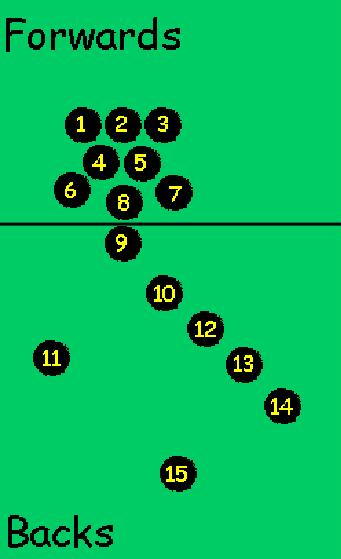
| Pack (Forwards) ~ Pack members are usually taller and stronger than the backs. They are the ones who come together to form scrums the entire game, as well as be the predominant tacklers. Pack are also required to run behind backs for support at all times, so overall strength and agility are important. A pack member will run anywhere from 4-6 miles during an average game. (No. 1-8) Backs ~ Backs are traditionally smaller and faster than the pack. Backs are the ones who will generally get the ball and run it down the field for a try, but not always. Swiftness and strong ball handling skills are essential. Even though they are smaller, backs will usually only run an average of 2 miles during an 80-minute game. (No. 9-15) Numbers ~ Unlike most sports, each position on the field has one designated jersey number. Note in the picture on the right, a pitch set up for a scrumdown. The pack, numbers 1-8, are set up in a scrumming position, while the backs, 9-15, are set up in a line ready to recieve the ball should the pack win. Tight-head Prop Hooker Loose-Head Prop Left Second Row Right Second Row Weak Side Flanker Strong Side Flanker 8 Man Scrumhalf Flyhalf Weak Side Wing Inside Center Outside Center Strong Side Wing Fullback |
||||||||||||||||||||||||||||||||||||||||||||
|
|
||||||||||||||||||||||||||||||||||||||||||||
| Home | Rugby Rules | Alumni | Roster | Schedule | Pictures | Links | ||||||||||||||||||||||||||||||||||||||
|
|
||||||||||||||||||||||||||||||||||||||||||||
| 2008. Fredonia Women's Blackhorse Rugby Club. All Rights Reserved. | ||||||||||||||||||||||||||||||||||||||||||||