Places... 
Gone, But Not Forgotten...
What happens after a juke box plays its last tune? Read on and visit a time and place now vanished.
Since passing life's mid-century mark, I often find myself remembering things that simply refuse to be forgotten. It's uncanny - almost disturbing, how reminders of the past keep popping up everywhere - like the tattered shoebox stuffed with old photos, scraps of newspaper clippings, and postcards. It's that same old shoebox that refuses to be thrown away. And now, I find reminders - of all places, on the Internet. Take Ken Kemp's web page
([Click Here to go There!]), for example, that featured a fine collection of jukeboxes.I contacted Ken by EMAIL to ask about a jukebox in an old photo-postcard I found - tucked away - in, you guessed it, the old shoe box. For all I know, it's a one-of-a kind -- an artifact from my family's restaurant in Biloxi, Mississippi - back in the 1940's. I stare at the old photo; the jukebox stares back. I'm compelled to learn more about it. In a few days, Ken replied by EMAIL.
It turns out that Ken is a genuine jukebox authority. He informed me that this particular model is now worth $8 to $12 -- THOUSAND that is. He tells me I "... could get a new reproduction of this early 1943 Model 950 now made by Rockola for ONLY $6,000. But it plays CD's..." The old 78's are all but gone!...
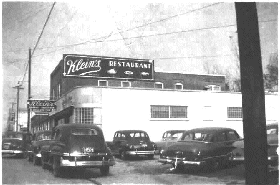
I sent Ken a copy of the postcard. Sifting through the old box, I found one of those Kodak Brownie snapshots with serrated edges. I see the exterior of the building. Memories began flooding back.
The parking lot is full. I see vintage Chevys, Fords, a Studebaker, two Hudsons, and maybe an old Packard. Another old car pulls into an empty spot in front of the building. I feel like I'm watching ghosts, frozen in time.
At the top of the building, I see that familiar billboard-sized sign - modern neon - complete with an animated arrow designed to attract passersby from Biloxi's main drag, Howard Avenue. Every night the sign fired up. It bathed the darkened parking lot with a fiery red glow until closing time - 10PM. The sign bore only two words-Klein's Restaurant -- and three pictures: a roasted chicken, a slab of steak and a broiled fish. This was just a sample, a teaser. The restaurant's six page menu featured everything from Biloxi "Po-boys" to a la carte dinners complete with soup and salad. AND, of course, there was always an endless supply of fresh warm bread from Grandpa Klein's bakery. A small hand-typed onion skin paper was clipped inside each menu - announcing the daily specials and feature dinners.
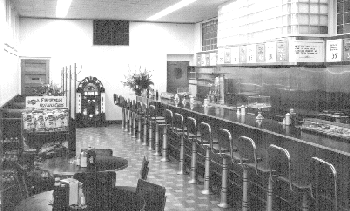
The postcard - it's a picture taken on opening day. Scattered around were floral arrangements from well-wishers to mark the festive event. I don't think people do that any more. Do they? But something is missing! Ah yes, I remember: the photo murals.
Some time later the murals filled the space along the walls' top borders. They were printed on 3x4 foot photo canvas, and were, literally, the talk of the town -- attracting customers - locals, and touriests. Why, one night the movie star, Billy DeWolf showed up to admire the scenes and eat a hearty meal.
Yes, those photos were something else. Without leaving the comfort of your table or booth, you could take a quick tour of the Mississippi Gulf Coast's unique sights - oyster fishermen at work with tongs, sail boat races, the blessing of the fleet, Deer Island, Ship island, the old seafood factories, and the boat-building yards on Biloxi's Back Bay. I understand these murals still survive today - on permanent exhibition at the People's Bank of Biloxi.
Funny, I recall one photo -- because I could never quite figure out. I guess it was just a bit too abstract for a youngster to visualize. Time after time my Dad tried to point out its features, but with no success. It was a picture of a huge Manta ray held up by a man standing atop a barrel on the old Biloxi yacht club pier. Oddly enough, I could make out the grotesque fish, but for some reason the man remained invisible!
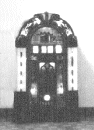
But it was the old Wurlitzer there in the center, that brings back so many memories. Though only four years old, I remembered how fascinating it was. How it shimmered with colored lights-- The moon-shaped window - the mechanical arm selecting just the right record from the bin of many - turning it over, and laying the disc to rest on the brown felt covered turntable. It moved with precision and grace - never making a false move. Often I would plunk in a nickel and hit any key just to see it go through the routine. But there was a bonus -- music -- instrumentals and songs that delivered from the soul of an American nation recovering from the war: Hoagey Carmichael's Stardust, Mario Lanza's Be My Love, and someone singing - I Don't Know Why I Love You Like I Do, I Just Do . Those dreamy gentle melodies drift back from the past -- when I first heard them on that old Wurlitzer.
It was years later, when the "unbreakable" 45 RPM records made the old Wurlitzer obsolete. It was replaced with a shiny 50's new Rockola. About that same time the juke box's owners, the Morrison Amusement Company, installed a glittering new revolving speaker on the ceiling. It hung like some monstrous top covered with small silver, gold, and green mirrors. When the music played it twirled silently - ever so slowly, shimmering and casting sparkles of light throughout the dining area.
Although the new Rockola machine was new and modern looking with its angular chrome case, traces of the old Wurlitzer's personality clung steadfast. The machine belted out a bizarre medley of old tunes (now on 45's) plus new ones. Les Paul and Mary Ford's Mocking Bird Hill now co-mingled with Patti Page's Old Cape Cod, and my grandpa's favorite- Prez Prado's Cherry Pink and Apple Blossom White.
My dear old grandpa... He'd hand me a quarter from the register and say, "Butch, go play Cherry Pink." And I'd ask, "What else, Grandpa - you get three for a quarter, you know?"
"Anything," he'd answer, "just don't play that new stuff...".
The new stuff he was referring to was rock and roll.
I heard my first rock and roll song on that same Rockola -- Bill Hailey and The Comets doing See you Later Alligator. It quickly caught on with the young airmen from Keesler Field. Soon more of the "new stuff" began playing. Mr. Morrison added Fats Domino, Guy Mitchell, and someone named Elvis -- a young truck driver from Meridian, who once stopped in with his local sweetheart June..
June's mom, Mae, worked the produce market at the A&P down Howard Avenue on the corner of Bohn Street. Mae was tickled pink that her daughter's boyfriend was beginning to "...make it big." But shortly after Elvis' first couple of records they lost track of him. It seems some guy named Colonel Parker convinced him to go touring. I guess he got all caughtup in new found success. In the next year, Elvis and June split up. Like Mae explained it, "She'll get over him. My girl's gotta get on with her life; she needs to meet a nice guy and settle down." No, she wasn't about to let her daughter become an old maid because of some showbiz upstart! At that time it seemed like the right decision because no one took Elvis seriously in those early days- especially the gang down at Si Simon's nite club on Division Street who still remembered him as "...the young feller who filled in between the Saturday night big stars." - Chet and Hank."
I strain my eyes a bit and peer deep into the old restaurant photo. I can see those neatly hand-lettered cardboard signs - permanently mounted above the grill on the stainless steel hood. I recall one especially. It read: "TRY OUR CHICKEN DINNERS - WE BOX THEM TO GO". Grandpa would jokingly remark, "Hmmp! If that chicken was any tougher, you'd have to box it with gloves on!"
In the late 1950's, the economy sort of dried up, and the restaurant business along with it. The staff of six waitresses working two shifts dropped to one shift, and then it dwindled down to just part-time. The better waitresses quit, rather than do the split-shift and part-time routine. But then there was Kay.
Kay, was the last of the waitresses. Poor Kay. She was a "clean freak". She worked like a truck-horse - trying to single-handedly keep everything spic and span - in between doing short order work on the grill. And all the time she went about her work smiling, and constantly chattering. She was a great worker, but she had this habit of talking to herself - and sometimes answering! And when the Juke box played, she would begin humming softly, then louder, and finally join in full volume with Jo Stafford, or Frankie Lane. I guess her "ways" un-nerved the few remaining customers. They gradually stopped coming - one by one.
How sad. It was like watching a clock running down, the whole place seemed to be visibly aging. The roof began leaking a bit in the back corner - causing the paint to crackle. Then a couple of the murals buckled. The stainless steel began looking drab -- no matter how much Kay tried cleaning it with her "special cleaner" - vinegar water and newspaper. The tempera colors of the once spotless signs had faded; the pasteboard began curling. Each week they became a little grungier as the grease stains showed through and began spreading. One by one the signs' prices were crossed out - and marked up, until Kay - (who by then was acting nuttier than a fruitcake) - began taping little white tissue squares over the old areas and writing on them.
One afternoon about 1957, the CLOSED sign was turned over for the last time, Kay turned in her beige uniform, and picked up her last pay envelope. In a few weeks, the people from the Morrison Amusement Company came to collect their jukebox -- by that time it had been upgraded to a chrome plastered Seeburg). The workmen meticulously removed all the remote selector boxes from the booths, and counted the last batch of quarters. For some reason they left the revolving mirrored speaker - I guess it had seen its day and wasn't worth salvaging - or maybe they just didn't notice it hanging up there - unlit - silent - still.
The bitter end came in 1973 or 74 - I forget - when the wrecking ball brought down everything on the block: the mirrored speaker, the glass block walls, the neon sign, the custom made glass front, and all of the remaining stainless steel interior and fixtures that hadn't been sold off in the final auction.
Now, all that's left are wonderful memories - a postcard, one table and four bent wood chairs that have somehow followed me from Biloxi, to four different cities in Connecticut.

Remember the old riddle: "If a tree falls in the woods, and no one's around - does it make a sound?" Well let me phrase this philosophical question a bit differently: "When an old juke box has played its last record, what happens to the sound?" I'll tell you. The sound goes on, and on, and on - conjuring up happy memories that spring to life at the mere sight of an old juke box photo - especially like the ones on Ken's website.
Thanks, Ken, for putting another nickel in the slot and letting me hear the old Wurlitzer play one more time.... "Gonna Take A Sentimental Journey... "
Copyright© 2002 - Fred J. Klein
