REVISITING THE 1902 BATTLE OF BAYANG
Federico V. Magdalena, Ph.D.
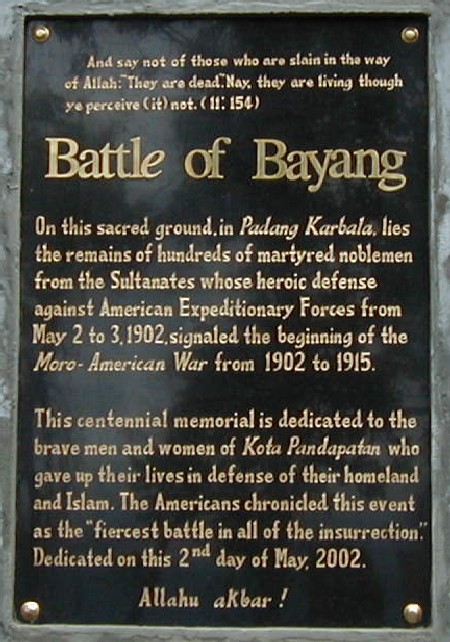
Exactly 100 years ago, Lanao became part of world history. On May 2, 1902, the first and "fiercest battle" in the Philippines (according to the late Dr. Mamitua Saber), was fought in what is now the town of Bayang on the southeastern side of Lake Lanao. Today, that event is celebrated throughout Lanao, about which a marker has been set in place in the town of Bayang, Lanao del Sur to immortalize the Battle of Bayang (see Box 1). The battle claimed the lives of at least 300 brave Maranao warriors in defense of their territory from the hands of the invading US military forces. It was followed by a series of pacification campaigns launched by superior US troops. Soon, a new era beckoned for Lanao and the rest of the Bangsamoro homeland.
Box 1 - The Battle of Bayang Marker The battle came unexpectedly in this part of Mindanao. In Sulu and Cotabato, where the US occupation forces had landed in 1899, a repeat of the Lanao experience would come some years later. In every instance, the clash between the Moro warriors and the US military followed the same pattern -- resistance against foreign invasion.
Recalling that fateful event in Bayang, what was it that led to its occurrence? It all began when the administration of the Philippine Islands changed hands. As a colony of Spain, the Islands fell on the lap of the United States by virtue of the Treaty of Paris in 1898, owing to the victory of the United States over Spain in the war precipitated by the Cuban affair. But the transfer included Mindanao and Sulu, which were territories unconquered by Spain. As the United States occupied the southern islands, it also inherited the 300-year conflict with the "Moros" (then a derogatory term for the Muslims in the Philippines).� Learning from its experience in winning the western frontier from the American Indians, the United States began to explore Mindanao and Sulu after concluding a "treaty" on August 20, 1899, with US General John C. Bates and Sulu Sultan Jamalul Kiram II as signatories (see Tan, 1994).� A year later, US authorities would send troops to survey the rest of Mindanao island and establish sovereignty of United States over the inhabitants, who had always remained free from foreign dominion.
Though well intentioned and honest, the United States authority introduced -- as it did for the rest of the new colony-- a new political arrangement, a "government of law" (Davis, in Bureau of Insular Affairs #5075-7, 1902, also called Record Group 350) centering on a "civilized" way of life inspired by US President William McKinley's pronouncements. This change, unfortunately, meant that� "no sultan or king over all Moros of any region or over other datos" be recognized except as "headmen in the several bands, and those who can earn wages in the performance of public service be paid as such�" (Davis, 1902:516).� Furthermore, General Davis suggested three courses of action for the areas inhabited by the Moros:
- "That the Bates Agreement be abrogated and set aside.
- "That the government over the Moros be military (emphasis added), and that all violators of the law which amount to capital offenses, also slave catching, be tried and punished by the courts that may be established by the supreme government.
- That trade in domestic products in the Moro country, carried on by Moros with any part of the Philippines under American flag, be free, unlimited and undutiable, and that export taxes on Moro products shall not be imposed, this immunity from taxation to continue for ten years.
Such would also hold for the Lanao district which the US forces intended to occupy. Six months before the siege of Bayang, General George W. Davis (1902:516) had recommended the following:
- The reopening of the wagon road from Iligan to the lake, to be guarded by a battalion of troops.
- The launching of light-draft gunboats on the lake, like the three which are now sunk in the lake.
- The installation of electric motors driven by turbines with the abundant water power of the Agus River.
- The utilization of this power to operate a trolley railroad on the wagon-road.
- There should be a regiment of troops in the lake country.
- The extension of the road around the lake, to and across the divide to Paran-Paran (Parang-Parang), which would be the base ultimately and a commercial port for all southern Mindanao, the road to be extended to Cotabato, where it would tap the trade of the Rio Grande Valley.
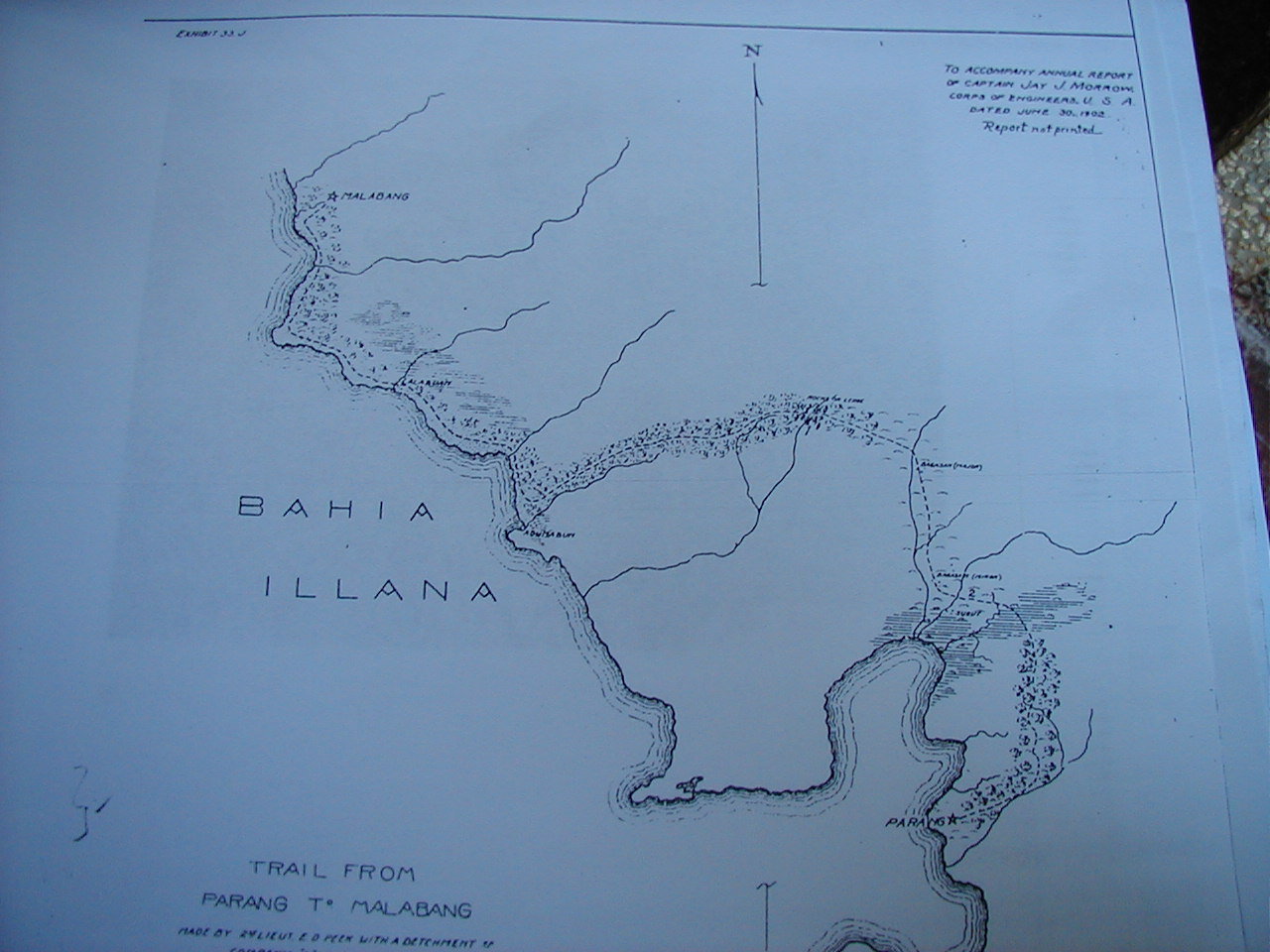
On orders of General Davis, Lt. William D. Forsyth led some cavalry troops in March 1902 to open a trail from Parang-Parang (Cotabato) to the Lake region. They were instructed to use considerable care when entering areas inhabited by "non-Christian tribes," to treat the Moros kindly, not to molest peaceful inhabitants, and not to interfere with their religious practices or in the observance of their tribal customs ("General Davis's Order, Washington Evening Star, April 22, 1902). While doing so, Forsyth and his men were attacked by Moros. One US soldier was killed and 18 of the horses were lost as they retreated to Buldon.� In that fight the Moros suffered more casualties: five of their men died. These Moros were all identified to be followers of the Sultan of Bayang. From this point on, the battle in Bayang was imminent.
Figure 1 - Trail to Malabang from Parang-ParangMeanwhile, several events were brewing in the vicinity.Bayang people reportedly stole four US government-owned cows in Malabang. In addition, two US soldiers were hacked to death by hostile Moros. Internal feuding and slavery remained unabated in nearby areas where US troops were camped.� Wasting no time, the military high command authorized Colonel Frank D. Baldwin to mobilize three battalions, including his 27th Infantry Battalion, consisting of 1,800 men in a possible punitive expedition to Bayang. Troops of US soldiers (namely, Batallion 17th Infantry under Major Lea Febiger, Batallion 10th Infantry under Major R. Hoyt, and Troop A, 15th Cavalry under W. Forsyth), were kept stationed at Malabang, ready to come to Baldwin's succor upon notice (Baldwin, in Annual Report of the War Department, 1902).� Col. Baldwin was no neophyte in this war game.� A veteran Indian fighter, he had engaged the ferocious Sioux Indians and Nez Perc� of Oregon. He served with distinction in the Great Sioux War of 1876-77 and in the capture of Chief Joseph, acclaimed leader of the Nez Perc� Indians in 1877 (Wooster, 1994:38). John J. Pershing, who would soon succeed him as commander of the US forces in Lanao, described him as a "fine soldier with large experience in handling Indians, but was disposed to use force instead of diplomacy" (see John J. Pershing's Unpublished Memoirs, Box 374, Pershing Papers).
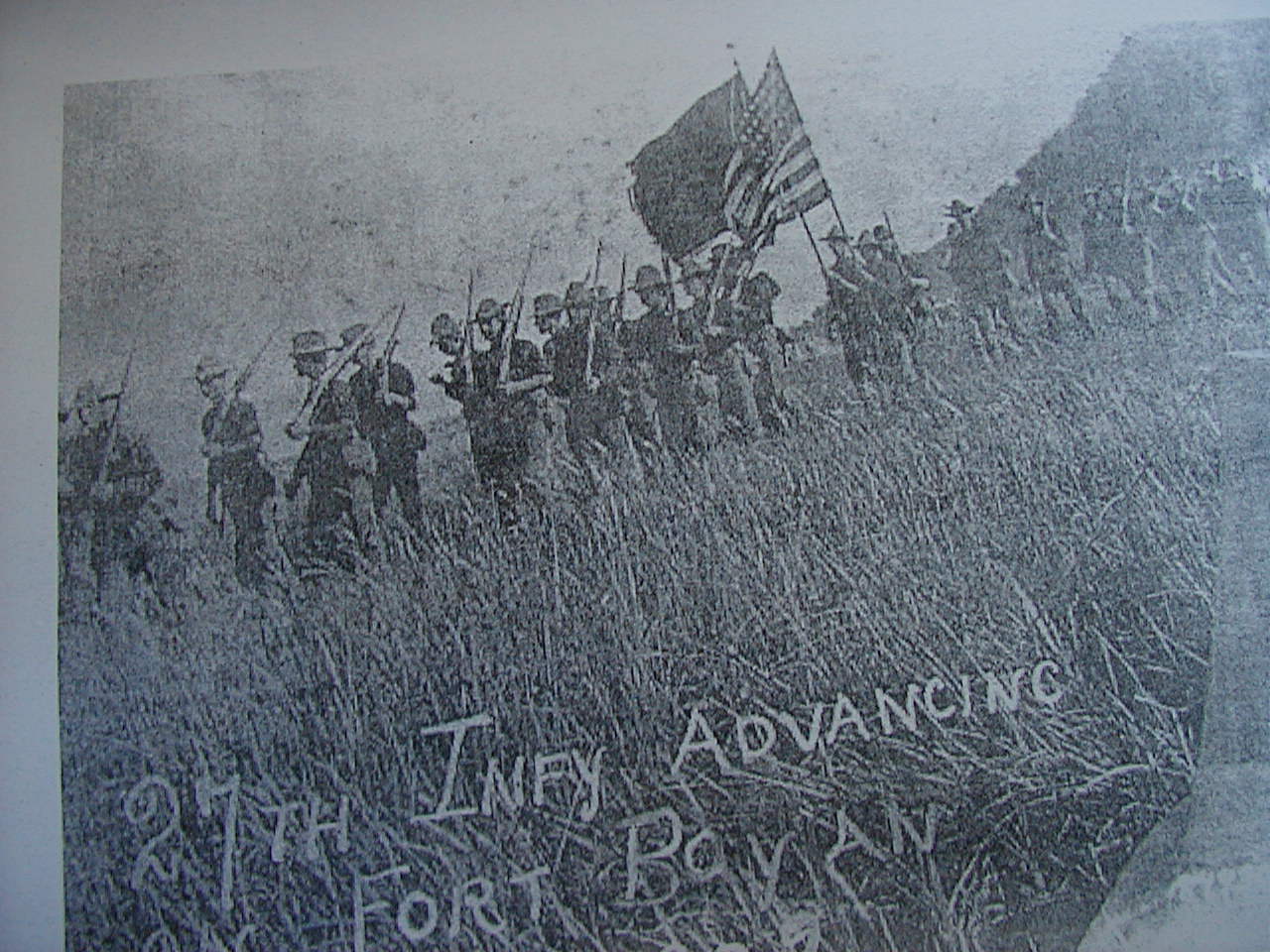
Figure 2 - The 27th Infantry Marching Toward Bayang, May 1902Then, as negotiations with Bayang went on, Col. Baldwin and seven companies of his 27th Infantry aided by the 25th Battery Field Artillery with four mountain guns, 225 dismounted cavalry and medical corps started preparing for war. He moved his troops from Malabang toward Bayang.� On the way, he met some opposition from the cottas (fortifications) of Pualas and Ganassi and engaged the Moro warriors who had stood their ground against the advancing enemies. It was easy for Baldwin to deal with them.� The battalion equipped with artillery battery pounded away at sniper fire and destroyed the Moro strongholds, leaving many casualties, among them the Sultan of Pualas (Baldwin, in Annual Report of the War Department, 1902).
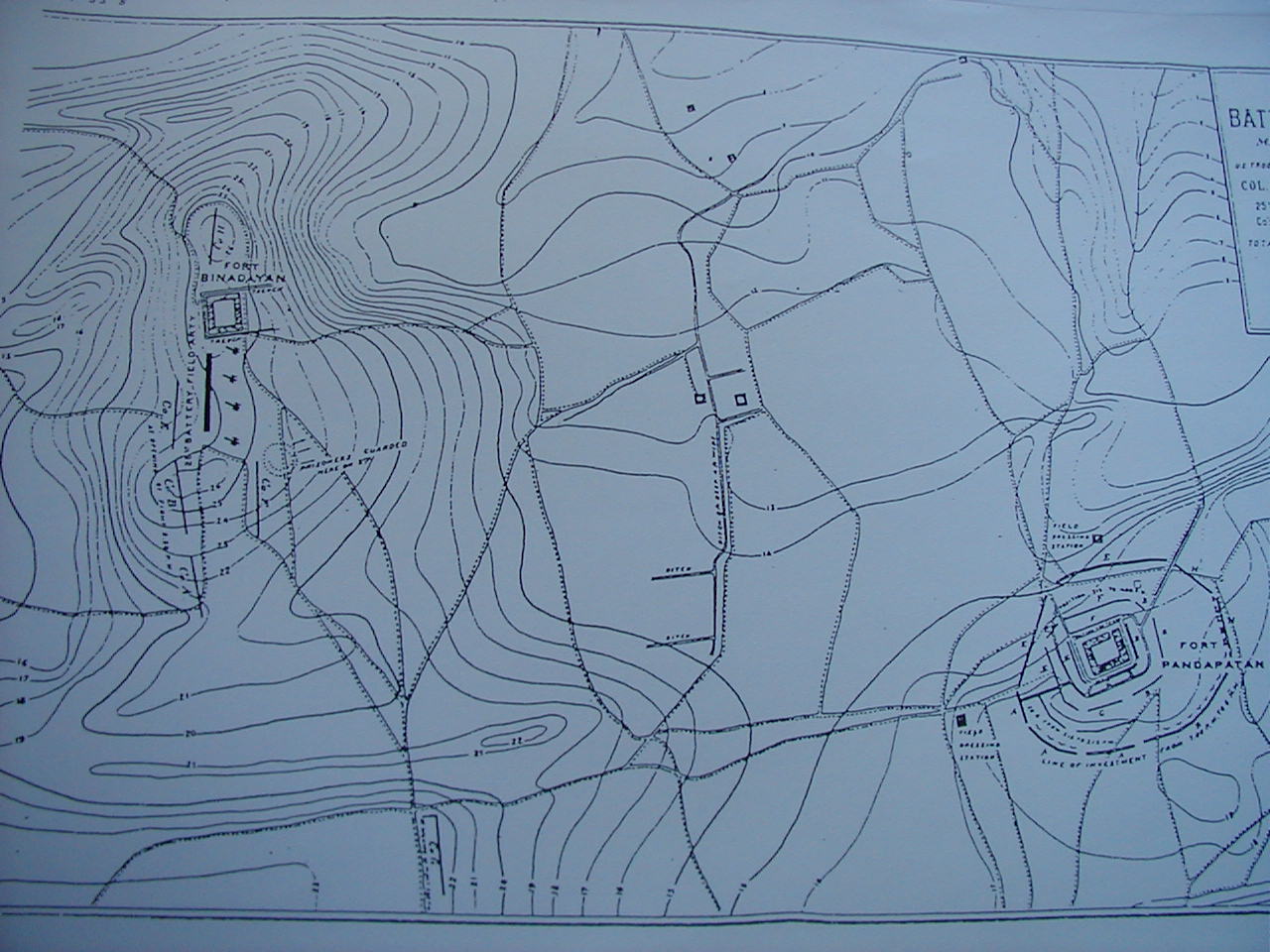
On May 1, 1902, an ultimatum was sent to the Bayang datus to give up the murderers within 24 hours, or else "the consequences would be bad for them."� The Bayang warriors -- joined by their allies from nearby Binidayan, with some delegations of fighters from Bacolod, Butig, Paigoay, Maciu and Dirimuyud -- had fortified themselves in what was known as the Cotta of Pandapatan, or Padang Karbala to the Maranaos.� Fort Pandapatan was reputed to be one of the strongest cottas in the Lake region, being over 100 years old and constructed atop a hill overlooking an approaching enemy, with several deep ditches around it for entrapment or to delay the investing troops.� Those ditches were about 10 feet deep and 12 feet wide, with sharp bamboos driven in slanting direction; their tops were camouflaged by natural ground cover for the unsuspecting enemy.� The interior of the fort was about 80 sq. feet, with various holes around the walls for serving the lantacas (brass cannons).� The exterior side of the fort was completely hidden by "live bamboos so thick that a field mouse could hardly get through it" (see Chaffee to Corbin, May 27, 1902, Box 1, Corbin Papers; Magdalena, 1994). In defense of this cotta were about 600 able-bodied warriors, many of whom had earlier fought Spanish soldiers. Of this number, 400 to 500 were warriors from Bayang and Binidayan (Davis, in Annual Report of the War Department, 1902). Armed with krises or kampilans (bladed weapons), some homemade rifles (paliuntod)and lantacas, they shouted as they waved red flags in defiance. Here they vowed to make their last stand.
Figure 3 - Fort Pandapatan (Bayang) and Fort BinidayanThe countdown began, but no word was heard from the Bayang cotta.� In May 1, as Baldwin's troops inched closer to their target while awaiting orders from superior officers, they met resistance from another cotta, that of Binidayan, (Baldwin, in Annual Report of the War Department, 1902).� Encamped within striking distance, they were fired upon by the Maranao fighters.� This prompted Baldwin to order the battery to hurl several shots at� the Binidayan cotta, killing many Moro warriors and eventually capturing the fort itself.� Those who escaped proceeded to Bayang and joined forces with their comrades there.
Then, at about 1:30 in the afternoon of May 2, 1902 the big day came. Col. Baldwin flashed the green light to his infantry to begin shelling the position of the recalcitrant Bayang cotta.� The US troops maintained a safe distance from the hills of Binidayan as they bombarded Fort Pandapatan for an hour, and then showered it with rapid fire using their krag rifles. Completely surrounded by a superior force, the Bayang warriors perhaps could not imagine what hit them.� They fired several shots with their paliuntod (rifles) but hardly hit anyone at long range; so they stopped to conserve precious bullets. Themselves trapped in their own cotta, they could do nothing about the incoming cannonballs, hitting their mark with devastating effects.� The US mountain guns were moved at a closer range of 400 yards and repeated the massive bombing of the beleaguered cotta.� Only then that the Moro warriors resumed firing to hold at bay the advancing troops.� As if the elements were conspiring, or mourning, heavy rain fell that day. Their ammunition running to dangerously low levels, the US troops got ready with their fix bayonets for a possible man-to-man combat.� But Baldwin ordered his men to retreat somewhat away from the fort before darkness came, giving the wounded opportunity to be treated. During the night, the US forces decided to scale the cotta the following day to launch the final assault against the weakened foes. At daybreak, however, the badly hit Maranao warriors hoisted their white flags of surrender.� The casualties were severe.� Some 300-400 died on the Moro side, according to the survivors, of whom 83 surrendered but shortly after made a dash for freedom. Unfortunately, many would not make it -- 35 bodies were counted dead among these escaping Moros while 8 were recaptured. Among those killed in the tragic battle were the Sultan of Bayang and his Radiamuda (crowned successor to the sultan).� On the part of the US forces, one officer, Lt. Thomas A. Vicars, and nine enlisted men were killed (three of the wounded would die later while being treated), making a total of 13 soldiers who perished in action (Davis, Baldwin, in Annual Report of the War Department, 1902).
The Battle at Bayang was concededly an uneven fight, with the odds stacked against the Maranao warriors at a ratio of 6 to 10. Outnumbered and outgunned, the "battle" would have easily been called a Moro massacre, or a "murderous retaliation," according to Jacob Shurman, president of Cornell University and first head of the Philippine Commission (Schurman, 1902: 1105).� Despite this notorious reputation, the US troops received profuse commendations from their superiors, including the US President, and earned for Col. Baldwin a meteoric promotion to Brigadier-General and a new assignment.� To General Chaffee, the battle reaffirmed "respect for United States authority in the center of savagery" (Outlook, 1902, Vol. 54:98).
Impressions
More than these results, the Battle of Bayang demolished the invincibility of Maranao resistance as the battle paved the way for more military expeditions during the ensuing years, under the command of Captain John J. Pershing.� Such expeditions also broke the insularity of the Lake Lanao region which, for centuries, had remained relatively untouched by outsiders. All these consequences would open the Lanao region to free trade and its absorption into the economic and political systems of an emerging Philippine state.� The deadly encounter between the kris and the krag would soon come to an end.� But the overriding significance of the Bayang battle is that it symbolized the triumph of globalism as well as the integration of the Bangsamoro homeland into the world system that gave life to modern states.� In particular, it meant the perfection of the three stars of the Philippine Republic and the union of two communities, the Filipinos and the Muslims, under the same flag.
REFERENCES:
����������� Baldwin, Frank D. �Colonel Baldwin�s Report of Operations in Lake Lanao District,�� Appendix 10, in Davis, George W. "Report of Brig. Gen. George W. Davis," Annual Reports of the War Department for the Fiscal Year Ended June 30, 1902, �pp. 567-573, Vol. IX. Washington, D. C.: Government Printing Office, 1902.
����������� Chaffee, Adna to Henry Corbin, letter, May 27, 1902. In Box 1, Henry C. Corbin Papers.� Manuscripts Division, Library of Congress, Washington, D.C.
����������� Davis, George W. "Notes On The Government Of The Country Inhabited By�Non-Christians In Mindanao And Neighboring Islands," Bureau of Insular Affairs #5075-7 (also Record Group 350), National Archives, Washington, D. C., 14 pp.� Also published as Appendix 9 in Annual Reports of the War Department for the Fiscal Year Ended June 30, 1902, �pp. 560-567. Vol. IX. Washington, D. C.: Government Printing Office, 1902.
����������� Davis, George W. "Report of Brig. Gen. George W. Davis," Annual Reports of the War Department for the Fiscal Year Ended June 30, 1902, �pp. 512-517. Vol. IX. Washington, D. C.: Government Printing Office, 1902. Among those included here are "General Davis's Report On Moro Affairs," Appendix 1, and several maps and sketches of the Cottas of Bayang, Binidayan, Ganassi and others.
����������� "General Davis's Order, Washington Evening Star, April 22, 1902.
����������� Magdalena, Federico V. "Bayang, Moro Province, the Philippines, Battle (1902)," In Benjamin R. Beede (editor), The War of 1898 and U.S. Interventions,�1898-1934: An Encyclopedia. New York & London: Garland Publishing, 1994, pp. 43-45.
����������� ____________________. "Moro Cotta," In Benjamin R. Beede (editor), The War of 1898 and U.S. Interventions,�1898-1934: An Encyclopedia. New York & London: Garland Publishing, 1994, pp. 347-349.
����������� Pershing, John J. "Unpublished Memoirs," in John J. Pershing Papers. Manuscripts Division, Library of Congress, Washington, D.C.
����������� Schurman, Jacob G. "The Philippines Again," Outlook, Vol. 54 (1902).
����������� Tan, Samuel K. "Bates Treaty (1899)." In Benjamin R. Beede (editor), The War of 1898 and U.S. Interventions,�1898-1934: An Encyclopedia. New York & London: Garland Publishing, 1994, pp. 42-43.
����������� Wooster, Robert. "Baldwin, Frank Dwight." In Benjamin R. Beede (editor), The War of 1898 and U.S. Interventions,�1898-1934: An Encyclopedia. New York & London: Garland Publishing, 1994, pp. 38-39.
Revised version of the paper presented to the Seminar-Workshop on the Centennial Anniversary of the Battle of Bayang held under the auspices of the National Historical Institute, Mindanao State University Campus, Marawi City, May 1-2, 2002.
Author is Professor of Sociology and the Director of Research, Mamitua Saber Research Center, Mindanao State University, Marawi City.� At this writing, he serves as Adjunct Faculty at Chaminade University of Honolulu, Hawai�I, and Visiting Fellow at the University of Hawai�i. He can be reached through his email address: [email protected].