 |
|
|
|
|
|
|
|
|
|
|
|
|
|
|
|
|
|
|
|
|
|
|
|
|
|
|
|
|
|
 |
|
|
|
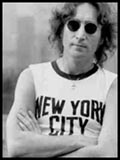
John Lennon |
|
|
|
|
|
John Lennon was born on October 9, 1940 in Liverpool, England, to Alfred Lennon and Julia Stanley Lennon. Early in his life he suffered the loss of both his parents, when his father left the family to become a seaman, and his mother, unable to care for a child on her own, decided to leave him in the hands of his aunt, Mimi. This early feeling of abandonment was to mark John for the rest of his life, and his fear of rejection can be heard in his lyrics, from his early work with The Beatles, all the way up to his pleading 1970's track "Mother. (John Lennon/Plastic Ono Band). |
|
|
|
|
|
With his aunt, Lennon experienced a quiet and undisturbed working class upbringing that left him with many happy memories. Some of these would later result in some of his best work. (Strawberry fields forever, the masterpiece single released before Sgt. Pepper was based upon his childhood recollections of happiness). Ever since his early childhood his artistic side found a way up to the surface of his personality and young Lennon began to express himself through sketches and artwork. A few of his teachers were impressed with his work, and suggested The Liverpool art school for the boy. Although John Lennon was (even by his own admission) a "child genius", he decided for this option, over a regular academic schedule. During this period, at fifteen years of age, John met Paul McCartney, at a Wooton Parish Garden Fete. The result of their conjoined musical talents was a band called "The Quarrymen", named after Quarry Banks, the school that they attended. Years later this band would become the greatest musical influence of recent recording history, and would define an entire generation. This would be under another name, though: The Beatles. |
|
|
At age 18, John's life underwent a drastic change, when, shortly after having reunited with his son, Julia Stanley Lennon, died. A bus driven by an off -duty policeman in Liverpool hit her. Lennon never fully recovered from the loss of his mother, and he continued to seek for her love in most of the women he met, finally finding comfort in the person of Yoko Ono, many years later. In the meantime, he met a fellow student, Cynthia Powell, and in spite of their many differences, they soon became romantically involved. In 1959, he left his natal Liverpool for Hamburg, Germany, along with Paul McCartney, guitarist George Harrison, long-time friend Stuart Stucliffe and drummer Pete Best. Their objective was to have a shot at fame and fortune in Hamburg's music scene. It was during this trip that he and his fellow band mates met Astrid Kilcher and Klaus Voorman; she, a visionary photographer who would document The Beatles' transition from Liverpool lads to full grown musicians, and would suggest the now legendary "moptop" image. The later, was to become John's close friend, and later play bass on many of his solo projects. Their trip ended when George was deported back to England for being a minor, by which time they had already achieved a certain amount of popularity. Lennon also lost Stucliffe, his best friend. At the time, Stuart had become a celebrated artist who died in Hamburg, after a short marriage to Astrid Kilcher. |
|
|
Back in Liverpool, The Beatles were hired to play the "lunch shift" on a little club, "The Cavern". Brian Epstein, a local record store owner and business man, decided to heard them, after their records were requested several times. It didn't take him much to realize the potential of the group. For the rest of his life he would make it his mission to see the boys succeed, and his first step was to get them a recording contract with EMI records. In 1962, The Beatles released "Love me Do" Their first single, and started on the road of musical history. |
|
|
In August 23, 1962, shortly after the Beatles' Big break, John married long-time girlfriend Cynthia Powell, and she soon gave birth to their son Julian. (April 8th, 1963): Because of the group's increasing popularity in both Britain and the US, his marriage was kept secret for a relatively long time. It was Brian Epstein's (the Beatles manager) idea that a married "moptop" would surely be less appealing to their targeted audience: mostly screaming teenage girls. John would later admit to being a failure both as a husband to Powell and as a father to Julian, mostly due to the war that he was still waging with his inner demons, which continue to haunt him, in spite of his success. |
|
|
John Lennon and Paul McCartney close song writing collaboration was clearly always the driving force of the Beatles' success. They also had very definite roles within the group. John always wrote songs or contributed with lyrics that highlighted his strong rock and roll roots and surfaced his feelings and raw emotions. He was the strong minded and outspoken genius. Paul was the directing part of the duo. He orchestrated the signature catchy tunes that placed the band in the charts. Although they differed vastly in their points of view, their song writing efforts produced more hit singles (59) and innumerable masterpieces than any other musical partnership in recording history, left as an enduring legacy of their work. |
|
|
For the next seven years, John got caught up on an ongoing cycle of bliss, fame, controversy, drugs and rock and roll that ultimately led him nowhere. In 1964 the Beatles were awarded the MBE (members of the British Empire) title by Queen Elizabeth, honour that infuriated some, but mostly amused both their fans and the group itself. Years later Lennon would return his MBE, citing Britain's involvement in the Vietnam War as reason. Unfortunately, he also mentioned his first solo single "cold turkey" falling off from the charts, a comment that widely cheapened the gesture. |
|
|
John's disappointment with the music business can be witnessed by listening to some of the songs he contributed to the Beatles's albums released in the period. After the first fecund years of boundary-pushing lyrics and melodies he stopped challenging his own song writing capabilities and simply gave up. Shortly after Sgt. Pepper, his songs clearly reflect how much of his early enthusiasm was gone, specially his contributions to the Yellow Submarine soundtrack and The White album, although it contains some of his best compositions ever. |
|
|
In the mist of the sixties' psychedelic, and after a great disillusion with the spiritual world, John met the woman who was to become his life partner: Yoko Ono. She was an avant-garde, Japanese American artist, six years his senior. Soon after they met, and in spite of public outrage they were inseparable. John decided to leave his wife and marry Yoko, who was being dubbed by the press as "the dragon lady", the woman who had cast a spell on "prince charming". They didn't seem to care. |
|
|
John married Yoko in March 20th 1969. , in Gibraltar. In the years to come, she would be accused of creating tension between the Beatles, and ultimately forcing John away from the group, thus inciting to their 1970 break up. They became close collaborators, not only artistically or music, but also as peace promoters. They staged "bed-ins" during their honeymoon in Amsterdam; elaborate press conferences conducted from their honeymoon suite, which centred on their peace efforts. Their marked eccentricities quickly alienated them with the British public opinion, and in the end they were force to seek refuge in America. And they fled for New York City. |
|
|
John and Yoko settled in New York City, and he remained there for the rest of his life. There were clearly a great number of qualities in NYC that reminded John of his native Liverpool. He was also very attracted to the city's communication capabilities. In his opinion, New York was capital of the world. He even went as far as saying "If I'd lived in Roman times, I'd have lived in Rome. Where else? Today, America is the Roman Empire, and New York is Rome itself" |
|
|
But as fond as John and Yoko were of New York City, not all New Yorkers were particularly fond of the Lennon?s. Politicians and government organizations, specially, thought that they could only mean trouble. An exhaustive undercover prosecution campaign against John would later unveil the tight scrutiny they were under. The FBI went as far as tapping their telephone conversations, and having agents pose as groupies or fans, all in an effort to deport them. Between December 1971 and August 1972, John and Yoko collaborated with numerous protests and spoke out whenever they felt worthy a cause. Good examples of this are Benefit at Apollo, where they performed "Attica State", protesting in favour of the infamous upraising in the prison and the Geraldo Rivera One to one concert. |
|
|
The pressures of their hectic lifestyles, combined with the ones of the outside world, finally affected the couple. After only three years of marriage, John and Yoko decided to take a brake from each other. That two-year period would later be known as John's infamous "lost weekend". John took off May Pang, his assistant and with some of his old friends, feeling carefree for the first time since he was 20. He reunited with Ringo, and helped him work on his album, and also played with the likes of David Bowie and Elton John. He was a bachelor once again, but only enjoyed it for a short period, before he started to long for home. |
|
|
Yoko Ono developed into her own person, after being criticized for so long, and being in the shadow of the genius of John. She became very active in the Avant-garde New York scene, regaining her place as an accomplished artist. She would often check in with May Pang, to catch up with his life without him finding out. |
|
|
John's work during this 18-month period clearly reflect the pain that being away from his beloved Yoko caused him. "What you got" "Nobody loves you when you're down and out" and "Sweet bird of paradox" share the same theme: Fear of abandonment and isolation. Even "whatever gets you through the night, the peppy single that propelled him back to the top of the charts, was based on the assumption that getting by alone is not easy. Soon it became clear to everyone who knew him that Yoko was not only the woman under John's shadow; she was also indispensable to him. |
|
|
John and Yoko finally got back together in 1974, after being set up at an Elton John concert, where John was making a guest appearance. They would remain together for the rest of his life. In 1975, John retired from public life, after releasing his last album of new material. On October 9 of that same year, Yoko gave birth to Sean Lennon, after several miscarriages. John was delighted with his life as a "house husband" and decided to stay home, to take care of Sean, while Yoko took care of business. He felt no urge to record or release any music during the next five years, although he continued to write songs as always. From time to new he would release statements, or give interviews, but amazingly he managed to regain his private person status and his inner peace. Sean had given him a second chance at parenting just as Yoko had given him a second shot at love. He kept away from the same music business he had pursuit with so much enthusiasm before. |
|
|
With the release of 1980's "Double Fantasy" John came back to the public eye. In this album, at the age of 40 he targeted audience had changed from screaming teenage girls to an entire generation: His generation, his age group. "How did things turn out for you" he seemed to asked the same persons he had moved to believe that "all you need is love" and to Imagine. The album was an immediate success, mainly because of the honesty of the songs it contained. The plans of a follow up album were cut drastically short, as so was his life. In December 8, 1980, in front of his NYC home, he was shot down by Mark David Chapman and died instantly. Yoko Ono released the unfinished ?Milk and Honey? in 1984. |
|
|
John Lennon's legend lives on and will remain alive as long as his vision of peace and love keep inspiring new generations of dreamers--To Love and Imagine. |
|
|
|
 |
|
|
Back To Contents |
|
|
|
|
|
Back To Biography Menu |
|
|
|
|