Missy packed while Eric and Curt played with Eric's cowboys and Indians. After breakfast at the health food café we did some shopping on the pedestrian mall buying clothes and handmade, Mayan hammocks. It seems to us that buying a hammock from a Maya Indian is a form of serving justice. The Maya was possibly the world's preeminent civilization from the 2nd through 8th centuries. Weakened by internal conflict then conquered by the Spanish in the 16th century, the Maya people fell into poverty and indentured servitude. In 1875, a henequen boom began with strong worldwide demand for the twine and rope made from that plant's sword-shaped leaves. The henequen is one of the few plants that can thrive on the thin, rocky soil and infrequent rains of the Yucatan Peninsula. It became known as "green gold." The Indian peasants who labored to keep up henequen production earned subsistence wages while the landowners built huge haciendas in Mérida, the Yucatan's capital. As the differences between rich and poor became more exaggerated and the plight of the native people became publicized, reform and revolution brewed. Seven years after the Mexican Revolution of 1910, a new constitution was adopted which produced a democratic government and returned land to the indigenous people. A leader of the reform movement, Emiliano Zapata, was assassinated during these turbulent times.
In 1994, still poor and marginalized, the Indians of Chiapas, Mexico's southern and most poverty-stricken state, formed the Zapatista National Liberation Army to press for greater indigenous rights and economic opportunities. They are currently negotiating with the Mexican government for these rights and opportunities. Farther north, in the Yucatan, Indians are benefiting from tourism. One of the products they make and sell is the hammock. Hammocks are fashioned from various materials including cotton, linen, nylon, silk, and sisal (henequen fibers). They range in size from single to matrimonial to family. They also come in two lengths, short (for most Mexicans) and long. Hammocks are often used by the Maya in place of beds and they prefer hammocks made of sisal because of their strength and smell–sisal has an ocean fragrance that keeps mosquitoes away.
We bought 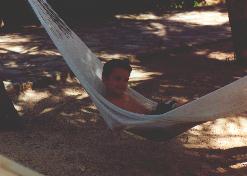 long hammocks, a single and a matrimonial, made
of sisal and crafted and sold by Maya Indians of the Yucatan Peninsula.
long hammocks, a single and a matrimonial, made
of sisal and crafted and sold by Maya Indians of the Yucatan Peninsula.
After cashing some traveler's cheques, we headed south out of town.
About a 40 minute drive south of Playa (39 miles) is the small town of Tulum (population 2,100). We passed a military checkpoint as we drove around looking for a hotel with air conditioning. We finally asked a soldier where we could find hotel El Meson de Tulum. He pointed across the street from where he was standing. (Dumb Americans.) The hotel was spartan (no phone or TV) but clean, inexpensive ($30), and it had an air conditioner as well as hooks for slinging hammocks across the room. We put our hammocks up and laid in them (though we wouldn't choose to try sleeping in one for the first time over a hard floor).
Lunch was a bit of a challenge. On the hotel manager's advice–he knew our dietary preferences from our vegan card–we drove a few miles to Maya Tulum, a "resort" consisting of a couple of dozen cabanas on a secluded beach and a very nice restaurant. The food was delicious but Eric didn't have much of an appetite. Some combination of heat, an insufficient breakfast (he only had a fruit salad), and a bouncy car ride contributed to him getting a slight fever and achy feeling. He wanted to spend time on a beach.
We combined beach time with a visit to the Tulum ruins.
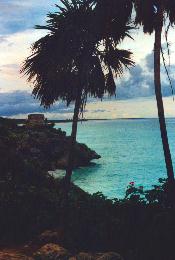 This is the only significant, ancient Maya city located on a beach. As
we lathered up for time in the sun, Eric got suntan lotion in his eye.
Already uncomfortable, he went over the top. Since there are rarely any
young kids at tourist sites, hearing one crying is even rarer. Missy sat
on the beach trying to comfort Eric and clear his eyes while Curt scouted
the ruins.
This is the only significant, ancient Maya city located on a beach. As
we lathered up for time in the sun, Eric got suntan lotion in his eye.
Already uncomfortable, he went over the top. Since there are rarely any
young kids at tourist sites, hearing one crying is even rarer. Missy sat
on the beach trying to comfort Eric and clear his eyes while Curt scouted
the ruins.
Tulum (meaning "Wall" in Maya) is the only place on the
Yucatan where limestone deposits built up to create coastal cliffs. The
Maya built a walled fortress on this site and the combination of nature
and ancient city makes for a dramatic setting. The most impressive building
is El Castillo ("The Castle"), which is perched on the cliff 80 feet above
the water. 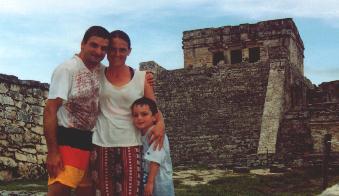 It is inviting but off-limits. It can be viewed and walked around
but not climbed.
It is inviting but off-limits. It can be viewed and walked around
but not climbed.
After Eric's eye was cleared and he got in some beach play, he and Missy joined Curt for a walk around the ruins.
Back in the hotel, Curt told Eric cowboy and Indian stories
till he fell asleep (at 6:00, three to four hours earlier than usual).
Missy went out for groceries while Curt did some laundry and broke a bottle
of Gatorade (whoops!). Eric awoke after an hour feeling very achy. Missy
went out again to get some children's Tylenol (she had seen some pharmacies
on her earlier venture out). Eric is very reluctant to take any kind of
drug or medication–taking after his parents. It took a lot of reassuring
combined with his discomfort for him to be willing to take the Tylenol.
Shortly thereafter he was asleep for the night (by 8:00). Missy and Curt
dined on peanut butter and banana burritos (PBBB). This meal, relatively
nutritious, tasty, simple to make, and for which ingredients are readily
available, served us well during our vacation.
| PREVIOUS DAY | NEXT DAY |
| Back to Curt, Missy, and Eric Homepage | Back to Start of Mexico Diary | Back to All Diaries |
© 1999 [email protected]
