Our neighbor Carol Everett drove us to the Raleigh/Durham airport two and a half hours before the flight was scheduled to depart. The extra early arrival was because Curt had misremembered the departure time by an hour. D'oh! Though he'd done flown lots of times, Eric was concerned about flying. On his most recent flights the air pressure changes in his ears bothered him. Chewing gum didn't alleviate the discomfort. (When he was younger, nursing during take-offs and landings was sufficient.) This time we supplemented the gum with noise reduction earphones (the kind ground crews wear) and he had no problems.
From Raleigh/Durham, we flew to Miami then on to Cancún. In the Miami airport we made the mistake of converting dollars to pesos and got a crappy rate (about 9:1 instead of 10:1). In the past, we would get national currency from a local bank before starting our vacation. The local banks now needed a few days notice for such exchanges and since we didn't give it to them, we went against tourist recommendations and converted our dollars in an airport (which give the worst rates anywhere).
Mexican money has some sensible and some funny aspects
to it. Their 500 peso bill has a picture of a dead horse (fallen in battle)
whose ass points to Ignacio Zarasoza (the man being "honored" on the bill).
The $200NP bill honors a 17th century Catholic nun and
poet (Juana de Assje), the $100NP sports an Indian (Nezahualcoyotl), the
$50NP bill 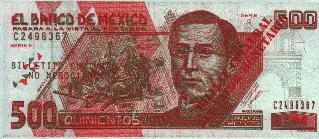 features cannons and the priest José Maria Morelos (who became a
generalissimo after defeating Spanish troops but was later captured at
Valladolid, defrocked, and executed), and the $20NP bill–in addition to
showing Mexican statesman and former president Benito Juarez–includes a
likeness of an angel statue. Current US currency doesn't honor women, artists,
victims of execution, native Americans, religious leaders, or religion
(though since the Civil War it carries the generic "In God We Trust" phrase).
We tend towards using images of presidents on our money (with Benjamin
Franklin the lone exception). As in European countries, Mexican coins have
buying power. Coins that are worth $1 and $2 US dollars are commonly used.
People were strange with torn money. We had a $10NP note with a half inch
tear in it. That would barely be noticed in a US bill. In Mexico, the $10NP
bill was refused on three different occasions because it was torn. (We
finally palmed the "old maid" card off on a toll booth operator.)
features cannons and the priest José Maria Morelos (who became a
generalissimo after defeating Spanish troops but was later captured at
Valladolid, defrocked, and executed), and the $20NP bill–in addition to
showing Mexican statesman and former president Benito Juarez–includes a
likeness of an angel statue. Current US currency doesn't honor women, artists,
victims of execution, native Americans, religious leaders, or religion
(though since the Civil War it carries the generic "In God We Trust" phrase).
We tend towards using images of presidents on our money (with Benjamin
Franklin the lone exception). As in European countries, Mexican coins have
buying power. Coins that are worth $1 and $2 US dollars are commonly used.
People were strange with torn money. We had a $10NP note with a half inch
tear in it. That would barely be noticed in a US bill. In Mexico, the $10NP
bill was refused on three different occasions because it was torn. (We
finally palmed the "old maid" card off on a toll booth operator.)
From Miami to Cancún, there was an in-flight meal but we had been told there was none so there was no vegetarian food ordered for us. We made do with pretzels and juices. The flight from Miami passed through beautiful, puffy white clouds that had rainbows arching among them. Though the clouds were scattered and the sun was brilliant, we saw lightning leaping between the clouds. On the ground and non-eventfully through customs in Cancún, we experienced another form of lightning–tour group and time share operators descended on us rapidly from all sides. We deflected their "help" and made our way to the van service for our hotel. Due to American Airlines tour package arrangements–which gave us airfare and three nights in a hotel for about the same cost as the cheapest available non-tour airfare–we were to stay in the Quality Calinda Viva where rooms are usually $120 a night. Normally we avoid high-cost places like the plague. They generally have and there were hidden costs. For example, we dropped $12 in tips just getting from the airport to our room. People affiliated with expensive hotels figure if you can afford to stay there you want to be pampered (we don't), are willing to pay (or tip) out the ying-yang for special care, and have bucks to drop at expensive restaurants and shops that grow around the hotel.
The airport shuttle bus dropped us off at the Calinda about 7:00 PM (Yucatan Peninsula time is CST or one hour behind EST). From our house to our hotel, door-to-door (including the extra hour spent in the RDU airport) took nine hours.
Cancún is actually two places, the city of Cancún
and the L-shaped sandbar, 15 miles long and a quarter mile wide that is
the Cancún Hotel Zone; technically called Isla Cancún, Cancún
Island. (Ignore the small text in the photo; they are names of hotels
and beaches.) 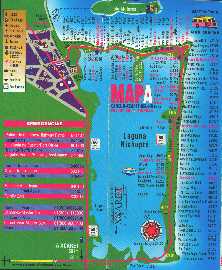 The Calinda, like all the expensive Cancún hotels, is in
the hotel zone. We had a strong sense of swimming with sharks while in
Cancún. It seems everyone wants to sell you "all inclusive" tours
or packages of some kind. "All-inclusive" is a detested phrase to us as
it generally means over-priced and under-choiced. Some people like the
"we'll pamper you including making your decisions for you and you'll pay
us handsomely to do so" arrangement, but we find it extremely unappealing.
On our vacation, doing our thing, we want to be the agents of choice and
change.
The Calinda, like all the expensive Cancún hotels, is in
the hotel zone. We had a strong sense of swimming with sharks while in
Cancún. It seems everyone wants to sell you "all inclusive" tours
or packages of some kind. "All-inclusive" is a detested phrase to us as
it generally means over-priced and under-choiced. Some people like the
"we'll pamper you including making your decisions for you and you'll pay
us handsomely to do so" arrangement, but we find it extremely unappealing.
On our vacation, doing our thing, we want to be the agents of choice and
change.
We had dinner in the 100% Natural restaurant across the street from our hotel (there are several "100% Natural" restaurants in the area). These were recommended on a webpage posting (www.interlog.com/~john13/cancún/meals.html) from a vegetarian who had toured the Yucatan Peninsula. 100% Natural has a soyburger on the menu. Surprisingly, this was something we found on the menus of many restaurants. We had our first liquados there. A liquado is a cold fruit drink containing the juice of from one to seven different local fruits. We probably had ten different types of liquados during our vacation. Another characteristic we liked that was common to the restaurants at which we dined was open air seating. With the typically beautiful weather and scenery in this part of the world, it was nice to be able to experience it while eating.
Eric and Curt scouted the beach below our hotel at night. They found the sand soft and clean and the water rolling in mild ripples, not waves. We wondered what the weather would be during our stay in Cancún. Before leaving, we visited the USA Today's weather webpage and saw five days of rain predicted for Cancún. This was not too depressing. We are aware that weather descriptions are context sensitive. A "sunny" day in a northeastern US state is a day in which the sun can be seen. In North Carolina, a "cloudy" day is one in which clouds can be seen. Both are technically accurate but misleading. A sky of big, white, puffy clouds with no threat of rain is a beautiful day in the northeast. The clearest and brightest skies one can hope to see. In NC, that's considered cloudy (at best, partly cloudy). Move a NC weather forecaster to the northeast and have him keep his same standards and every prediction would be either clouds and/or precipitation. Perhaps a prediction for rain in Cancún is inevitable, after all it is on the sea in the tropics. An eyeblink of dark skies and a dash of rain don't make for a dreary day. As we would learn, we were correct not to be concerned with the "rain" predictions.
A concern with travel in Mexico is Montezuma's revenge. The way to get the runs is by drinking unpure water. This can occur subtly as by eating foods washed in unpure water. Mexico has made great progress in reducing the incidents of this disease by widely using purified water. The large hotels even have purified water coming from their taps–in theory. We managed this risk by only drinking and brushing our teeth with bottled water and asking at restaurants if any raw fruits and vegetables were washed in purified water (the answer was always "yes"). During our vacation we avoided eating fruits with edible peels (e.g., grapes, plums, apples).
| NEXT DAY |
| Back to Curt, Missy, and Eric Homepage | Back to Start of Mexico Diary | Back to All Diaries |
© 1999 [email protected]
