Postpartum Weirdness
Sunday July 13, 2003
 The new and improved Frantz family at birth plus 1 1/2 hours The new and improved Frantz family at birth plus 1 1/2 hours |
After Cara was born, the rest of the morning was a blur, a jumble of overwhelming emotions. It would be three hours before we started calling family and friends. Audrey, Sonya, and Cindi stayed at our home--though with a very low-key presence--until it was clear that the new expanded family was doing well. They gave us time alone, cleaned up the birthing bedroom, and started the laundry.
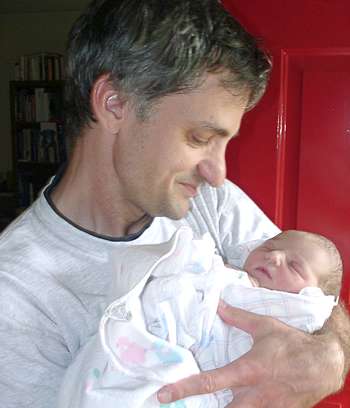 Elated dad and daughter Elated dad and daughter |
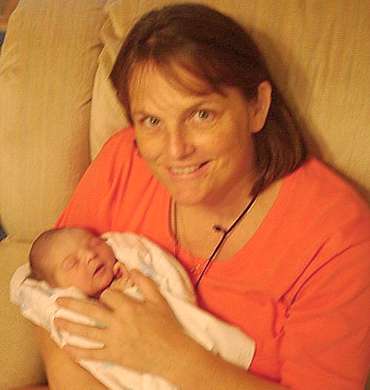 Glowing mom and her baby girl Glowing mom and her baby girl |
Cara Nicole Frantz weighed 8 lb 8 oz and measured 21 inches long. She began nursing within twenty minutes of birth. At birth, Cara had an especially cone shaped head, we guess because she sat so low in Missy for so long and perhaps because of being somewhat stuck during birth and pressed by Missy's powerful pushes. The newborn cap kept sliding off her pointy head.
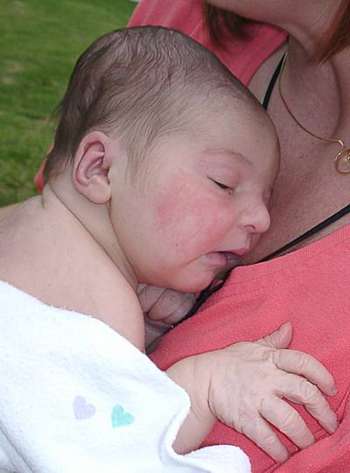 |
 (Left) Probably due to being carried so low for so long, Cara had an extreme conehead. The baby hat placed on her head kept sliding off. This photo was taken on her birthday. (Left) Probably due to being carried so low for so long, Cara had an extreme conehead. The baby hat placed on her head kept sliding off. This photo was taken on her birthday. (Above) This photo was taken one week after birth. Cara's coneness has receded dramatically. |
Thirty minutes after Cara was born, the placenta--the "afterbirth"--was passed. Eric was concerned that it was placed in the same bowl into which Missy had wretched. He was assured the bowl had been cleaned.
Missy had a couple small birthing tears the largest of which Audrey closed with two stitches. It is rather rare for a woman who births in water to have any tears but Audrey thought that this particular birth would have caused a larger tear. Eric held a flashlight for her as Audrey performed the stitching.
Sitting on our bed, holding Cara on his lap for the first time, Eric beamed at his little sister. Sonya asked him how he was feeling. Eric continued smiling and shook his head, "It's nothing I can describe. It's beyond words. More than I could have expected. If I went through it again, it would still be more than I could have expected." Wise words from one so young.
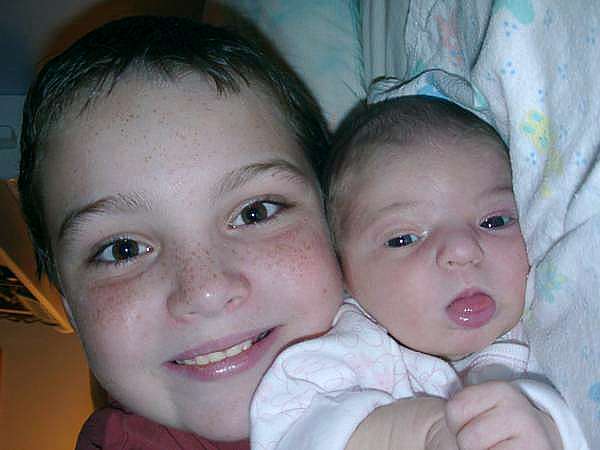 Loving brother and little sister Loving brother and little sister |
Our birthing music soundtrack consisted of over eleven hours of classical music and soft music of the last 40 years (including music by artists such as Celine Dion, John Denver, The Carpenters, Lionel Richie, Kenny Rogers, Air Supply, and Bread). The songs were being played in random order. Cara's birth song, Ravel's Bolero, was appropriate. Bolero was the music used in the 1979 movie "10" starring Bo Derek. The music was appropriate because Cara is perfect to us. An hour after the birth, another especially moving piece played, Faith Hill's Breathe. Hill's longing calls for her loved one to "just breathe" stirred Curt to embrace Missy and Cara--and cry.
Within two hours of birthing, ebullient Missy was carrying Cara downstairs and outside for a birthing party photo. The next day Cara visited with our friends at White Tiger Taekwondo. People fawned over the day old baby as well as marveling at the mother who looked supremely comfortable and happy. It makes one wonder if postpartum depression is caused or worsened at least in part by a birthing process that robs the mother of her womanhood. The honoring of her womanhood and the empowerment that this birthing experience provided for Missy were complete.
The day of and after her birth, Cara had difficulty being moved between people or just having her position shifted. We initially chalked it up to having a hard time with transitions (she seemed reluctant to transition from the womb to the external world). Then we realized she was probably just very sore from the birth experience and being moved aggravated that soreness. This dislike of being moved disappeared within a couple of days.
During her first day, Cara had three states: sleeping, crying, or nursing. The voice that most calmed her in her crying state was that of her big brother Eric. By the second day she had recovered enough from her birthing ordeal that she added a fourth state; alert and mellow. When Missy's milk arrived in the morning of day three, the nursing state seemed to become Cara's favorite. The guidelines for breastfeeding babies are that they are expected to lose weight in the first few days after birth while they are only getting colostrum from nursing. This special milk is low in volume and fat, and high in carbohydrates, protein, and antibodies to help keep the baby healthy. Nursing babies are expected to regain their birthweight by their second week then to gain an ounce a day. By her fourth day, Cara had gained half a pound over her birth weight strictly from breastnurturing.
 |
 (Left) Cara's wombmate, the placenta. We stored it in our freezer. In the future we'll look at slices of it under a microscope and then bury it beneath Cara's tree. (Left) Cara's wombmate, the placenta. We stored it in our freezer. In the future we'll look at slices of it under a microscope and then bury it beneath Cara's tree. (Above) Our sacred cenote. The white area is a reflection of the bathroom skylight. |
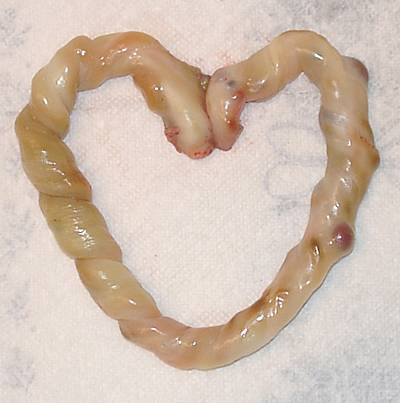 Eric had three goals regarding the birth: catch the baby, announce the gender, and cut the cord. He did the first two but the cord's normal cutting end near the baby broke so he cut the placenta end. We shaped the umbilical cord into a heart and allowed it to dry. Makes a cool wall-hanging. Eric had three goals regarding the birth: catch the baby, announce the gender, and cut the cord. He did the first two but the cord's normal cutting end near the baby broke so he cut the placenta end. We shaped the umbilical cord into a heart and allowed it to dry. Makes a cool wall-hanging. |
What if it were a planned hospital birth?
Had we gone the typical route of an OB/Gyn hospital planned birth, it would almost be a certainty that Missy would have been induced at two weeks past her due date. Missy's body and/or the baby may have been delaying labor for critically important, but unrecognized, reasons. It's unlikely any need for additional delay would have been honored. When administering pitocin to induce labor, a woman is largely immobilized and connected to a monitor. She becomes a patient with a medical condition and the loci of attention shifts to the hospital staff and what they are going to do.
The stronger but less effective pitocin induced contractions may have weakened Missy to the point of accepting if not asking for a drugged birth experience for her and the baby. Had her contractions fallen on top of each other in the hospital, as they did at home, this likelihood would have been much greater. The local hospitals do not have birthing tubs and it was the tub that spaced out the contractions.
When Missy called out, "She's stuck!" An attending physician, if he were listening to and trusting Missy, might have thought "get the forceps ready."
Eric would not have been allowed to help catch the baby. We would not have been allowed to keep the umbilical cord or the placenta.
Cara would not have gotten to know all those who had the honor of being at her birth and vice versa. As Cindi Freeman said while holding Cara a few hours after her birth, "I'm going to enjoy watching you grow up." Everyone at Cara's birth knew her family and already loved her.
When the unexpectedly short umbilical cord broke--which almost certainly would have happened in the hospital as it did in our home--Cara would have been taken from us to a place beyond our view. Our anxiety would have been worse and for longer than it was at home where we could see her breathing and struggling to cry.
The presence of the midwife, doula, and family friend enabled Curt and Eric to stay with Missy throughout the birthing. We would not have wanted to birth without their presence; whether at home or in a birth center or hospital. During Missy's birthing of Eric, Curt often left her side between contractions to get water, play music on a cassette deck, interface with the hospital staff, adjust the camcorder, etc.. Numerous studies have shown the enormous value of having a doula during childbirth. With a doula and the knowledge and caring they bring present:
- Cesarean rates decreased by 50%
- Labor shortened by 25%
- Requests for pain medication decreased by 30%
- Epidural requests decreased by 60%
- Need for forceps decreased by 40%
- Oxytocin (Pitocin) use decreased by 40%
- Greater sense of fulfillment with the birth experience
- Reduced use of vacuum extraction
- Reduced chances of health complications and hospitalizations of baby
- Reduced chances of maternal fever and infection
- Reduced maternal bleeding following birth
- Increased chances of successful breastfeeding
- Reduced incidence of post-partum depression
- Reduced levels of anxiety with mothers feeling more in control and secure
- Increased chance of spontaneous vaginal birth
- Mothers have higher regard and increased sensitivity towards babies.
When Cara was two days old, we took her for Craniosacral Therapy. We heard of this form of therapy from friends who experienced it firsthand or had it done with their newborns to amazing results. The craniosacral system consists of the brain and spinal cord, the fluids that bathe them, the membranes that enclose that fluid, and the bones (skull and spine) that house those membranes. Craniosacral Therapy is the gentle manipulation of this system to release restrictions or fluid pressures to enable the bones to move into their appropriate positions. Craniosacral therapists are typically massage therapists, chiropractors, or osteopaths who have had special training.
There was no particular problem we were looking to address, Cara had a cone head but that's fairly typical of newborns and we thought it would correct itself. We sought out a craniosacral therapist because we thought of Cara as a person who had just undergone a traumatic experience and who might need a gentle form of physical therapy to detect and deal with difficulties associated with her birthing--as she could not express any problems she might have in words. As a society, this is not something we generally think about but here is a life changing event that happens to a person (being born) at a time when they don't have many life event contexts into which it could be placed. It is incredibly difficult and dangerous to be born. (The infant mortality rate for newborns in the U.S. (in 1998) was 7.2 deaths per 1000 live births. This placed the U.S. 28th of the countries reporting their rates to the World Health Organization. It is a mortality rate 15 times higher than that for military personnel deployed for the second Iraq war.) Yet few of us ever think about therapy for a newborn that does not have an obvious medical condition.
The craniosacral therapist we saw, Wanda Sundermann, was incredible! She completely accepted and respected Cara as an individual. She asked that she be taken from the room when Missy related the details of her birthing, so she need not relive that experience. Clearly Cara could not understand the words Missy would use, but the emotional state she might enter could be something with which Cara was very attuned.
When Curt returned to the therapy room with Cara, Wanda asked to hold her, then asked Cara in the most gentle and caring voice if it would be all right with her if she worked with her. Cara made an agreeable expression to which Wanda responded, "I'll take that as a 'yes'." Wanda continued talking to Cara as if she were an adult, knowing the words would not be understood by her but the emotions being conveyed by Wanda and Cara's nearby parents would have a comforting and encouraging effect. Wanda gently held Cara's head and told her about her bravery and strength during her birthing. Wanda placed a gloved finger in Cara's mouth and felt the strength of her sucking. She detected the soft palate at the roof of Cara's mouth was not centered. She gently helped Cara correct that. She lightly touched Cara's jaws and talked about how difficult it must have been to struggle for her first breaths; to have had an oxygen mask placed on her while she struggled to breathe. Cara's jaw dropped open, she worked her tongue and mouth making little sucking movements. After a few minutes, Wanda said to Missy, "I think she might want to nurse."
Cara had a habit of tightening her jaw and clenching both her fists near her mouth whenever she went for a breast--as if protecting her mouth. This made nursing difficult. Her mouth and nose had undergone the trauma of having CPR applied to them shortly after birth. Missy took Cara to her breast. For the first time, Cara let her arms fall apart and her mouth opened widely to take in Missy's nipple. It was like magic.
After breastnurturing, Cara returned to Wanda. Wanda touched her spine in a few places and held her hand on Cara's lower back. "Oh, you have tenseness here. You can let that go Cara." As Wanda talked softly to her, Cara began relaxing her legs. They twitched, then gradually became loose and fell open. After awhile, Wanda turned Cara on her side and found tenseness in her left shoulder. She placed a hand on it then after a few silent minutes, told us Cara was doing wonderful, releasing that tenseness as well. She turned Cara's arm and her hand fell wide open, fingers completely relaxed. Not something newborns typically do.
During this craniosacral therapy session, we spent nearly two hours with Wanda in her beautiful home, we saw immediate benefits in improved nursing, and the cost for the session was just $50. It was incredible! How many health care providers offer that type of care or pricing? Wanda said that Cara did a great job and probably didn't need a second session. We were amazed by the beauty and the magic of the experience and will explore it further for the entire family.
Approach To ParentingWe've posted a description of some of our parenting practices and beliefs on our website.
| Topic | Assertion |
| Healthy, Natural Parenting | Healthy parenting begins with an understanding of and respect for the animal nature of our human physiology. |
| Learning From A Newborn Baby's Animal Nature | A newborn baby gives parents an opportunity to get back to their animal roots. |
| The Manly Art of Fathering | Our societal understanding of "manly" has changed and it can lead to a different, healthier approach to fathering. |
| Birth Story of Cara Nicole | Curt, Missy, and Eric Homepage | Other Curt, Missy, and Eric news |
© 2003 [email protected]
