Republic of South Africa Provisional Patent for:
FOLDING POCKET KNIFE TYPE
KEY HOLDER SYSTEM
or
otherwise known by aliases:
a)
Flick key.
b) Key
blank pocket filing holder.
c)
NuKey.
d)
Flat key.
e)
Pocket key.
f)
Easy Key Case.
g)
Sauermann Key system.
Abstract
This
system and device is intended as a replacement for the traditional key ring
arrangement where a person puts his keys onto a chain or ring for easy
management.
The
device will be easier to store, manage and handle than the normal key ring used.
Ease and speed of selection of keys is ensured.
The
system consists of empty key templates or blanks sold by a locksmith, which can
be mounted into the pocketknife type assembly device. When the user needs keys
to be added to the empty device, he then takes the device to a locksmith, along
with his old keys. The locksmith can then make copies of the old set of keys
onto the empty key templates/blanks, designed to fit into this folding device,
with the same method as used with standard key templates/blanks. These new keys
then get added to the folding holder.
The
key templates can be of different colours for easy identification.
Additional
units may be added to the folding holder such as transponders, lights, lasers
and tool implements.
Inventor: Sauermann, Frans Johan
Applicant: Sauermann, Frans Johan Provisional Patent No: Physical Address: Field of the Invention This invention relates to any application
where keys as those commonly found in homes and offices must be periodically
handled and used. It is particularly applicable to the use of pocket key cases
to prevent wear and unsightly bulges in clothes where compactness and ease of
selection of the proper key is essential. The ease of use and the
blank/template key system is also considered as opposed to the single folding
device. Improvements on previous
devices and methods Traditionally,
up to now when a person wanted a copy of any of his keys, he would take the key
in question to the locksmith to make a copy for him. The locksmith, with
specialized machinery and a key template that is alike in shape to the key that
is to be copied, then commences to make a
copy of the key. When the locksmith is done with the copy process, he hands the
original and the copy of the key back to the customer, who then goes to the
counter to pay for both the template and the copy service from the locksmith. The
key that was copied will have the same functionality as the original key. In
choosing a template a person is also faced with different colour
templates/blanks, to make picking out semi-identical keys easier. The user then
usually adds his new keys to a key ring or similar assembly. In
addition to key templates/blanks, most people have now grown accustomed to,
own, or have least seen a pocketknife before. In
particular, most people know of the "Swiss Army Knife" brand knifes
that exceed in quality and craftsmanship to other pocket knifes. These knives
pack a lot of functions into a small package, and are remarkably easy to carry
around in a normal trouser pocket. In
times of writing of this patent, it was known by the inventor that the average
grown and working person carries at least three items in his pockets: - A
cell phone - A
wallet -
Keys, possibly divided into car keys and building chains. Since
these days security is at a premium, any person is liable to carry around any
of the following on his key chain: - Car
ignition key. - Car
immobiliser button. - Car
Gear lock key. - Car
steering lock key. - Car
door key. - Home
Parking garage key. -
Garage transponder. - Car
Alarm disable dongle. -
Driveway gate key. - Home
Front door gate key. - Home
Front door key / yale lock key. - Home
Back door key. - Home
Back door gate key. - Safe
key. - Work
garage key. - Work
outer office key / keys. - Work
inner office key. - Mini
LED Light - Mini
Laser pointer Since
so many keys can be used by a single person, they tend to take up a lot of
pocket space. This can inconvenience a person by scratching, pinching and
irritating his skin. In overall, a lowering of quality of life can be gained by
carrying a lot of keys. My invention attempts to alleviate this social illness. In
addition to keys, the modern person also carries around a cell phone. Since
cell phone theft is rampant, a person normally would opt to put his cell phone
in his trouser pocket, and usually in the front trouser pocket. With a wallet,
the same can be said, since putting it in the back pockets makes it easier to
steal. What
with a cell phone and a wallet, much less space is left inside the pockets of
the trousers to keep the keys. This has some people to resort to having keys on
an external chain or other odd retractable devices. If the
keys are kept in the pocket, they are liable to tear at the pocket material, as
these pockets weren't designed to take the continual poking of the keys while
walking. Numerous
trousers have been ruined due to damage from keys. The
pocketknife is known and loved by many. It is a compact tool with a variety of
uses. It usually includes a cutting blade, with additional blades that perform
can opening, corkscrew, screwdriver and bottle open functions. Examples of this
type of knife include the Victorinox and Wenger
type pocket knifes, and all their respective models. It also includes the other
less well-known imitations of the original Swiss army knives, now available
widespread even in big retail stores. The pocketknife has the advantages that
it is very small in relation to most everyday tools. It is
also surprisingly lightweight and durable in most permutations. The
construction of the pocketknife leads it to easy manufacture, with well-defined
interlocking parts. This is due to its ability to present these tools in an
easy folding type assembly. To
solve the problem traditionally experienced with keys as explained above, I
have devised a means of combining the advantages of folding pocket knife
technology with standard� locksmith
practice to yield a key blank system that is extremely useful, and a device
that is easy to adapt as new keys are added. The basic idea is to use a system
of empty key templates or blanks, which would normally bet cut to a user's
specification. These
key blanks are manufactured with an altered profile to fit a folding key holder
device. These
altered key templates/blanks can have the same front part of the usual key
templates/blanks, with the back part, usually held in hand when in operation,
is in a shape that facilitates the pocketknife type frame or assembly. This key
can be held in place with a mechanism similar to those used in most pocket
knifes, or it can be friction mounted on a shaft. The
whole device will be modular, so that extra keys can be added when needed, with
extra spacers and spindles available from a locksmith outlet. Now,
this device has several distinct advantages over normal key chains. Firstly,
esthetically it looks better. A folded pocket assembly looks neater than a
bunch of keys lying around. Secondly
the keys, once cut, will remain in the same relative positions, making it
easier to find keys in the dark and also to have numbered designations to the
keys. Thirdly,
the key assembly will not scratch, poke or pinch the way normal keys do in a
pocket. Fourthly,
the key assembly will take up less space in a trouser pocket, making it ideal
for modern day application. Fifth, the keys themselves are protected
from damage, and will last longer this way. Sixth,
additional tools and keys can be added as needed. The
system will be compatible with commercial key - cutting machines such as the
Silca range of key cutting machines. Just
slot the blank into the machine as you would with any standard blank. The
device itself can also be used for storing transponders, lights and electronic
keys that are compatible with the system, with side covers that are
interchangeable for different models. Prior Art The
use of key holders within key cases has been prevalent for many years wherever
keys must be used and selected in an orderly manner, and carried where damage
might occur to clothing or compactness is desirable. I feel that the following
patents classify as the prior art that is closest to my invention: Inventor� ���� ���� R.S.A. Patent number John
Godsiff�� ���� 77/3338 Anton
Tsamas.�� ���� 89/6465 Ariel
Gluch���� ���� 92/3636 Wilhelmus
Mommers���� 83/4522 Beatrice
Foods Co.���� 78/1341 Inventor� ���� ���� U.S. Patent number Toyoda;
Minoru��� ���� 4,389,864 Yang;
Tayhugh L.�� ���� 4,289,003 Sorensen;
Peter H. ���� 4,596,126 Wing;
Russell T.���� 4,646,913 Kim;
Bonjue �� ���� 4,653,299 Jacobsen;
Stephen C.4,688,410 � My
invention differs radically from all other prior art in that: a) No
prior art ever investigated the possibility to use the holder as part of a
SYSTEM of key blanks specifically designed for the holder. b) No
prior art uses a folding holder of the pocketknife type as described here. My
invention implements the required in a neat, pocketknife type assembly. Examples
of implementations in prior art is the following: i) A
case for inserting a key with key ring into, that can be locked, folded etc.
This case can take the form of a shell, sliding pocket or even a purse in most
implementations ii) A
click-on click-off key ring attachment for easy removal of other key rings from
each other. iii) A
key that folds into a flat assembly imprinted with the reverse image of the
key, thus giving a flat surface. iv)
Spring mounted and sliding assemblies. v)
Flat plastic cards that have indentations where keys can be fastened to, or
snapped to. vi)
Belt or buckle mounted boxes. vii)
Retracting chains and associated devices. viii)
Folding knife assemblies with compartments in it to keep keys separate. These
are cumbersome and include extra parts such as key movement fingers. ix)
Box assemblies where the key is slid in and out of the assembly by an external
button. c)
Most prior art also focuses on A specific, given key, and not on keys already
existing as generic blanks in their various shapes and sizes, to be used by the
public. My invention relies on custom key blanks cut to the specific profile of
the holder device. d)
Many prior art inventions focuses on the mounting of a key grip, or
transponder, to the main key body. e) My invention is a modular device. As
new keys are needed, the device is expanded to have the space available for it,
with the minimum hassle or financial expenditure. No prior art takes modularity
into account. f) My
invention is extremely straightforward to manufacture, and it includes no
intricate moving parts. The manufacture can be fully automatic. A small effort
is needed to assemble the device. Either the locksmith or the user of the
device can do this. All other prior art assumes mechanical assemblies that are
quite difficult to manufacture, and requires human intervention in the assembly
line. g) All
prior art treats the symptom instead of the disease: Given that keys are
inconvenient, it attempts to design a solution around the existing keys. My
solution is an attempt to standardize a key blank set that will fit snugly into
a folding device as stipulated here. Thus, my solution treats the disease,
which is that the keys themselves have to change to fit into my device. With
modern locksmithing practice, this is achievable and easy to do. h)
Most prior art requires superfluous parts which is susceptible to breakage,
including trays and lids, whereas my invention is minimalist in its material
requirements and quite sturdy. i) All
prior art focuses on the patent itself, isolated from real world issues like
manufacture, distribution, marketing, sales and service around it. My invention
takes into account all of the above mentioned. j) My
patent has commercial viability, whereas prior art only serve as gimmicks and a
waste of time for patent offices worldwide. k)
Some prior art uses leaf springs to hold keys in position. These springs are
susceptible to breakage. My device does not contain such springs. l)
Some prior art requires the keys to be cut from templates that are essentially
unworked metal, which is unfeasible and too generic for the average locksmith
and tools generally available. Claims
1. A
folding assembly that is capable of housing keys and key blanks specifically
manufactured for it, or adaptable to it. 2. The
device of claim 1, that is capable of housing transponders, LED light units,
Laser pointer units, nail file units, bottle opener units, or any units that
fits with, and / or designed for, the profile of the device. 3. The
device of claim 2, with side covers mounted on the edges, or with side covers
omitted when profiled side plates are used. 4. The
device of claim 3, with side plates mounted inside the side covers if they are
present. 5. The
device of claim 4, with shafts extending between the mounting plates, which
keeps the device together, and which may be of a variable size, and upon which
key blanks or other units can be mounted. 6. The
device of claim 5, which may also contain either washers or divider plates
mounted between key blanks or other units. 7. The
device of claim 6, which may contain a click bar to keep keys or other units in
place. 8. The
device of claim 7, which may contain spacers of variable width taking the place
of keys or other compatible units. 9. The
device of claim 8, on which may be mounted a spring washer of variable size for
keeping the unit tightly together. 10.
The device of claim 9, with the shafts either consisting of nut-and bolt
components, shafts with split pin assembly, or shafts with permanently mounted
nuts on it. 11.
The device of claim 10, with the side covers made of plastic, stainless steel
or any other suitable material. 12.
The device of claim 11, with the side covers of any colour as required. 13.
The device of claim 12, with the components made of stainless steel, iron,
plastic, spring metal or any other suitable material. 14.
The device of claim 13, on which can be mounted keys cut with the outer
profile, or with a profile close to the outline. 15.
The device of claim 14, with the keys made out of a suitable material for
cutting on normal locksmithing machines. 16. The
device of claim 15, with the side covers transparent or opaque. 17.
The device of claim 16, with the side covers either having mounting holes for
bolt assemblies, or recesses for split pin and permanent nut assemblies. 18.
The device of claim 17, with the side plates having holes inside it to
facilitate the mounting of the shafts. 19.
The device of claim 18, with the side covers having the profile of the nut in
the case of a nut and bolt type assembly. 20.
The device of claim 19, with all possible permutations of the parts described,
mounted on it. 21. A
system of key blanks, fitting the profile of the folding assembly of claim 20. 22.
The system of claim 21, with the key blanks having an outer profile a little
smaller, close to, or exactly the outline of the side plates or side covers. 23. The system of claim 22, with the key
blanks having an inner profile that conforms to the specific key blank in
question. 24.
The system of claim 23, with the key blanks having a standard mounting end
where the mounting shaft can go through. 25.
The system of claim 24, with the mounting end having either a round profile, or
having a profile that conforms to the outer profile of the side plates or
covers. 26.
The system of claim 25, with the mounting end having a hole on it to facilitate
the mounting of the keys on a shaft. 27.
The system of claim 26, with the key end having a profile that is either flat
as viewed from above, or profiled to fit the keyhole in question. 28.
The system of claim 27, with the key blanks being of a variety of colours. 29.
The system of claim 28, where the key blanks may have extended front ends to
facilitate resting on the opposite end of the device of claim 20. 30.
Any other informal or formal claims as stipulated in this patent application. Alternate forms of the
device The
device in question can also take on a few minor permutations with the main
differences being which size of bolt is employed. Other,
lesser used permutations include the presence of the bottom key lock bar, and
divider plates. Since
this device is extensible by adding additional keys, the bolt can be of various
sizes. Since
the folding assembly is a modular device, part of a key system, additional
implements can be added later on with a variety of uses. All permutations
described in the patent application needs to be considered. For example the folding assembly can be
sold apart from the key blanks with the following inclusive: Basic
kit: -
space for 4 keys. - side
plates, side covers - 2
short size bolts. - 2
nuts - 4
spacers - 6
washers Upgrade
kit 1: - 2
medium size bolts - 4
spacers - 4
washers - 2
spring washers Upgrade
kit 2 - 2
long size bolts - 8
spacers - 8
washers. - 2
long spring washers Accessories: - Nail
file - LED
light -
Laser pointer -
Bottle
opener. All
other variations and combinations can also be considered within logical bounds.
More upgrade kits can be added as seen fit. Parts of various
permutations of the device Please
refer to drawings as referenced. a) Side cover i) The
Side cover is a piece of flat plastic or metal, rounded on the edges, with the
outside surface smooth, and the inside surface indented with the necessary
spaces to accommodate snapping to, or being fastened to, the body of the device,
depending on implementation. ii)
The side cover can be transparent or opaque, to allow the user to see the
inside of the device iii)
The side cover can be, on later versions of the device, developed as a housing
of transponder devices and buttons. iv)
The side cover can have beveled holes in it to facilitate the fitting of bolts
that keep the device together, and enable the device to be extended. v) The
side cover can have a label area for the user to fill in any particulars he
sees fit. vi)
The side cover can have glue put on it to affix it to the side plate, or it can
have a fitting which snaps onto the side plate, or it can have a pattern which
snaps onto a nut protruding from the side plate, or it can have holes in it to
facilitate the mounting of a bolt and the hexagonal fitting of a nut to keep
the nut from moving. b) Side plate i) The
side plate is a piece of flat, stainless steel, rounded on the edges that
servers as the hard edge of the device body inside the side Covers. ii)
The side plate can have holes inside it to facilitate the mounting of bolts,
split pin bolts and shafts through the device body. iii)
The side plate can have holes in it to facilitate the mounting of the side
covers. iv)
The side plate can have nuts permanently attached to it to facilitate the
mounting of side covers. v) The
side plate can be marked on the inside with manufacturer details and patent
information. c) Divider plate, not commonly used in
the main implementation i) The
divider plate is a piece of flat, stainless steel, rounded on the edges, and
recessed in the center. i) The
divider plate serves as a divider between keys, spacers, click bars and divider
washers. ii)
The divider plate is recessed to allow easy finger access into the device iii)
The divider plate adds physical stability to the device, and ensures that the
device may only be used from the one side. iv)
The divider plate can have holes inside it to facilitate the mounting of bolts,
split pin bolts and shafts through the device body. v) The
divider plate can be recessed in the center, or be extended in the center to
facilitate another shaft mounting hole. vi)
The divider plate can have a hole in the center to facilitate the mounting hole
for a click bar. d) The click bar, not commonly used in
the main implementation i) The
click bar is a flat to key-blank thickness piece of stainless steel metal,
rounded on the edges. ii)
The click bar is mounted beneath the key blanks to provide stability to the
keys and enable them to click into either an open, halfway or closed position. iii)
The click bar is supported on a bolt or shaft through the center of it iv)
The click bar has a "U" hole on the center to facilitate both a
bending action as well as a mounting point for the bar. v) The
click bar is supported both sides by either a key blank or a spacer, to keep it
from rocking. vi)
The click bar returns to a position flat relative to the body of the device, if
the key blank is either in a fully open or fully closed position. vii)
The click bar can either have a divider plate, side cover, washer or spacer
mounted next to it. viii)
The click bar ensures that the device is only used from one side. ix)
The click bar keeps all keys in their closed position when they are not in use. e) Spacer i) The
spacer is a round or rounded piece of plastic or stainless steel. ii)
The spacer is key thickness. iii)
The spacer has a hole inside it to facilitate the mounting of a shaft or bolt. iv)
The spacer can be fitted between washers, key blanks, divider plates and side
plates. v) The
spacer can be fully round to facilitate an open type device, or it can be half
round to facilitate the mounting of a click bar. vi)
The spacer can either have a divider plate, side cover, key blank, washer or
another spacer mounted next to it. vii)
The spacer can be used as a stabilizing element in the device. f) Shaft with split pin, not commonly
used in the main implementation g) Nut and bolt Shaft. i) The
nut and bolt shaft consists of a bolt part and a nut part. ii)
The bolt part has an allen key inner female head, or phillips type inner head,
or flat screwdriver inner head. iii)
The bolt part has a round profile on the head outer. iv)
The bolt part has a screw thread that is the thickness of the nut screw thread. v) The
nut part has an outer hexagonal profile. vi)
The nut part has a screw thread on the inner side. vii)
The nut part has a rounded exterior side. h) Shaft with permanent nut mountings
on end, not commonly used in the main implementation. j) Washer i) The
washer is a round or rounded piece of plastic or stainless steel or other
material. ii)
The washer is less than key thickness. iii)
The washer has a hole inside it to facilitate the mounting of a shaft or bolt. iv)
The washer can be fitted between spacers, key blanks, divider plates and side
plates and other units. v) The
washer can be fully round to facilitate an open type device, or it can be half
round to facilitate the mounting of a click bar, or it can fit the outer
profile of the mounting unit. vi)
The washer can either have a divider plate, side cover, key blank or spacer
mounted next to it. vii)
The washer can be used as a stabilizing element in the device. viii)
The washer keeps the elements from moving unnecessarily, and eases the movement
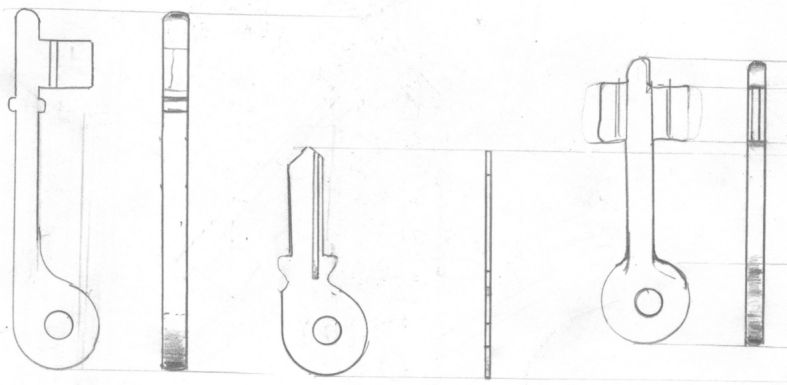
of one key relative to other keys. k) Keys / Key blanks. i) The
key blanks conform to all claims made as above. ii)
The mounting end of the key blanks is described in the drawings. iii)
The front end of the key blanks is left undefined, except for the requirement
that it fits with the outer profile of the mounting frame. l) Spring washer i) The
Spring washer is a spring flanked by two round or rounded� pieces of plastic or stainless steel. ii)
The spring washer is intended to hold keys to one side on� a partially empty device. iii)
The Spring washer has a hole inside it to facilitate the mounting of a shaft or
bolt. iv)
The Spring washer can be fitted between washers, key blanks, divider plates and
side plates. v) The
Spring washer can be fully round to facilitate an open type device, or it can
be half round to facilitate the mounting of a click bar. vi)
The Spring washer can either have a divider plate, side cover, key blank,
washer or another spacer mounted next to it. vii)
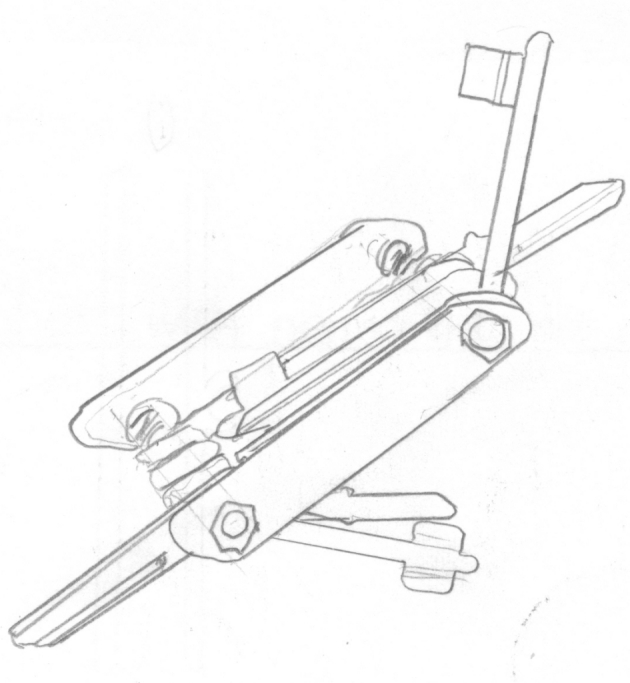
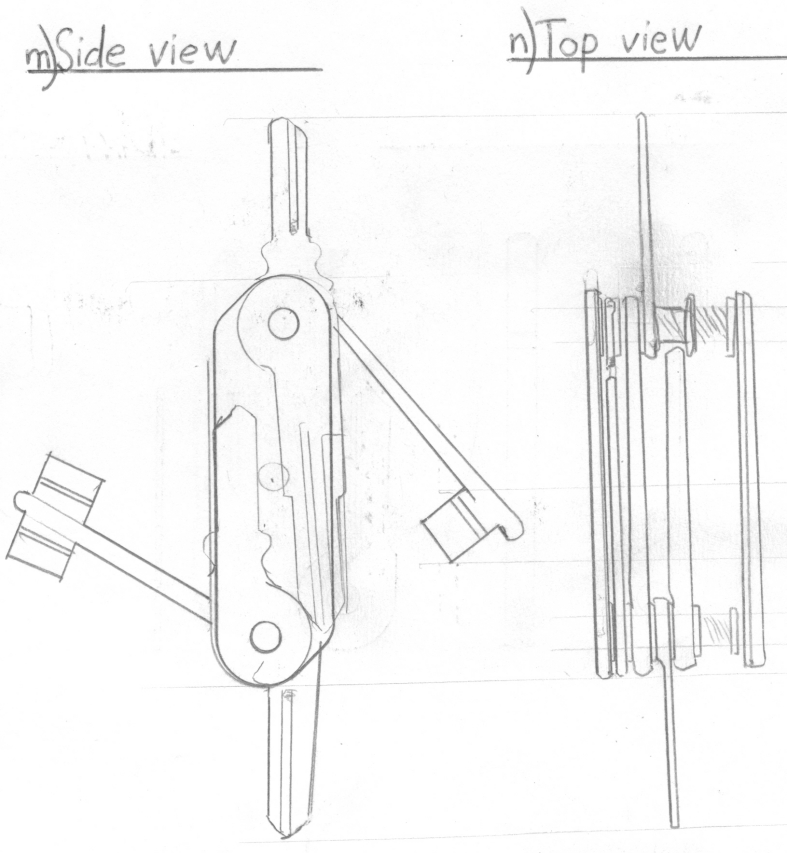
The Spring washer can be used as a stabilizing element in the device. m) Side view n) Top view � medium sized example o) Isometric view � medium sized
example Draft drawings of variations also
attached. A
manufacturer of key blanks can buy manufacturing rights for this invention. A
small change on the machines in the assembly line needs to take place, and then
the necessary key blanks can be manufactured as normal. The
folding device needs to be manufactured on a different assembly line, but since
only two very simple parts needs to be manufactured, it won't cause difficulty. The
key blanks for this invention can take the normal route of distribution through
existing channels as set up by the key blank manufacturer. They will eventually
end up on a hardware store or locksmith display case, where it can be cut to
the user's specification. The locksmith can also sell the folding device and
install the first few keys himself with minimal effort. Mostly
word of mouth marketing will be used. The locksmiths will recommend this
product, and incentives by the manufacturer can be given. Television
advertising and other media can be used to introduce the device, from where it
will penetrate the market. The goal of this invention is to perpetuate the
market completely. Any
logical minor adjustments to the key system and/or design of the device this
patent should also be considered as a given. Minor adjustments on the design of
the holder should be allowed on a basis of practicality. Possible modifications to the device
Manufacture
Distribution
Marketing