| LINER
NOTES
From the second album to
now
In September 1977, the
group discussed the possibility of signing up a lead singer to allow Hans
to concentrate more on his keyboard work. Additionally, they imagined that
a singer would have a beneficial effect on the visual aspect of their
show. They hoped to find a singer with a different voice to Hans', one who
would add new colours and dimensions to their music. But finding a singer
would prove difficult given the complex and primarily instrumental nature
of their music. No auditions had go out been planned; the group just
decided to go out and find a singer who was free.
Roine considered Magnus Uggla, a highly theatrical singer. He'd released
two albums on CBS, and although he hadn't enjoyed much success, his
qualities as a singer were plain to see. Live, his stagecraft could much
offer to Kaipa, a band that didn't go in much for onstage trickery, apart
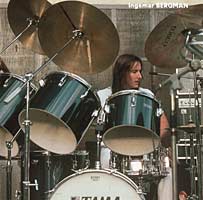
from the periodic interventions of Ingemar. In spite of all, though, Kaipa
never contacted Magnus, who subsequently went on to become one of Sweden's
most popular singers, selling hundreds of thousands of records!
Another singer the group toyed with was Derek Hudson of the folk-rock
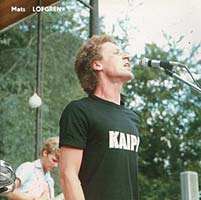
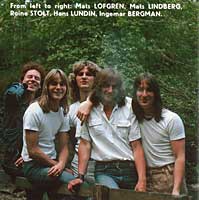
group Scafell Pike but in the end they plumped for Mats Lofgren (b.1951),
a member of the jazz-rock group Rio Brazzaville and a friend of Ingemar's.
After a few conclusive try-outs and the recording of some demos, Kaipa
welcomed him into the fold in October 1977. Mats also had the advantage of
being a guitarist and percussionist, and later on he'd play percussion
live with the band. However, Mats didn't bother with any visual gimmicks,
make-up or costumes- rather like Kaipa themselves.
Hans, who up until then had handled vocals, had a very individual voice,
but Mats had a deeper tone and a different timbre. The bands followers
were suspicious of the change at first but soon grew to appreciate Mats'
qualities as a singer.
After a while, he was 'adopted' by the band's fans as they got used to the
change in the look and sound of the group (at this time, Kaipa were still
playing material from their first two albums only on stage).
After Tomas Eriksson left, the band had the opportunity to ask one Lars
Hoflund, then playing with Tomas Ledin, to join, but instead he preferred
playing blues, and anyway he could earn much more money playing with Tomas
Ledin. Kaipa then called up Mats Lindberg, a school-friend of Roine's who
was only 18 years old at the time. Roine and Ingemar knew of his qualities
as a bassist, jammed with him in their rehearsal room. He was also a nice
guy and was equally at home playing guitar. He could play 12-string and
was able to handle the double-neck guitar left by Tomas. He duly joined in
November 1977.
Tomas' characteristic bass sound and lines had been very much a part of
the original Kaipa sound. The group, with its two new members, decided to
make up for this very considerable absence by throwing themselves into
their work investing all their energy in a new album.
By now, having gained quite a reputation as Sweden's premier prog outfit,
Kaipa determined to cut an album a year to satisfy the demand and sustain
the interest of their public
Throughout the autumn of 1977, Kaipa worked on new songs and set about
rehearsing and perfecting them. Somewhat restricted by the limited
playing-time of the new album, the band selected their favourite new
numbers and some of the songs written since 'Inget...' had to go. This was
a democratic choice undertaken by all the band members.
For this album, Kaipa utilized for the first time pre-production
techniques, at that time a little-used process. Firstly, the band laid
down the tracks on demos on a cheap 4-track recorder in October and
November 1977. During these sessions, they worked for the first time with
some new instruments. Hans played a Poly moog and Mats used a Moog bass
pedal. Roine tried out a new guitarsynth manufactured by the Swedish firm
Hagstroem in collaboration with Ampeg.
A few of the new songs originally had English lyrics but the band decided
to rewrite them in Swedish. Their efforts to break the international
market with an English language version of 'Inget nytt under solen' hadn't
succeeded, and so Kaipa reverted to their native language.
The recording of the album was set for December 1977 in Europa Film
Studios in Stockholm, a famous studio complex which was regarded as one of
the best in the country. Sessions began on 19th December and ended on
27th, with the music transferred onto 24 tracks with the assistance of
sound engineer Olle Ramm.
Although Kaipa knew the studio well, it was some time before they could
get the synth, drum or synth-orchestration sounds they wanted, preferring
to record a sound different to that produced by the band on stage. Roine
tried to convince the other members of the band of the importance of using
a mellotron on the new album. Hans managed to hire one, but it was in such
poor condition it could only be used on one track, 'Taijgan', and it broke
down completely soon after the recording! The uncertain pitch produced by
this instrument lends 'Taijgan' a bizarre, other-worldly atmosphere.
Oddly, the band had never owned a mellotron; they'd always hired them.
Roine loved the sound of the instrument but the rest of the band were
never so keen!
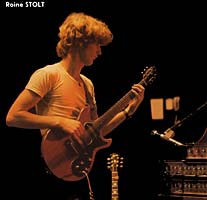
Roine used some guitar-effects, running it backwards, multilayering etc.
as practiced by players such Brian May of Queen. He used a Fender
Stratocaster and a very rare Melody Maker as well as an Ovation acoustic
in addition to his own instruments. All his guitar work was treated
through a customized pedal-board and amplified through a new Roland Jazz
Chorus Amp. He also resorted to the aforementioned guitar-synth with an
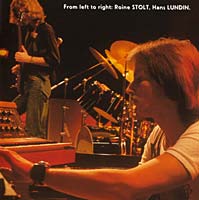
Oberheim expander, a customized talk-box and an HH echoplex. Hans used a
wide range of keyboards, mini and Poly moogs, Korg String 2000, mellotron,
Hohner clavinet, grand piano, Hammond organ and a Fender electric piano.
Mats Lindberg played a Fender Precision bass. a double-neck Shergold
guitar and also a Danelectro fretless bass with Moog pedals and Sunn Amps.
The mixing took place between 3 and 5 January 1978. The album was produced
by the band and Olle Ramm. It contained fewer reverb effects than before
and the guitar and drums were more to the fore on the soundstage of the
record. This predominance of guitar and the fact that Roine had written
most of the songs could have provoked a small crisis in the band- up until
now Hans had been the chief writer. Each wanted to foreground his talents
to the maximum advantage; but Kaipa were a democratic band and it just so
happened that the majority of the five on this occasion favoured Roine's
songs and a greater guitar input.
The sleeve of the album was designed by Lasse Tholm, an artist and friend
of the group who'd given him carte-blanche as to the design. The frame of
the design was much inspired by that of Jackson Browne's 'Pretender'
album. One of the characters in Lasse drawing was called Solo, and the
group, liking the name, decided to call the album 'Solo'. Electra swung
into action behind the album making a great promotional effort with
attractive stickers and posters.
The album came out in May 1978. It didn't enjoy the immediate success of
'Inget nytt under solen' but gradually attained a sales figure of 10,000.
In fact, the release of the album, at the start of the Swedish summer, had
been very badly timed The press were highly laudatory, and the band's
concerts were invariably sold out. Kaipa had clearly "arrived' as a
major Swedish group.
They had cult status in Sweden and they also toured Norway and Denmark.
Some of their Copenhagen concerts were recorded for broadcast on Danish
radio. The group was on a roll; they were playing many gigs and Finnish
and British tours were on the point of being finalized. The group didn't
have much in the way of management but many people were always on hand to
sort out problems for them. At this time sound engineering was being
handled by Kevin Fickling, Göran Dahlin and Mikael Hildong, the latter
also being responsible for the band's light-show.
Kaipa had worked so hard and so intensively that they decided to take a
break. This was more than necessary: they were weary of touring and
rehearsing and of the tensions that inevitably resulted from living
together almost every day. Roine wanted to record a solo album but the
other members of the group wanted him to hold over his best songs for the
next Kaipa album. At this point, Kaipa could have gone on to record a
truly great album, given the great musical rapport in the band and the
talent and technique of its individual members. However it was not to be.
From the autumn of 78 to the spring of 79 the group continued to build on
its success in Scandinavia but by this time Roine and Mats Lindberg were
seriously thinking of quitting and forming their own band. This would have
had a techno-pop orientation, mixing diverse influences- the first UK,
Allan Holdsworth, Weather Report and even Toto.
Roine had already begun recording a solo album with Mats and Håkan
Hultman, a drummer they'd known before joining Kaipa. The trio worked on
new and different compositions. These they recorded on a simple Teac
8-track machine. Roine also called up Hans Bruniusson, drummer of Zamla
Mammaz Manna to play percussion on certain numbers. When the musicians
finally felt satisfied with their work Mats and Roine decided to leave
Kaipa- this was in the spring of 1979. Mats would later rejoin Kaipa when
they were planning their fourth album, 'Hander'. Max Ahmann (ex-Exit) was
recruited to replace Roine.
Roine set up his own group (named Fantasia) in spring 1980. Fantasia
comprised Roine on guitar, his 15-year-old brother Michael on bass, Per
Andreasson on keyboards (he'd been a member of the group Circus of whom
Tomas Erikson had been the bassist), Hans Bruniusson on percussion, Håkan
Hultman on drums and singer Robert Zima, sometime a member of Trettioariga
Kriget. He was replaced later by Mats Lofgren who quit Kaipa after the
recording of 'Hander'.
'Hander', came out in spring 1980 on the Polar Label. Kaipa had decided to
leave Electra and were signed up by Polar, the label of international
megastars ABBA. They offered the best possible management and promotion.
At first, the songs earmarked for 'Hander' were in the progressive idiom
of the previous album, but they were all dropped in favour of more
commercial material, only the tracks 'Regn' and 'Elgrandi' surviving. The
music evolved towards a more vocal- and keyboard-orientated rock-
although, oddly enough, the Hammond organ was now no longer in the bands
repertoire. The guitar took a back seat and the music was plainly less
symphonic in character than it had been on previous recordings. Good
notices greeted 'Hander' but the album didn't achieve the sales attained
by its three predecessors. The group underwent a turbulent period with
many personnel changes. At the end of 1980 Mats Lindberg and Mats Lofgren
left, replaced by Torkel Tyrell and the female singer Anne Chaban. Then
Ingemar Bergmann and Anne Chaban left in December 1981. Erstwhile Dice
drummer Pelle Andersson succeeded Ingemar and Hans decided to take over
vocals again. Kaipa went on touring, however, with moderate success.
Hans, the only surviving original member of the group, recorded the final
Kaipa album in 1981 with Max Ahman, Pelle Andersson and, incredibly,
another, different Mats Lindberg (nicknamed 'Microben') on bass! Entitled
'Nattdjustid', the album was released on Pigglet Records. Eschewing
symphonic rock altogether, the music was straightforward rock, with
upfront vocal parts sung by Hans. The public, already turning towards new
wave, deserted the group. Kaipa eventually separated in 1983.
Since then, Hans and lngemar have opened their own record shop, Tomas
works in local radio and Roine continues his musical career. In 1982 he
released an album with Fantasia on WEA Records. The music was
guitar-oriented pop-rock. In 1985 and 1986 Roine and Ingemar also played
together in a blues band called The Desert Honkers and undertook a few
mini-tours in Sweden and Estonia. At around about the same time Roine
formed the group Stolt with whom he cut two albums and seven singles.
Ingemar brought out three singles and an album with his pop group The
Ingemar Bergman Troop, among whom were Mats Lofgren and the onetime
guitarist Panta Rei, Lennart Backvall. Hans Lundin recorded three albums
of keyboard-dominated electronic progressive rock , 'Tales'. 'Visions of
Circles of Sounds' and 'Houses'. Tomas, meanwhile, worked on several
projects with Roine in the latter's studio. Roine cut some solo albums
whom the progressive 'The Flower King' in 1994.
In 1989, the original members of Kaipa decided to reform and turn their
attention once again to progressive music.
Acknowledgements : Roine Stolt, Hans Lundin Ingemar Hjertqvist. |

 Solo
(1978)
Solo
(1978)