


 |
|
| Plumbing: Repairing Faucets | |
|
A compression
faucet stops water by tightening down a rubber washer to block water
flow. A washerless faucet uses a rotating mechanism -- like
a ball or valve -- to open and shut water flow. A compression faucet usually has threaded brass stems that open/close firmly. A cartridge faucet has brass or plastic valves with holes in them and operate more easily. Tips Before You Start
Repairing Double-Handled Faucets
Pry off
the handle's decorative cap to access the knob screw. Unscrew and
remove the knob to expose the stem. Make sure the water is turned
off. For a compression
handle, loosen the "packing" nut holding the stem. Remove the stem,
flip it over and check the condition of the washer and O-ring. Replace
the washer and O-ring if they show any wear or fraying. A cartridge
handle is repaired about the same way. Lift out the cartridge, check
the O-rings and replace them as needed. As a last resort, replace
the cartridge if the leak persists. Re-install
the assembly, turn on the water and check for drips. If a compression
faucet still leaks, the seat where the valve seals may need to be
cleaned, or re-cut with a seat cutter tool. To stop a leak around the handle, add a packing washer over the stem. If an old compression type handle still leaks, remove the packing nut and wind packing (a string gauze) around the nut to seal the assembly. Fixing Ball-Type Faucets
Locating
the leak and shut off the water. Remove the set screw holding the
handle. Using the kit's wrench, snug down the adjusting ring
if it's loose and slowly turn the water back on to see if the leak
has stopped. If the
ring is already tight or the leak persists, turn off the water and
remove the adjusting ring. Take off
the plastic or ceramic cam piece and its seal that sets on the ball
valve. Replace the seal if needed. Make a note of how the ball
valve slot lines up with its small alignment pin then remove
the ball. Most models
have two rubber seals and springs that set under the
ball. Remove them, clean out any deposits and replace with new seals
and springs. On the outside of the housing, cut off the rubber O-rings and roll on new ones and re-install the faucet. Repairing A Single-Handle Cartridge Faucet
Remove
the lock nut and retaining clip holding the cartridge in place. Lift
out the cartridge and inspect its seals. In most cases, the cartridge
piece doesn't need replacing, but any worn or frayed seals should
be replaced. Re-insert
the cartridge, align it as removed, and pop on the retaining clip.
Fit the faucet back on and tighten down the lock nut. Re-position
the handle, screw it down and put the cap back on. |
|
|
.
 |
|
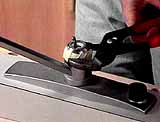 There are a few different types and combinations of faucets:
single-handle or two-handled shut-offs that are compression or washerless
(cartridge, ball or disc mechanism).
There are a few different types and combinations of faucets:
single-handle or two-handled shut-offs that are compression or washerless
(cartridge, ball or disc mechanism). 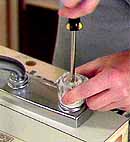 If a faucet is leaking, a washer (for compression) or O-ring
(for cartridge) probably needs to be replaced.
If a faucet is leaking, a washer (for compression) or O-ring
(for cartridge) probably needs to be replaced. 
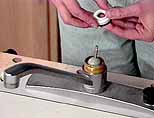 A ball faucet can leak in several places: around the handle,
spout, collar, base. Therefore, we'll describe how to repair the whole
works. Yet, fixing your faucet may only involve one of these steps.
A ball faucet can leak in several places: around the handle,
spout, collar, base. Therefore, we'll describe how to repair the whole
works. Yet, fixing your faucet may only involve one of these steps.
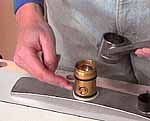
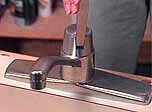 After locating the leak and shutting off the water, pry off the
faucet's top cap, remove the screw and lift off the handle piece.
After locating the leak and shutting off the water, pry off the
faucet's top cap, remove the screw and lift off the handle piece.
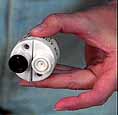 While the cartridge is out, inspect and replace the O-rings on
the outside of the housing. Just cut them off and roll on new ones.
While the cartridge is out, inspect and replace the O-rings on
the outside of the housing. Just cut them off and roll on new ones.