

| Plumbing: Fitting Plastic Pipe | |
 To safeguard against health hazards,
most areas of the country require your plumbing project to comply with
local regulations; however small the job. To safeguard against health hazards,
most areas of the country require your plumbing project to comply with
local regulations; however small the job. Codes vary and certain areas may not allow plastic pipe to be used. Check with your local building authority to find out about codes, permits and inspections. Types Of Pipe
PVC is
usually white or cream colored and ABS is black. Both are typically
used only for vents and drains and aren't made to fit directly together.
CPVC
(chlorinated polyvinyl chloride) is another rigid plastic used for
hot and cold water supply lines because it can handle normal water
pressure loads. Compared to copper lines, CPVC is lightweight, easy to work with, doesn't corrode and may be priced about 3/4ths less. Cutting & Fitting
Dry
fit the entire run of pipe you're installing before gluing pipe
and fittings together.
A fitting that's glued crooked can sometimes throw off the whole run and/or won't fit properly with the next piece. Discover these problems during the dry fit rather than after the pipe is glued. Gluing Pipe
To glue
ABS pipe, check that any cut ends are fairly straight. Remove
any burrs with a knife or emery cloth and clean both pieces with a
rag. Apply ABS glue to both the pipe and fitting.
Gluing
PVC pipe is a similar process, but a cleaning chemical (primer)
that prepares the plastic goes on before the glue. CPVC pipe
also has its own type of glue so be sure to purchase the glue that
matches the plastic you're working with. Once the
joint is primed, apply the glue, push and twist the pipe or fitting
and hold them in place for a few seconds. |
|
 |
|
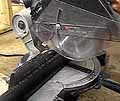 Cut plastic pipe to length with a
hacksaw, or abrasive disk of a miter saw/chop saw. After each cut,
clean out the small burrs/shavings that remain inside the pipe with
a knife, rag or emery cloth.
Cut plastic pipe to length with a
hacksaw, or abrasive disk of a miter saw/chop saw. After each cut,
clean out the small burrs/shavings that remain inside the pipe with
a knife, rag or emery cloth. 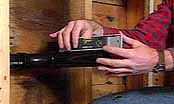 Check small pipes and fittings for
plumb/level with a torpedo level. Also, double check the drain flow;
about 1/4" per 1' as a general guide.
Check small pipes and fittings for
plumb/level with a torpedo level. Also, double check the drain flow;
about 1/4" per 1' as a general guide. 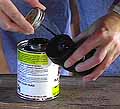 Plastic pipe joints are connected
with glue that actually melts the pieces together. The joints for
both PVC and ABS are glued the same way, but the types aren't interchangeable
and only a special fitting can connect them together.
Plastic pipe joints are connected
with glue that actually melts the pieces together. The joints for
both PVC and ABS are glued the same way, but the types aren't interchangeable
and only a special fitting can connect them together. 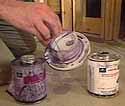 Push the joints together with a twisting
motion to spread the glue. Hold the joints together for a few seconds
so they won't push apart while the fast-drying glue sets.
Push the joints together with a twisting
motion to spread the glue. Hold the joints together for a few seconds
so they won't push apart while the fast-drying glue sets.