 |
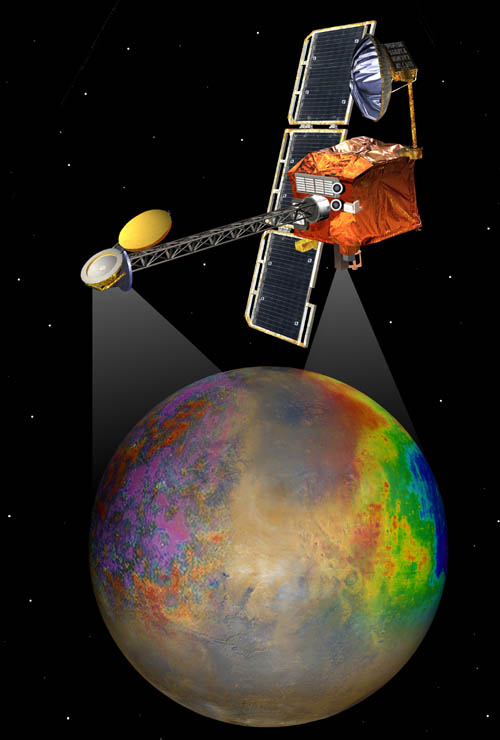
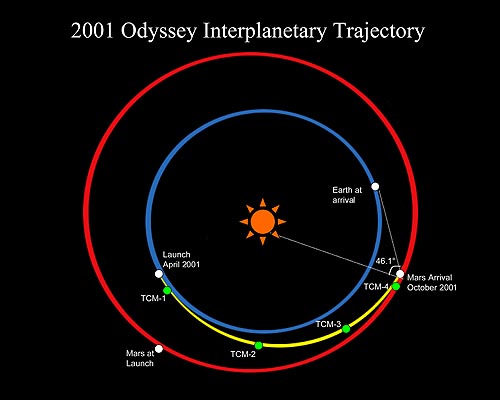
| 2001 Mars Odyssey |
| Mars has attracted more spacecraft exploration attempts than any other object in the solar system, and no other planet has proved as daunting to success. Of the 30 missions sent to Mars by three countries over 40 years, fewer than one-third have been successful. (Full Story) |
 |
| NASA's Mars Odyssey Points to Melting Snow as Cause of Gullies Images from the visible light camera on NASA's Mars Odyssey spacecraft, combined with images from NASA's Mars Global Surveyor, suggest melting snow is the likely cause of the numerous eroded gullies first documented on Mars in 2000 by Global Surveyor. [more...] Mars Odyssey is pictured at right, ready for launch in 2001 |
 |
| Travelers of the Future, Beware! Mars is no place for the faint-hearted. Arid, rocky, cold and apparently lifeless, the Red Planet offers few hospitalities. Fans of extreme sports can rejoice, however, for the Red Planet will challenge even the hardiest souls among us. Home to the largest volcano in the solar system, the deepest canyon and crazy weather and temperature patterns, Mars looms as the ultimate lonely planet destination. If you dream of going, here's what to expect: Mars Quick Facts: Learn about the similarities and differences between Mars and Earth, and about the two small moons that orbit Mars. "Mars" here on Earth: If you want to know what it might be like to spend time in the Martian environment, visit the Haughton-Mars Project, which tested prototype Mars astronaut suits on July 26, 2000 and August 3, 2000. The Haughton impact crater is in the Canadian high arctic, and has a rocky polar desert setting somewhat like Mars--though, of course, nothing on Earth comes close to the extreme conditions on the red planet. Other places on Earth that can help us understand Mars include: Death Valley, California, where Ubehebe crater and "Mars Hill" have geologic features similar to those on Mars. Mono Lake, California, which is a 700,000-year-old evaporative lake that compares to Gusev Crater, a basin on Mars where water once was likely. Channeled Scabland in Washington, where catastrophic floods swept through the land much like what happened long ago in the Ares Vallis flood plain where Mars Pathfinder landed. Permafrost in Siberia, Alaska and Antarctica, where subsurface water-ice and small life forms exist. Volcanoes in Hawaii, which are like those on Mars, though much smaller. |
| EXTREME PLANET |
 |
|
|
|
|