|
|
|
 |
|
Principal
Sponsors:
 |
H.323 |
1. What Is H.323?
The H.323 standard is a cornerstone technology for the
transmission of real-time audio, video, and data communications over
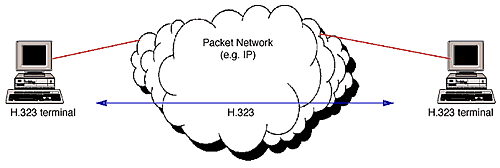
packet-based networks. It specifies the components, protocols, and
procedures providing multimedia communication over packet-based
networks (see Figure 1). Packet-based networks include IP肪ased
(including the Internet) or Internet packet exchange (IPX)肪ased
local-area networks (LANs), enterprise networks (ENs),
metropolitan-area networks (MANs), and wide-area networks (WANs).
H.323 can be applied in a variety of mechanisms預udio only (IP
telephony); audio and video (videotelephony); audio and data; and
audio, video and data. H.323 can also be applied to
multipoint-multimedia communications. H.323 provides myriad services
and, therefore, can be applied in a wide variety of areas幼onsumer,
business, and entertainment applications.
H.323 Versions
The H.323 standard is specified by the ITU傍 Study Group 16.
Version 1 of the H.323 recommendation要isual telephone systems and
equipment for LANs that provide a nonguaranteed quality of service
(QoS)謡as accepted in October 1996. It was, as the name suggests,
heavily weighted towards multimedia communications in a LAN
environment. Version 1 of the H.323 standard does not provide
guaranteed QoS.
The emergence of voice-over蜂P (VoIP) applications and IP
telephony has paved the way for a revision of the H.323
specification. The absence of a standard for voice over IP resulted
in products that were incompatible. With the development of VoIP,
new requirements emerged, such as providing communication between a
PC肪ased phone and a phone on a traditional switched circuit network
(SCN). Such requirements forced the need for a standard for IP
telephony. Version 2 of H.323用acket-based multimedia communications
systems謡as defined to accommodate these additional requirements and
was accepted in January 1998.
New features are being added to the H.323 standard, which will
evolve to Version 3 shortly. The features being added include
fax-over-packet networks, gatekeeper-gatekeeper communications, and
fast-connection mechanisms.
H.323 in Relation to Other Standards of the H.32x Family
The H.323 standard is part of the H.32x family of recommendations
specified by ITU傍. The other recommendations of the family specify
multimedia communication services over different networks:
- H.324 over SCN
- H.320 over integrated services digital networks (ISDN)
- H.321 and H.310 over broadband integrated services digital
networks (B蜂SDN)
- H.322 over LANs that provide guaranteed QoS
One of the primary goals in the development of the H.323 standard
was interoperability with other multimedia-services networks. This
interoperability is achieved through the use of a gateway. A gateway
performs any network or signaling translation required for
interoperability. Gateways are explained in detail in Topic
6.
|