 |
| Dutch Grand Prix 1970 |
| Sadly, Francois' first Formula One race was ultimately a tragic affair, resulting as it did in the death of the popular and personable Englishman, Piers Courage, at the wheel of his Frank Williams-entered deTomaso. The race was eventually won by Jochen Rindt in the Lotus 72, but it was a hollow victory for the Austrian, who had lost one of his closest friends. When Francois Cevert was announced as the replacement for the retiring Johnny Servoz-Gavin at Tyrrell prior to the Dutch Grand Prix at Zandvoort in 1970, few expected him to become a front-runner; Patrick McNally in Autosport went as far as to say 'it is difficult to believe that Cevert will make the grade'. After all, Francois had but two and a half seasons of proper competition behind him, and many felt (perhaps justifiably) that he had gained the seat solely because both he and Tyrrell were sponsored by Elf. Ken Tyrrell certainly did not expect too much from the young Frenchman. "My only worry about Francois", he explained "was that he would want to go too fast, too soon. From our observations I'd formed the opinion that he was impatient and anxious to make his mark quickly, so I decided, from the start, to hold him on a tight rein. The first day of practice confirmed my thinking - he was going too fast. Early in the afternoon I said 'that's all for today.' He was disapponted, he felt he'd hardly driven at all." The main task facing Francois was merely to qualify - in those days only the top drivers were guaranteed to make the race. The 'unseeded' remainder - of which Francois was one - had to scrap it out for a place on the grid. In reality, Francois' March was a good, well-prepared car, and more than capable of getting comfortably onto the grid - the problem arose in keeping that rein on a naturally fired-up and eager Cevert.... During the second session of qualifying, Cevert spun the car wildly behind the pits. Tyrrell was, unsurprisingly, livid. Francois received a stern lecture from the Englishman - eyewitnesses recall Cevert resembling a 'naughty schoolboy being ticked off by the headmaster'. The lesson he received was invaluable however, for there were to be no more 'incidents' that weekend, and looking at the longer picture, perhaps that talking-to laid down the foundations for the lifelong respect with which Francois held Ken. Francois was nonetheless struggling with set-up on the March and this was reflected in a hitherto rather mediocre time. Unbeknown to him, his team-mate Jackie Stewart asked the mechanics to set up Cevert's car like his own before asking a stunned Francois to 'follow me'. Cevert trailed Stewart round the Dutch track, gradually learning the braking points, the apexes....until eventually he had shaved 2 seconds off his time. Again - a relationship had been forged, Stewart the maestro; Cevert the eager-to-learn protege. Eventually, qualifying was over - Jochen Rindt snatching pole from Stewart, with Jacky Ickx in the Ferrari completing the three-car front row. Cevert was back in 15th but well pleased with his performance, 'Do you see what I've just done? I would never have thought I could do such a time. Its smashing, isn't it?'. A typically exuberant remark from the man who felt 'like an amateur footballer who'd suddenly been asked to play for Real Madrid'. Francois was amongst the big boys now, and determined to make the most of it. Raceday dawned overcast and miserable, perhaps a harbringer of events to come. Ickx made the best start, and led away from Rindt and Jackie Oliver in the BRM. Cevert, near the back of the field, made a steady start and settled into 15th place between John Surtees and the March of fellow debutant Ronnie Peterson. By the third lap Rindt had passed Ickx, Stewart had passed Oliver, and the places remained relatively constant for a few laps. It seemed that the race was settling down into a relatively stable rhythm when on lap 23 an ominous pall of black smoke rose above the Zandvoort dunes.... Piers Courage in the deTomaso had run wide on the right-hander before the East Tunnel, hit a bank and overturned. Almost immediately the car erupted into a fireball. The flames, fed by the magnesium bodywork of the car, burnt so fiercely they set fire to the surrounding trees, and with the primitive fire-fighting equipment of the era (highlighted dreadfully by Roger Williamson's awful accident at the same circuit 3 years later) poor Piers stood no chance. What Cevert made of having to pass the burning wreck for several laps in his first Grand Prix has not been recorded for posterity, but his own race did not last much longer in any case. On lap 31 he pulled into the pits with the engine split and streaming oil. It had been a solid if unspectacular debut, fulfilling Ken Tyrrell's desire for Francois to 'get as much racing mileage as possible' without flying off the road. The rest of the race was obviously overshadowed by the death of Courage - the only incident of note being Ickx's midrace stop to replace a deflating rear tyre which lost him second place to Stewart. The faces on the podium were grim - Courage was one of the most popular drivers of the time, and a close personal friend of both Jochen Rindt and Jackie Stewart. Prizegiving was cancelled and the drivers slipped away, all too acutely aware of another friend lost, another wife widowed, another life offered up to the Gods of the cruellest of sports. And in the midst of this, almost unnoticed, Francois Cevert had quietly made his debut, but perhaps more importantly he had begun friendships with Ken Tyrrell and Jackie Stewart that would help to lead him to the very top in Formula One. BACK TO THE F1 1970 INDEX BACK TO THE RACES INDEX BACK TO THE MAIN PAGE |
|
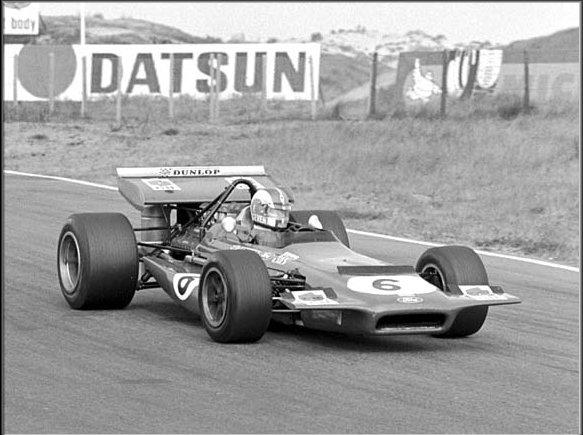
| F.Cevert, Dutch Gp 1970, Zandvoort, picture courtesy Motor Racing Retro |
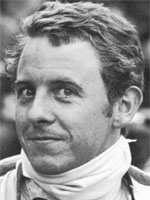 |
| Piers Courage, 1942-1970 |