|
The Seven Sorrows of Mary
Prayers
(Approved by Pope Pius VII, 1815)
With Meditations by St Alphonsus Liguori
I. The Prophecy of Simeon
Scripture: Luke 2:33-35
"And the Child's father and mother were amazed at what was being said
about him. Then Simeon blessed them and said to His mother Mary, 'This
Child is destined for the falling and rising of many in Israel, and to
be a sign that will be opposed so that the inner thoughts of many will
be revealed--and a sword will pierce your own soul too.' "
Meditation:
When David, in the midst of all his pleasures and regal grandeur, heard,
from the Prophet Nathan, that his son should die-- "The child that is born
to thee shall surely die," he could kind no peace, but wept, fasted, and
slept on the ground. Mary with the greatest calmness received the announcement
that her Son should die, and always peacefully submitted to it; but what
grief must she continually have suffered, seeing this amiable Son always
near her, hearing from Him words of eternal life, and witnessing His holy
demeanour! Abraham suffered much during the three days he passed with his
beloved Isaac, after knowing that he was to lose him. O God, not for three
days, but for three and thirty years had Mary to endure a like sorrow!
But do I say a like sorrow? It was as much greater as the Son of Mary was
more lovely than the son of Abraham. The Blessed Virgin herself revealed
to Saint Bridget, that, while on earth, there was not an hour in which
this grief did not pierce her soul: "As often," she continued, "as I looked
at my Son, as often as I wrapped Him in His swaddling-clothes, as often
as I saw His hands and feet, so often was my soul absorbed, so to say,
in fresh grief; for I thought how He would be crucified." The Abbot Rupert
contemplates Mary suckling her Son, and thus addressing Him: "A bundle
of myrrh is my Beloved to me; He shall abide between my breasts." Ah, Son,
I clasp Thee in my arms, because Thou art so dear to me; but the dearer
Thou art to me, the more dost Thou become a bundle of myrrh and sorrow
to me when I think of Thy sufferings. "Mary," says Saint Bernardine of
Sienna, "reflected that the strength of the Saints was to be reduced to
agony; the beauty of Paradise to be disfigured; the Lord of the world to
be bound as a criminal; the Creator of all things to be made livid with
blows; the Judge of all to be condemned; the Glory of heaven despised;
the King of kings to be crowned with thorns, and treated as a mock king."
Prayer:
I grieve for you, O Mary most sorrowful, in affliction of your tender
heart at the prophecy of the holy and aged Simeon. Dear Mother, by your
heart so afflicted, obtain for me the virtue of humility and the gift of
the holy fear of God. Hail Mary.

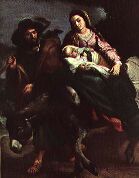
II. The Flight Into Egypt
Scripture: Matthew 2:13-15
"Now after they had left, an angel of the Lord appeared to Joseph in
a dream and said, 'Get up, take the Child and His mother, and flee to Egypt,
and remain there until I tell you; for Herod is about to search for the
Child, to destroy Him.' Then Joseph got up, took the child and his mother
by night, and went to Egypt, and remained there until the death of Herod.
This was to fulfill what was spoken by the Lord through the prophet, 'Out
of Egypt I have called my Son.' "
Meditation:
Any one may imagine what Mary must have suffered on this journey. To
Egypt the distance was great. Most authors agree that it was three hundred
miles; so that it was a journey of upwards of thirty days. The road was,
according to Saint Bonaventure's description of it, 'rough, unknown, and
little frequented.' It was in the winter season; so that they had to travel
in snow, rain, and wind, through rough and dirty roads. Mary was then fifteen
years of age a delicate young woman, unaccustomed to such journeys. They
had no one to attend upon them. Saint Peter Chrysologus says, 'Joseph and
Mary have no male or female servants; they were themselves both masters
and servants.' O God, what a touching sight must it have been to have beheld
that tender Virgin, with her new-born Babe in her arms, wandering through
the world! 'But how,' asks Saint Bonaventure, ' did they obtain their food?
Where did they repose at night? How were they lodged? What can they have
eaten but a piece of hard bread, either brought by Saint Joseph or begged
as an alms? Where can they have slept on such a road (especially on the
two hundred miles of desert, where there were neither houses nor inns,
as authors relate), unless on the sand or under a tree in a wood, exposed
to the air and the dangers of robbers and wild beasts, with which Egypt
abounded. Ah, had any one met these three greatest personages in the world,
for whom could he have taken them but for three poor wandering beggars.'
(St. Alphonsus Liguori)
Prayer:
I grieve for you, O Mary most sorrowful, in the anguish of your most
affectionate heart during the flight into Egypt and your sojourn there.
Dear Mother, by your heart so troubled, obtain for me the virtue of generosity,
especially toward the poor, and the gift of piety. Hail Mary.
III. The Loss of Jesus in
the Temple
Scripture: Luke 2:41-52
"Now his parents went to Jerusalem every year at the feast of the Passover.
And when he was twelve years old, they went up according to custom; and
when the feast was ended, as they were returning, the boy Jesus stayed
behind in Jerusalem. His parents did not know it, but supposing him to
be in the company they went a day's journey, and they sought him among
their kinsfolk and acquaintances; and when they did not find him, they
returned to Jerusalem, seeking him. After three days they found him in
the temple, sitting among the teachers, listening to them and asking them
questions; and all who heard him were amazed at his understanding and his
answers. And when they saw him they were astonished; and his mother said
to him, "Son, why have you treated us so? Behold, your father and I have
been looking for you anxiously." And he said to them, "How is it that you
sought me? Did you not know that I must be in my Father's house?" And they
did not understand the saying which he spoke to them. And he went down
with them and came to Nazareth, and was obedient to them; and his mother
kept all these things in her heart. And Jesus increased in wisdom and in
stature, and in favor with God and man."
Meditation:
There are some who assert, and not without reason, that this dolour
was not only one of the greatest, but the greatest and most painful of
all. For, in the first place, Mary, in her other dolours, had Jesus with
her: she suffered when Saint Simeon prophesied to her in the temple; she
suffered in the flight into Egypt; but still in company with Jesus; but
in this dolour she suffered far from Jesus, not knowing where He was: "
And the light of my eyes itself is not with me." Thus weeping she then
said, 'Ah, the light of my eyes, my dear Jesus, is no longer with me; He
is far from me, and I know not whither He is gone.' Origen says that through
the love which this holy Mother bore her Son, 'she suffered more in this
loss of Jesus than any martyr ever suffered in the separation of his soul
from his body.' Ah, too long indeed were those three days for Mary; they
seemed three ages; they were all bitterness, for there was none to comfort
her. And who can ever comfort me, she said with Jeremias, who can console
me, since He who alone could do so is far from me and therefore my eyes
can never weep enough: "Therefore do I weep, and my eyes run down with
water: because the Comforter . . . is far from me." And with Tobias she
repeated, "What manner of joy shall be to me who sit in darkness, and see
not the light of heaven?"
Prayer:
I grieve for you, O Mary most sorrowful, in those anxieties which tried
your troubled heart at the loss of your dear Jesus. Dear Mother, by your
heart so full of anguish, obtain for me the virtue of chastity and the
gift of knowledge. Hail Mary.
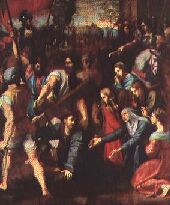
IV. Carrying the Cross
Scripture: John 19:17
"So they took Jesus; and carrying the cross by Himself, He went out
to what is called the place of the Skull, which in Hebrew is called Golgotha."
Meditation:
While Mary was waiting in that place, how much must she have heard
said by the Jews, who soon recognised her, against her beloved Son, and
perhaps even words of mocking against herself. Alas, what a scene of sorrows
then presented itself before her! the nails, the hammers, the cords, the
fatal instruments of the death of her Son, all of which were borne before
Him. And what a sword must the sound of that trumpet have been to her heart,
which proclaimed the sentence pronounced against her Jesus! But behold,
the instruments, the trumpeter, and the executioners, have already passed;
she raised her eyes, and saw, O God ! a young man covered with blood and
wounds from head to foot, a wreath of thorns on His head, and two heavy
beams on His shoulders. She looked at Him, and hardly recognised Him, saying,
with Isaias, " and we have seen Him, and there was no sightliness.'' Yes,
for the wounds, the bruises, and the clotted blood, gave Him the appearance
of a leper: "we have thought Him as it were a leper," so that He could
no longer be known: "and His look was, as it were, hidden and despised;
whereupon we esteemed Him not." But at length love revealed Him to her,
and as soon as she knew that it indeed was He, ah what love and fear must
then have filled her heart! as Saint Peter of A1cantara says in his meditations.
On the one hand she desired to behold Him, and on the other she dreaded
so heart-rending a sight. At length they looked at each other. The Son
wiped from His eyes the clotted blood, which, as it was revealed to Saint
Bridget, prevented Him from seeing, and looked at His Mother, and the Mother
looked at her Son. Ah, looks of bitter grief, which, as so many arrows,
pierced through and through those two beautiful and loving souls. When
Margaret, the daughter of Sir Thomas More, met her father on his way to
death, she could only exclaim, 'O father! father!' and fell fainting at
his feet. Mary, at the sight of her Son, on His way to Calvary, did not
faint, no, for it was not becoming, as Father Suarez remarks, that this
Mother should lose the use of her reason; nor did she die, for God reserved
her for greater grief: but though she did not die, her sorrow was enough
to have caused her a thousand deaths.
Prayer:
I grieve for you, O Mary most sorrowful, in the consternation of your
heart at meeting Jesus as He carried His cross. Dear Mother, by your heart
so troubled, obtain for me the virtue of patience and the gift of fortitude.
Hail
Mary.
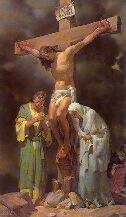
V. The Death of Our Lord
Scripture: John 19:25-30
"Meanwhile, standing near the cross of Jesus were His mother, and His
mother's sister, Mary the wife of Clopas, and Mary Magdalene. When Jesus
saw his mother and the disciple whom He loved standing beside her, He said
to His mother, 'Woman, here is your son.' Then He said to the disciple,
'Here is your mother.' And from that hour the disciple took her into His
own home. After this, when Jesus knew that all was now finished, He said
(in order to fulfill the Scripture), 'I am thirsty.' A jar full of sour
wine was standing there. So they put a sponge full of the wine on a branch
of hyssop and held it to His mouth.. When Jesus had received the wine,
He said, 'It is finished.' Then He bowed His head and gave up His Spirit."
Meditation:
All these sufferings of Jesus were also those of Mary: 'Every torture
inflicted on the body of Jesus,' says Saint Jerome, 'was a wound in the
heart of the Mother.' 'Whoever then was present on the Mount of Calvary,'
says Saint John Chrysostom, 'might see two altars, on which two great sacrifices
were consummated; the one in the body of Jesus, the other in the heart
of Mary.' Nay, better still may we say with Saint Bonaventure, 'there was
but one altar-that of the cross of the Son, on which, together with this
Divine Lamb, the victim, the Mother was also sacrificed;' therefore the
Saint asks this Mother, 'O Lady, where art thou? Near the cross? Nay, rather,
thou art on the cross, crucified, sacrificing thyself with thy Son.' Saint
Augustine assures us of the same thing: 'The cross and nails of the Son
were also those of His Mother; with Christ crucified the Mother was also
crucified.' Yes; for, as Saint Bernard says, 'Love inflicted on the heart
of Mary the tortures caused by the nails in the body of Jesus.' So much
so that, as Saint Bernardine writes, 'At the same time that the Son sacrificed
His body, the Mother sacrificed her soul.'
Prayer:
I grieve for you, O Mary most sorrowful, in the martyrdom which your
generous heart endured in standing near Jesus in His agony. Dear Mother,
by your afflicted heart, obtain for me the virtue of temperance and the
gift of counsel. Hail Mary.
VI. Christ's Body is Pierced
and Taken Down
Scripture: Psalm 22:15, John 19:31-37
"My mouth is dried up like a potsherd , and my tongue sticks to my
jaws; you lay me in the dust of death. A company of evildoers encircles
me. My hands and feet have shriveled." | "Since it was the day of Preparation,
in order to prevent the bodies from remaining on the cross on the sabbath
(for that sabbath was a high day), the Jews asked Pilate that their legs
might be broken, and that they might be taken away. So the soldiers came
and broke the legs of the first, and of the other who had been crucified
with him; but when they came to Jesus and saw that he was already dead,
they did not break his legs. But one of the soldiers pierced his side with
a spear, and at once there came out blood and water. He who saw it has
borne witness--his testimony is true, and he knows that he tells the truth--that
you also may believe. For these things took place that the scripture might
be fulfilled, "Not a bone of him shall be broken." And again another scripture
says, "They shall look on him whom they have pierced."
Meditation:
The afflicted Mother, fearing that other injuries might still be inflicted
on her Son, entreated Joseph of Arimathea to obtain the body of her Jesus
from Pilate, that at least in death she might guard and protect it from
further outrage. Joseph went, and represented to Pilate the grief and desires
of this afflicted Mother. Saint Anselm believes that compassion for the
Mother softened the heart of Pilate, and moved him to grant her the body
of the Saviour. Jesus was then taken down from the cross. O most sacred
Virgin, after thou hast given thy Son to the world, with so great love,
for our salvation, behold the world now restores Him to thee; but, O God,
in what state dost thou receive Him? O world, said Mary, how dost thou
return Him to me? "My Son was white and ruddy;" but thou returnest Him
to me blackened with bruises, and red-yes! But with the wounds which thou
hast inflicted upon Him. He was all fair and beautiful; but now there is
no more beauty in Him; He is all disfigured. His aspect enamoured all;
now He excites horror in all who behold Him. 'O, how many swords,' says
Saint Bonaventure, 'pierced the poor Mother's soul' when she received the
body of her Son from the cross! Let us only consider the anguish it would
cause any mother to receive into her arms the body of her lifeless son.
It was revealed to Saint Bridget, that three ladders were placed against
the cross to take down the Sacred Body; the holy disciples first drew out
the nails from the hands and feet, and, according to Metaphrastes, gave
them to Mary. Then one supported the upper part of the body of Jesus, and
the other the lower, and thus descended it from the cross. Bernardine de
Bustis describes the afflicted Mother as standing, and extending her arms
to meet her dear Son; she embraced Him, and then sat at the foot of the
cross. His mouth was open, His eyes were dim; she then examined his mangled
flesh and uncovered bones; she took off the crown, and saw the sad injuries
which the thorns had inflicted on that sacred head; she saw the holes in
His hands and feet, and thus addressed Him: 'Ah, Son, to what has Thy love
for men brought Thee; and what evil hadst Thou done them, that they should
thus cruelly have tormented Thee? Thou wast my father' (continues Bernardine
de Bustis, in Mary's name), 'Thou wast my brother, my spouse, my delight,
my glory; Thou wast my all.' My Son, see my affliction, look at me, console
me; but no, Thou no longer lookest at me. Speak, say but a word, and console
me; but Thou speakest no more, for Thou art dead. Then, turning to those
barbarous instruments of torture, she said, O cruel thorns, O cruel nails,
O merciless spear, how, how could you thus torture your Creator? But why
do I speak of thorns or nails? Alas! Sinners, she exclaimed, it is you
who have thus cruelly treated my Son.
Prayer:
I grieve for you, O Mary most sorrowful, in the wounding of your compassionate
heart, when the side of Jesus was struck by the lance before His Body was
removed from the Cross. Dear Mother, by your heart thus transfixed, obtain
for me the virtue of fraternal charity and the gift of understanding. Hail
Mary
VII. The Burial of Christ
Scripture: John 19:38-42
"After this Joseph of Arimathea, who was a disciple of Jesus, but secretly,
for fear of the Jews, asked Pilate that he might take away the body of
Jesus, and Pilate gave him leave. So he came and took away his body. Nicodemus
also, who had at first come to him by night, came bringing a mixture of
myrrh and aloes, about a hundred pounds' weight. They took the body of
Jesus, and bound it in linen cloths with the spices, as is the burial custom
of the Jews. Now in the place where he was crucified there was a garden,
and in the garden a new tomb where no one had ever been laid. So because
of the Jewish day of Preparation, as the tomb was close at hand, they laid
Jesus there."
Meditation:
Finally, the disciples raised the stone and closed up the holy sepulchre,
and in it the body of Jesus, that great treasure-a treasure so great that
neither earth nor heaven had a greater. Here I may be permitted to make
a short digression, and remark that Mary's heart was buried with Jesus,
because Jesus was all her treasure: "Where your treasure is, there will
your heart be also." And where, may we ask, are our hearts buried? In creatures-perchance
in mire. And why not in Jesus, who, although He has ascended to heaven,
is still pleased to remain on earth, not dead indeed, but living in the
most holy sacrament of the altar, precisely that our hearts may be with
Him, and that He may possess them? But let us return to Mary. Before leaving
the sepulchre, according to St. Bonaventure, she blessed the sacred stone
which closed it, saying, 'O happy stone, that doth now enclose that sacred
body, which for nine months was contained in my womb; I bless thee and
envy thee; I leave thee the guardian of my Son, of that Son who is all
my treasure and all my love.' Then raising her heart to the Eternal Father,
she said, 'O Father, to Thee do I recommend Him-Him who is Thy Son at the
same time that He is mine.' Thus bidding her last farewell to her beloved
Jesus and to the sepulchre, she left it, and returned to her own house.
'This Mother,' says St. Bernard, 'went away so afflicted and sad, that
she moved many to tears in spite of themselves; and wherever she passed,
all who met her wept,' and could not restrain their tears. And he adds
that the holy disciples and women who accompanied her 'mourned even more
for her than for their Lord.'
Prayer:
I grieve for you, O Mary most sorrowful, for the pangs that wrenched
your most loving heart at the burial of Jesus. Dear Mother, by your heart
sunk in bitterness and desolation, obtain for me the virtue of diligence
and the gift of wisdom. Hail Mary
Let us Pray
Let intercession be made for us, we beseech You, O Lord Jesus Christ,
now and at the hour of our death, before the throne of Your mercy, by the
Blessed Virgin Mary, Your Mother, whose most holy soul was pierced by a
sword or sorrow in the hour of Your bitter passion. Through You, O Jesus
Christ, Saviour of the World, Who with the Father and the Holy Spirit lives
and reigns world without end. Amen. |
