 finances and his gambling debts forced him to leave after a year, whereupon
he joined the army for two years. In 1830 he entered West Point, but left soon
afterwards because of John Allan's continued lack of financial support.
finances and his gambling debts forced him to leave after a year, whereupon
he joined the army for two years. In 1830 he entered West Point, but left soon
afterwards because of John Allan's continued lack of financial support.
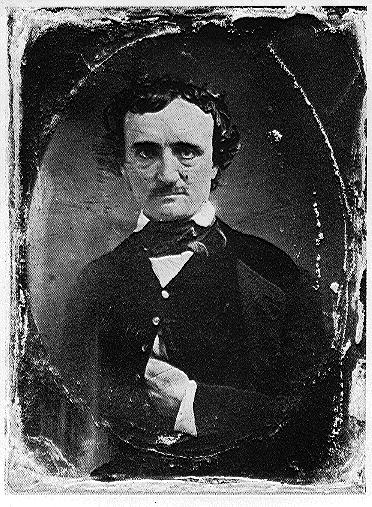
Edgar Allan Poe
Edgar
Allan Poe's life was tragic and tormented. Not only was it short, but it was
marked by almost unremitting misery and misfortune. The child of itinerant actors,
Poe was born in Boston on 19 January 1809, the second of three children. Orphaned
at an early age � both parents died
of tuberculosis � he was adopted by Frances Allan, the childless wife of John
Allan, a prosperous Richmond tobacco merchant. His childhood was relatively
comfortable and stable; he was athletic and an excellent student with a promising
future. In 1826, Poe entered the University of Virginia, but his excessive drinking
and quarrels with his foster father about
finances and his gambling debts forced him to leave after a year, whereupon
he joined the army for two years. In 1830 he entered West Point, but left soon
afterwards because of John Allan's continued lack of financial support.
Although Poe had published his first volume of verse, Tamerlane and Other Poems, in 1827, it gained little critical or popular notice. His literary career truly started some years later when he began to write short stories for magazines. He also worked for several important magazines where his outstanding skills as an editor and critic gained him some prominence and respect. But personal problems and poverty continued to plague him, and his alcoholism cost him several editorial posts. In 1836, Poe married his fourteen-year-old cousin, Virginia Clemm, but her ill health was a constant source of anxiety. Her death in 1847, of tuberculosis, led to Poe's complete mental and physical breakdown. When he recovered he joined a temperance society and became engaged to his childhood sweetheart, Elmira Royston Shelton. Then, on 03 October 1849, he was found beaten and unconscious in an alley and was taken to a Baltimore charity hospital where he died four days later without ever regaining consciousness. The exact circumstances of his death will forever remain a mystery.
Part of the popular fascination with Poe is his image as a tortured genius. The novelist D.H. Lawrence said that Poe was "doomed to seethe down his soul in a great continuous convulsion of disintegration, and doomed to register the process." But this view undermines the full extent of Poe's brilliance and his enormous influence. The poet W.H. Auden said, "No one in his time, put so much energy and insight into making his contemporary poets take their craft seriously."
Poe is considered the father of the detective story and the modern gothic horror tale, as well as a great lyric poet. He was the first modern writer to explore the darker recesses of the human psyche in poems and stories, which seem to take place in the surreal landscapes and situations of nightmares. Although considered one of the great writers of short fiction, Poe had an affinity for verse. "With me, poetry has been not a purpose but a passion," he wrote. His poetry is rich with musical phrases and sensuous, evocative imagery. Poems like "The Raven," "The Bells," and "Annabel Lee," remain among the most popular and technically accomplished in the English language.
Collected in this web page are the selected poems of Edgar Allan Poe. A constant editor of his own work, his final versions are used, except in the instances where an earlier version is of interest.
Edgar Allan Poe's Selected Poems:

[HoMe] [THe LaDY BeHiND][CiRCLe oF FRieNDS] [LiFe oF a PRoFeSSioNaL BuM] [MY WRiTiNGS] [eNDLeSS YaKiTY]