Return to Erewhon
Erewhon 1999
Journal
Erewhon 2000
Journal
Erewhon 2001
Journal
Erewhon 2002
Journal
Erewhon 2003
Journal
Erewhon 2004
Journal
Using French Locks
Some simple Mechanics
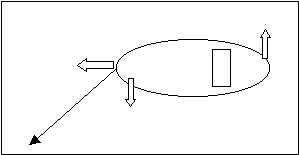 It may be obvious, but many newcomers to canals
don’t recognise the fact that all of the force being applied to a boat along a rope,
is in the direction of the rope. So a rope in front of the boat only pulls on the front of
the boat and pulls that bit in the direction of the rope.
It may be obvious, but many newcomers to canals
don’t recognise the fact that all of the force being applied to a boat along a rope,
is in the direction of the rope. So a rope in front of the boat only pulls on the front of
the boat and pulls that bit in the direction of the rope.
Secondly, as shown in the diagram, this tension has two components, one pulling
the boat to the side, and one pulling it forward. The further in front of the boat you
pull from, the more it pulls the boat forward and the less it pulls to the side. On the
other hand, if you wish to pull the bow to the side, you should pull directly from the
side.
Another application of this principal applies when deep in a lock, especially when it
is filling..
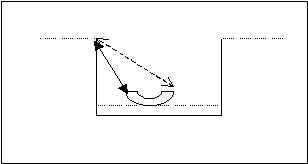 As you can see, the rope from the side of the boat
nearer the lock side has most of its tension in a vertical direction and only a small
proportion horizontally pulling the boat against the lock side. On the other hand, pulling
on a rope from the far side of the boat applies a much more effective force pulling the
boat against the side. Unfortunately, overhead obstruction often makes this impossible,
but use it when you can.
As you can see, the rope from the side of the boat
nearer the lock side has most of its tension in a vertical direction and only a small
proportion horizontally pulling the boat against the lock side. On the other hand, pulling
on a rope from the far side of the boat applies a much more effective force pulling the
boat against the side. Unfortunately, overhead obstruction often makes this impossible,
but use it when you can.
Getting the best from a bollard
.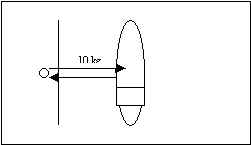 If you are standing on the boat, pulling the rope as
above, you get an immediate 10 kg of force pulling the boat to the side of the lock (or
mooring).
If you are standing on the boat, pulling the rope as
above, you get an immediate 10 kg of force pulling the boat to the side of the lock (or
mooring).
In addition, the rope will tend to slide around the bollard resulting in a tension on
the rope back to the cleat. This tension here will be between 0 and 10 kg, depending on
the friction between the rope and the bollard. So the cleat and the crewmember together
will have a total force of between 10 and 20 kg. You can’t lose, and you probably
gain considerably.
Also, if wind or current flows are carrying the boat away from the bollard, your 10-kg
of force will hold against a considerably greater force than 10 kg. 10 kg around a high
friction concrete bollard may hold against 100 kg of tension and even a steel bollard will
probably double the tension in the fixed cable.
A consequence of these examples is that usually there is major benefit for the crew to
stand on the deck, rather than the shore. This is particularly the case for the front line
on a boat ascending a lock.
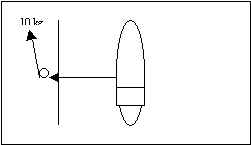 However there are circumstances when you
will need to stand on the shore and hold the boat. For instance, when mounting a series of
locks, or if you need to climb ashore in a rising lock to start the operating cycle. Then
it makes sense to wait for the boat to come to you!
However there are circumstances when you
will need to stand on the shore and hold the boat. For instance, when mounting a series of
locks, or if you need to climb ashore in a rising lock to start the operating cycle. Then
it makes sense to wait for the boat to come to you!
In this case, the effect of friction reduces any pull you make around a bollard, and if
you need to pull the boat in, it is much easier to do so directly. However if there is a
possibility of the boat being difficult to hold, then put a turn (or even two with a
smooth bollard) to hold a strong pull.
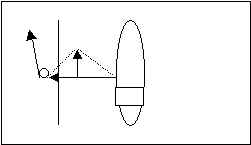 Hold a tension around the bollard, and with
the other hand, pull up at right-angles to the line, as shown, between the boat and the
bollard. When you have some slack, let it go and take up the slack around the bollard.
Repeat as necessary.
Hold a tension around the bollard, and with
the other hand, pull up at right-angles to the line, as shown, between the boat and the
bollard. When you have some slack, let it go and take up the slack around the bollard.
Repeat as necessary.
To summarise, bollards are useful for holding a boat from moving away, but work against
you if you try to pull the boat in with the rope wrapped around it.
LOCKING
There are basically three systems of locks in France; manual, semi-automatic and
automatic.
Manual locks are operated exclusively by lock keepers. If the lock keeper
doesn’t observe your approach to the lock you may need to signal your presence with
your horn. Watch for any boat, which may leave the lock and enter when the lock gate
opens. It is usual and courteous to put a crewmember ashore to help with the closing and
opening of the doors, as well as the changing of the sluices, all under the guidance of
the lock keeper.
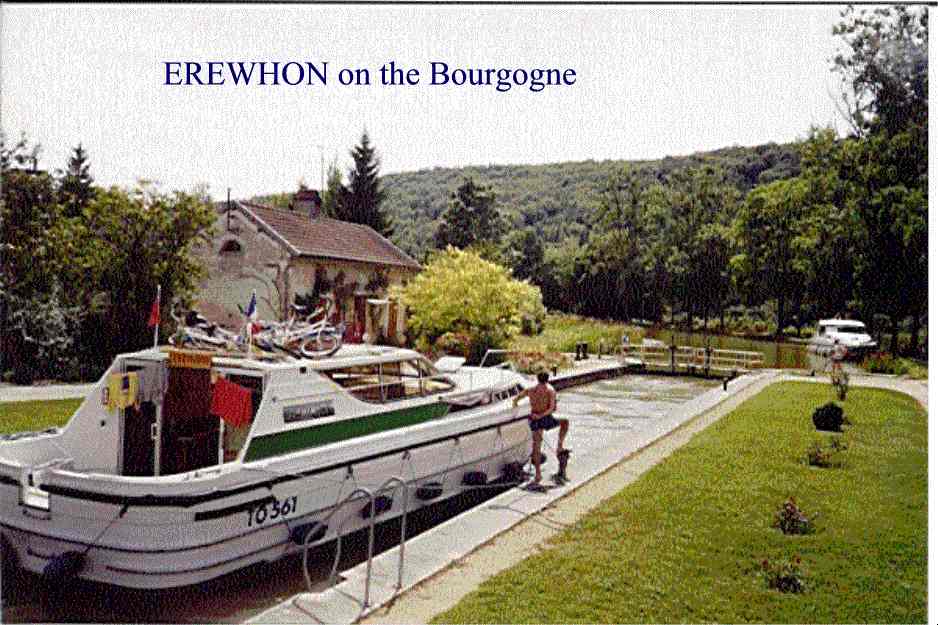
Semi-manual locks are operated by the lock keeper, who uses electric or hydraulic
power to open and shut the locks and sluices.
Automatic locks are operated by the user. One of several methods is used to tell of
your boat’s approach to the lock. Usually a green light will advise the boat to enter
after the door has opened. A red light prohibits entry and a red/green combination advises
that your presence has been noted and the lock is being prepared. The boat enters, moors
and after securing, the crew operate a switch to start the filling or emptying cycle. In
some systems the crew must also tell the system to open/close the exit gate when the cycle
is complete.
Going up a lock.
If you have sufficient crew you may wish to put one ashore before entering the lock.
Enter, and as you pass the ladder, send a crewmember up, holding the free end of two lines
attached, one to the stern and one to the bow. Quickly fasten the stern line around a
convenient bollard, then pass the bow line around an appropriate bollard and pass/throw it
back to a crewmember on the boat (the helmsperson if no-one else is available) who will
pull the boat in so it will lie alongside the lock. Alternatively, if you sent the
crewmember ashore, a crewman on board can throw the ropes up to the shore crew.
The shore crew member then starts the filling cycle or indicates to the lock-keeper
that all is ready and takes hold of the stern line again and controls it.
If there is only one boat in the lock, it is easier to stay at the back of the lock and
avoid the rush of water as it fills. However if you are the first of two or three, the bow
crewmember may have some effort to hold against the inflow. In some circumstances it may
be best to use the bow cleat to help. As the boat rises, it will be necessary to take in
both lines.
The choice of bollards on the lock side is important to get a stable for and aft
position, so that you don’t hit the lock gate in front or behind, or the other boats
sharing the lock.
When the lock is the first of a series, it may be best for two crew members to hold the
loose ends of the lines as the boat passes from one lock to the next. Push the boat gently
out from the first position so the helmsman can easily steer into the second chamber, and
then use the lines to moor again.
When the lock gates are ready to exit the lock, the shore crew should push out gently
with the bow pointing correctly and the helmsman can gently take the boat out of the lock
without losing any fenders.
Just a point at this stage. Many canal boats have no steerage when the propeller is not
thrusting forward. So it is often best to slow early and allow some power when entering
and exiting locks so steerage is possible.
Going down is a lot easier. It is not necessary to send a crew person ashore,
except perhaps to help a lock keeper on a manual lock. I advise that one or two crew coil
both a stern and a bow rope, and sit on the forward quarter waiting for the helmsperson to
slowly bring them over the lock side at any convenient place. Signal a stop, drop ashore
and pull the boat into position against the lock side, avoiding scraping the sides of the
boat on the concrete/stone. Activate the down cycle or signal ready to the lockkeeper and
watch that strakes, fenders and other parts of the boat don’t catch as the boat
descends. Before the deck falls below ground level, pass the ropes around appropriate
bollards and step on to the boat, still holding the boat loosely to the lock side.
Otherwise you will be left stranded, having to climb down ladders or get picked up later.
. If you only have one crew, the helmsperson my need to hold one of these. When the gate
opens, pull the free end from around the bollard and gently push the boat away from the
side bow slightly out to make the helmsperson’s job easy. Dragging fenders are a sign
of poor deck-work as well as helm control. Thank the lockkeeper!
If the lock is first of a series it is usually best for the (two) shore crew to stay on
shore and walk the boat through as in going up.
Choice of ropes. If you have a hire boat you take what you are given. However you
should check that the two stern ropes are long enough to reach the bow. This may require
swapping with a longer bow rope or asking the company to change your ropes. The bow rope
is not so critical, but should be no less than 8 metres. If you are providing your own
ropes, my choice is polypropylene, as it is easier to coil and throw around a bollard as
you enter a lock. They fall better. However they are not so easy on the hands as the moor
expensive braided nylon. When mooring at night with a wind, I have found the braided rope
creaks, disturbing your sleep. Although a heavy rope may be necessary for towing, a
lighter rope is easier to throw, hold and to fasten to a cleat.
Gloves. I don’t usually need gloves, but crew who don’t use their hands a
lot for manual work will find them useful. A pair of light gardening gloves are
sufficient, but classier boating gloves are available. I do use gloves in wet or cold
weather, when your hands are more vulnerable.
Use of a centre cleat. When you have more experience, a solo crew member will often
find locking easier using a single line fastened to a cleat at mid-ships. So long as a
convenient bollard is available to keep the boat in a good for and aft position, one line
is sufficient. However, when locking up, you will need to stay at the back of the lock or
the water rushing in will push your bow out. If you are the first boat of two or three
going up a lock, a bow line is then essential to counter the force of the water from the
sluices. You will also need another line, either at the stern or midships.
Lassooing a bollard. The secret to successful lassooing is careful laying of the
line. Throw the line along the deck to reduce tangling, and take it in the left hand abot
2 metres from the cleat, Then reach along the rope with the right hand as far as
comfortable and then place this rope into the left, twisting it one turn with your thumb
as you do so. The loop should hang without a twist if you do it correctly. Repaet till the
line is coild smoothly. As you approach the bollard, hold the end of the rope with your
thumb while the coil is hanging over your hand and throw it with a circular motion so the
middle of the rope lays in a large circle around the bollard. The promptly take in the
slack and pull the boat in.. You will need to experiment, because the twist of the rope
means it will tangle if you throw the circle the wrong way around the bollard.
However if it doesn’t work, you can always drop ashore!