The Royal Swedish Academy of Sciences has decided to award the
Nobel Prize in Physics for 2002 with one half jointly to Raymond Davis Jr (Department of Physics and Astronomy, University of
Pennsylvania, Philadelphia, USA), and Masatoshi Koshiba (International Center for
Elementary Particle Physics, University of Tokyo, Japan) "for pioneering
contributions to astrophysics, in particular for the detection of cosmic neutrinos"
and the other half to Riccardo Giacconi
(Associated Universities Inc., Washington DC, USA) "for pioneering contributions
to astrophysics, which have led to the discovery of cosmic X-ray sources".
Two New Windows on the Universe
The Earth lies in the path of a continuous flux of
cosmic particles and other types of radiation. This year’s Nobel Laureates in Physics
have used these very smallest components of the universe to increase our understanding of
the very largest: the Sun, stars, galaxies and supernovae. The new knowledge has changed
the way we look upon the universe.
The mysterious particle called a neutrino was predicted as early as 1930 by Wolfgang Pauli
(Nobel Prize in 1945), but it would take 25 years to prove its existence (by Frederick
Reines, Nobel Prize in 1995). This is because neutrinos, which are formed in the fusion
processes in the Sun and other stars when hydrogen is converted into helium, hardly
interact at all with matter and are therefore very difficult to detect. For example,
thousands of billions of neutrinos pass through us every second without our noticing them.
Raymond Davis Jr constructed a completely new detector, a gigantic tank filled with
600 tonnes of fluid, which was placed in a mine. Over a period of 30 years he succeeded in
capturing a total of 2,000 neutrinos from the Sun and was thus able to prove that fusion
provided the energy from the Sun. With another gigantic detector, called Kamiokande, a
group of researchers led by Masatoshi Koshiba was able to confirm Davis’s
results. They were also able, on 23 February 1987, to detect neutrinos from a distant
supernova explosion. They captured twelve of the total of 1016 neutrinos
(10,000,000,000,000,000) that passed through the detector. The work of Davis and Koshiba
has led to unexpected discoveries and a new, intensive field of research, neutrino-astronomy.
The Sun and all other stars emit electromagnetic radiation at different wavelengths, both
visible and invisible light, e.g. X-rays. In order to investigate cosmic X-ray radiation,
which is absorbed in Earth’s atmosphere, it is necessary to place instruments in
space. Riccardo Giacconi has constructed such instruments. He detected for the
first time a source of X-rays outside our solar system and he was the first to prove that
the universe contains background radiation of X-ray light. He also detected sources of
X-rays that most astronomers now consider to contain black holes. Giacconi constructed the
first X-ray telescopes, which have provided us with completely new – and sharp –
images of the universe. His contributions laid the foundations of X-ray astronomy.
De The Royal
Swedish Academy of Sciences, 8 de octubre de 2002
Los académicos suecos reconocen el
trabajo que Raymond Davis Jr. y Masatoshi Koshiba han realizado en la detección de los
neutrinos cósmicos. Por su parte, Riccardo Giacconi ha sido premiado por su contribución
en el campo de la astrofísica, que permitió “el descubrimiento de las fuentes
cósmicas de los rayos X”.
Los pequeños neutrinos
Raymond Davis Jr. y Masatoshi Koshiba han sido premiados por su labor pionera en la
detección de neutrinos cósmicos. Los neutrinos están considerados los componentes más
pequeños del universo y su formación se origina en los procesos de fusión en el sol y
otras estrellas, cuando el hidrógeno se convierte en helio. En su fallo, la Academia
sostiene que el trabajo de Davis Jr. y de Koshiba ha conducido al descubrimiento de un
nuevo campo de la investigación: la neutrino-astronomía.
La existencia de los neutrinos cósmicos fue pronosticada en 1930 por Wolfgang Pauli,
quien recibió por ello el Premio Nobel de Física en 1945. La comprobación de dicha
teoría no llegó sino hasta 25 años después, gracias al descubrimiento del también
premio Nobel Frederick Reines.
Astronomía de rayos X
Por su parte, Riccardo Giacconi, nacido en Génova (Italia) en 1931, ha sido el primero en
detectar una fuente de rayos X fuera de nuestro Sistema Solar, gracias a la construcción
de los primeros telescopios de rayos X. Con ellos, ha proporcionado inéditas y
asombrosamente exactas imágenes del universo. A juicio de la Academia, su contribución
supuso la fundación de la astronomía de los rayos X.
|
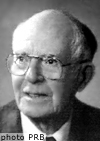
Raymond Davis Jr
Estadounidense nacido en Washington, D.C. en 1914.
Educado en escuelas públicas de Washington, se graduó en Química en la Universidad de
Maryland en 1938, y en 1942 recibió el Ph.D. en químico- física. En la actualidad
trabaja en el departamento de Física y Astronomía de la Universidad de
Pensilvania |
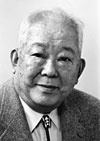
Masatoshi Koshiba
Japonés nacido en Toyohashi en 1926. Graduado en Física en la
Universidad de Tokio en 1951 y Ph.D en Física por la Universidad de Rochester en 1955 con
una tesis sobre Fenómenos de Alta energía en Rayos Cósmicos. Actualmente trabaja en el
Centro Internacional para la Física de Partículas Elementales de la Universidad de
Tokio. |
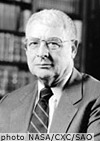
Riccardo Giacconi
Italiano nacido en Genoa en 1931. Doctorado en Física en
1954 por la Universidad de Milán y Doctor Honorario de Ciencias por la Universidad de
Chicago en 1983. Es el presidente de la Associated Universities de Washington. |
