Is the Rat Terrier the Breed for You?
|
History -
Developed in Great Britain in the 1820�s, the Rat Terrier is believed to have been a cross between the smooth-coated Fox Terrier and the black and tan Manchester Terrier. Known as "Feists" at the time because of their fiesty nature, this breed excels at killing vermin and was a welcome competitor in the sport of ratting, which was popular among nineteenth century British commoners. These competitions usually took place in areas where there was a large rat population (such as landfills), and individuals would wager on which dog could kill the most rats in a given period of time. Rat Terriers came to America in the late 1800�s and were popular companions, watchdogs, and hunting dogs. In fact, former United States president Teddy Roosevelt had these energetic little dogs as pets throughout his presidency and even coined the name "Rat Terrier". The shorter legged variety of the Rat Terrier is known today as the "Teddy Roosevelt Terrier". After coming to America, they were bred to other Fox Terriers, Beagles, and Whippets. Though not officially confirmed, it is also speculated that they were later bred to Chihuahuas to create the smaller Rat Terrier varieties. Today, these dogs are still popular house pets and are used for hunting raccoons, opossums, rabbits, ground squirrels, and rats, of course :o).
Temperment -
Compared to other terrier breeds, Rat Terriers have very mild temperaments. They make wonderful family pets as their easy-going, gentle personality make them perfect companions for children. They can be good companions for other dogs and cats, if they are raised with them. They are a fearless breed and, though they are friendly and social dogs, can be quite protective if the need arises. Rat Terries are very intelligent, but keep in mind that intelligence and trainability are two separate things. Rat Terriers are inherently stubborn and some train easier than others. Being intelligent, they need constant mental stimulation. Remember, a bored dog also has the potential for becoming a destructive dog. Their speed and intelligence makes the breed an ideal choice for competitive events such as agility, flyball, and obedience trials.
Appearance -
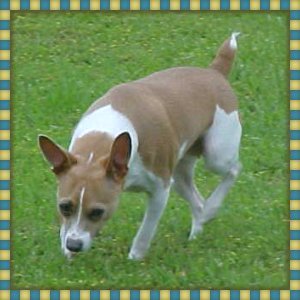
These short, sturdy, muscular dogs come in every imaginable color or combination except merle and brindle (while these colors are a disqualification in the show ring, that does not necessarily mean that there are no merle or brindle Rat Terriers). The coat should be smooth, dense, and short, but there is also a hairless variety known as the American Hairless Terrier or American Terrier. The Rat Terrier has two body types: the Type A variety (long-legged) and the Type B (short-legged, also known as the Teddy Roosevelt Terrier). While tails are normally docked at birth, some Rat Terriers can have natural bobbed tails or full-length tails. The ears can be erect, button, tipped, or a combination. There are several recognized size variations including Toy, Miniature, Standard, and Decker Giant.
Special Requirements -
Being a highly energetic and intelligent breed, Rat Terriers require a lot of exercise and mental stimulation. If this is not provided, they will find something to busy themselves with. Rat Terriers can also be quite stubborn, which could make training a challenge. They shed a little and should be groomed regularly to keep it under control. As they have been bred to hunt small animals, extreme caution should be used when introducing a Rat Terrier with a high prey drive to small pets such as rabbits and hamsters. They are also notorious "chow hounds" and obesity is also a concern for this breed.
Health -
Rat Terriers are also known to be a very hardy breed. They have very few common genetic health problems, but as the breed grows in popularity, some genetic diseases are starting to show up in the breed. While still relatively uncommon, these hereditary diseases include luxating patellas, CDA, and a few reports of deafness. Like most other small breeds, Rat Terriers also have a relatively long lifespan. With proper care, a healthy Rat Terrier can live into its mid-teens.
For more information on the Rat Terrier, please visit the following sites:
American Rat Terrier Kennel Club - Breed info, care, breeder listing and more.
National Rat Terrier Association - Breed info, care, training, breeding info, health survey and more.
www.Rat-Terrier.com - More breed info, pictures, and more.
Rat Terrier Club of America - Breed info, listing of upcoming events, and rescue info.
United Kennel Club - Rat Terrier breed standard.
Teddy Roosevelt Terrier Association - Info about Teddy Roosevelt Terriers (short-legged variety).
United Kennel Club - Teddy Roosevelt Terrier breed standard.
American Terrier Club - Info about American Hairless Terrier (also known as American Terrier or Hairless Rat Terrier).
~Home~
Graphics, web design, & content � 2003 Jennifer Chappell. All rights reserved.
The graphics and content of this site may not be duplicated, electronically or otherwise, without the author's permission.
|
|
|