

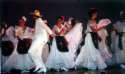
The platform dance, or "huapango fandango", originated as a flamenco dance and later acquired regional characteristics. It is performed throughout an area extending from the Huasteca region of Tamaulipas to southern Veracruz. Vigorous heel and toe stampings are executed on a special wooden platform called "huapango", which has holes bored in its sides to convert it into a sounding board.
Couples face each other on the platform in attitudes of cool indifference while their feet follow the rhythms of the music. Instruments are violins, guitars, jaranas (small, double-stringed guitars) and in some regions, harps. One or two men sing, sometimes, as in the Huasteca area, in falsetto.
In southern Veracruz there is a variation of the Huapango called Son Jarocho. The step is more vigorous and ingenious than the Son Huasteco. And real dance virtuosi perform the "Zapateado" which resembles the Andalusian dances in rapidity and complexity. Accompanying instruments are the harp, the jarana and the requinto (another variety of small guitar). Singing is in the normal voice range, and the song lyrics are generally picaresque and reflect the boisterous spirit of the Veracruzanos:
"Lucky the tree that bears
Apples, peaches and pears.
But luckier I, no doubt
With ten darlings about.
Three are widows, three are maidens
And four are damsels with husbands laden."
The nature of these "sones" ranges from the richly melodic, like the Jarabe and the Cascabel, to the strongly rhythmic like the Bamba, the Siquisiri and the Zapateado.
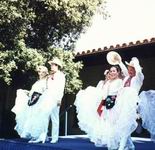
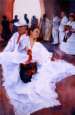
The "jarocha" costume consists of a great flounced skirt, a small black, flower-embroidered apron, a blouse and a thin, triangular shawl secured at the bosom with a brooch. The head is adorned with flowers, bows and decorative combs.

