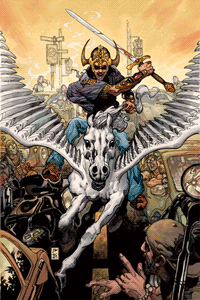
Noteworthy Items: Noteworthy Items:

The opening sequence, the fall of Camelot, parallels that of Jack Kirby's Demon #1.
The knights and king can each represent, roughly, the big 7 of the Justice League.

Lancelot |
= |

Superman |

Gawain |
= |

Batman |

Caradoc |
= |

Martian Manhunter |

Peredur |
= |

Wonder Woman |

Bors |
= |

Flash |

Galahad |
= |

Green Lantern |

King Arthur |
= |

Arthur Curry, Aquaman |
Castle Revolving is likely a contemporary version of Caer Sidi, the castle of the goddess Arianrhod, which sat at the hub of the "Silver Wheel" in Annwn, the Welsh underworld. It was also called the Castle of Glass, which links it to Ynis Witrin, the Isle of Glass (aka Avalon, and possibly Glastonbury).
Cauldron of Youth is also referred to as the Inexhaustible Cauldron and the Cauldron of Rebirth and Plenty.
“It sang once in Murias, at the Mighty Dagda’s table. It brings the dead to life and heals all wounds.” The Dagda was an Irish god, the chief of the gods, who dragged about a cauldron that could never be emptied. The cauldron was one of 4 Irish treasures.
Olwen - Olwen is the daughter of a giant in the Welsh folktale.
Gloriana Tenebrae = Sheeda Queen = Morgana La Fey?
In the mythology of King Arthur, Morgan le Fay, alternatively known as Morgaine, Morgain or Morgana and a slew of related name variants, is an important female figure and sometime antagonist of Arthur and enemy of Guinevere. In the 12th century Latin Life of Merlin (Vita Merlini) "Morgen" is said to be the first of nine sisters who rule Avalon, The Fortunate Isle or the Isle of Apples (cf. Garden of the Hesperides), where in fact she is the sole sister with a definite presence. Morgan is presented by Geoffrey of Monmouth as a healer and even a shapeshifter. Following Geoffrey of Monmouth, later writers like Chretien de Troyes enlarge on the theme that in time Morgana will heal and cure Arthur on the island of Avalon, reverting to her benevolent role.
About the "Red am I in Battle. Red the ravens that follow at my heels" thing. At the beginning of Shining Knight #1 Morrison mentions the Morrigan predicting the fall of Avalon. The Morrigan was a triple goddess of womanhood, war and destruction -- aka the Raven goddess. I think those words probably had religious significance to Justin. Morrigan is her patron goddess, maybe?
This first issue Shining Knight may be based heavily on Preiddu Annwn (or Annwfn, or Annwvyn), in which Arthur and his knight appear to storm Caer Sidi and steal the Cauldron.
What’s Justin speaking in the end of the issue? Possibly Welsh. |